Get Full Government Meeting Transcripts, Videos, & Alerts Forever!
Get email alerts on the Education Funding topic
No spam. Unsubscribe anytime.
Auditors and taxpayer groups back bill to limit school revenue growth tied to property reappraisals
Summary
Proponents at a Ways and Means hearing supported House Bill 186, which would cap allowable revenue growth in school districts already at the 20‑mill floor to cumulative inflation between valuation updates, aiming to reduce steep property tax increases tied to rapid property value growth.
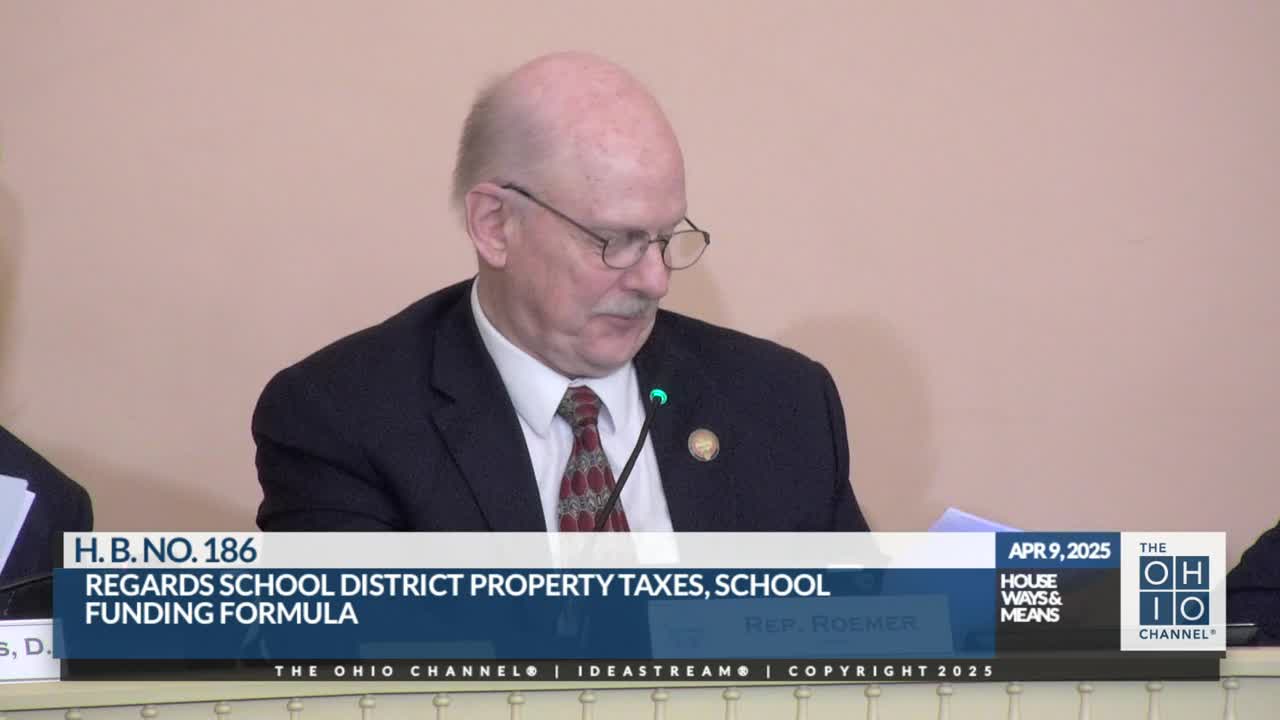
At a second hearing on House Bill 186, the House Ways and Means Committee heard proponent testimony from county auditors and taxpayer groups who said the bill would restore the original protections intended by the 20‑mill floor and tamp down unvoted tax increases driven by rapid property value growth.
Chris Klein, chief deputy auditor for Lawrence County, testified on behalf of his county and the County Auditor’s Association of Ohio, urging the committee to advance the bill. Klein said House Bill 920 (1970s) and its reduction factors were intended to prevent automatic tax increases tied to rising property values, but that the 20‑mill floor currently allows property tax bills to grow with market values, producing “unprecedented and unsustainable property tax increases” in affected districts. “House Bill 186 addresses this issue by tying the allowable revenue growth in 20‑mill floor districts to the cumulative rate of inflation between mandated valuation updates,” Klein said.
Nut graf: Proponents said the proposal would limit future unvoted revenue growth in districts at the floor by applying an inflation‑based cap — callers and written testimony argued this would protect homeowners while allowing modest inflationary growth for school revenue.
Tom Zano and Brian Pereira of the Ohio Taxpayer Protection Coalition added that more than three‑quarters of Ohio school districts are affected by the floor and that current district cash reserves are, on average, substantially higher than a decade ago — testimony cited Department of Education data showing average cash reserves rising from roughly 22 percent of annual expenses in 2012 to more than 45 percent in 2024. Zano said the bill would not claw back current revenues but would “merely tamp down the rate of future unvoted growth in revenues.”
Committee questions focused on tradeoffs between protecting homeowners and preserving school revenue, whether broader changes to House Bill 920 are appropriate, and on comparisons to other tax bases such as income or sales taxes. Witnesses said the proposal aims to maintain revenue stability for districts while restraining growth tied solely to real estate market surges.
Ending: Proponent testimony concluded; the committee recorded two written pieces of testimony and adjourned without a vote on House Bill 186.