Get Full Government Meeting Transcripts, Videos, & Alerts Forever!
Get email alerts on the Property Tax Reform topic
No spam. Unsubscribe anytime.
Vice Chair Thomas Proposes Limits on Reallocating School Millage; Committee Hears First Hearing on HB129
Summary
Vice Chair Thomas told the House Ways and Means Committee that House Bill 129 would stop certain reallocations and the use of continuous emergency levies to increase school property tax revenue beyond the state’s 20-mill floor without explicit voter approval.
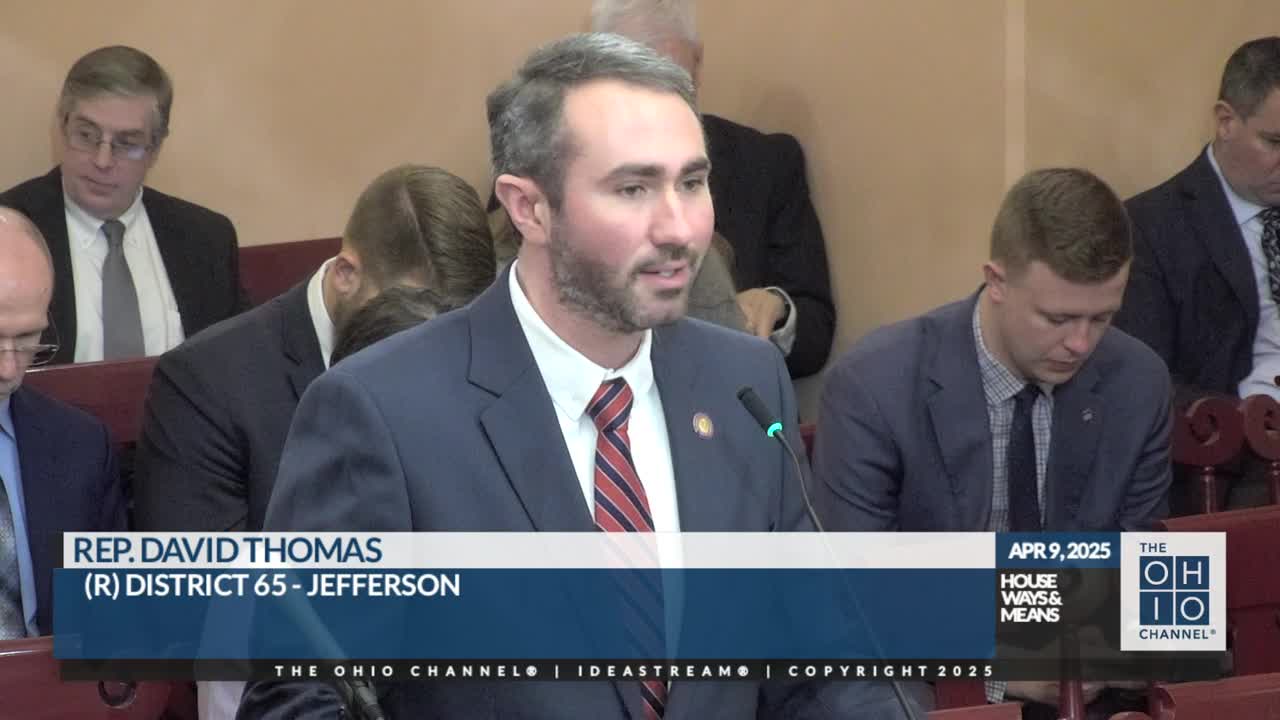
Vice Chair Thomas presented House Bill 129 in a first hearing before the House Ways and Means Committee, outlining changes intended to limit how school districts count levies toward the state’s guaranteed 20-mill property tax rate.
Thomas said the bill targets two practices the sponsor believes reduce transparency for taxpayers: (1) repeated use of emergency or substitute levies for general operating revenue that do not count toward the 20-mill floor, and (2) allocations of portions of inside millage (such as moving funds to permanent improvement accounts) that reduce the tax rate class counted toward the 20-mill guarantee. "If the voters are approving a levy that can go towards general expenses, that levy should count towards their guaranteed tax rate," Thomas told the committee. He said the bill does not intend to affect bond or permanent-improvement levies that are for capital projects.
Thomas acknowledged the policy is complicated and urged careful implementation and a reasonable effective date. He estimated roughly 200 school districts have emergency levies combined with the 20-mill floor and said impacted taxpayers could see significant changes if the counting rules change. He suggested a delayed effective date (he had earlier proposed January 1, 2027 in accompanying budget language) to allow districts time to plan.
Committee members questioned the rationale and potential consequences. Representative Hall noted voters explicitly approve emergency and substitute levies and asked why those levies should be folded into the guaranteed rate; Thomas replied that voters have not approved the full amount taxpayers are charged under the current mixture of effective rates and emergency levies, and that counting those levies would give voters clearer control over their actual school-tax bills. Representative Troy asked about the historical reasons emergency levies became excluded from the 20-mill count; Thomas said emergency levies evolved into routine revenue sources and that the original emergency intent has been overtaken by repeated renewals.
Thomas said the bill would preserve voters’ ability to approve additional revenue; it would only change which levies count toward the guaranteed rate. He also said language in the introduced bill that would count income-tax revenue toward the 20-mill calculation should be removed for constitutional and practical reasons. The committee closed the first hearing; no committee vote was taken.