Get Full Government Meeting Transcripts, Videos, & Alerts Forever!
Get email alerts on the Property Tax topic
No spam. Unsubscribe anytime.
Vice chair presents bill to restrict reallocations that can raise school property tax bills without voter approval
Summary
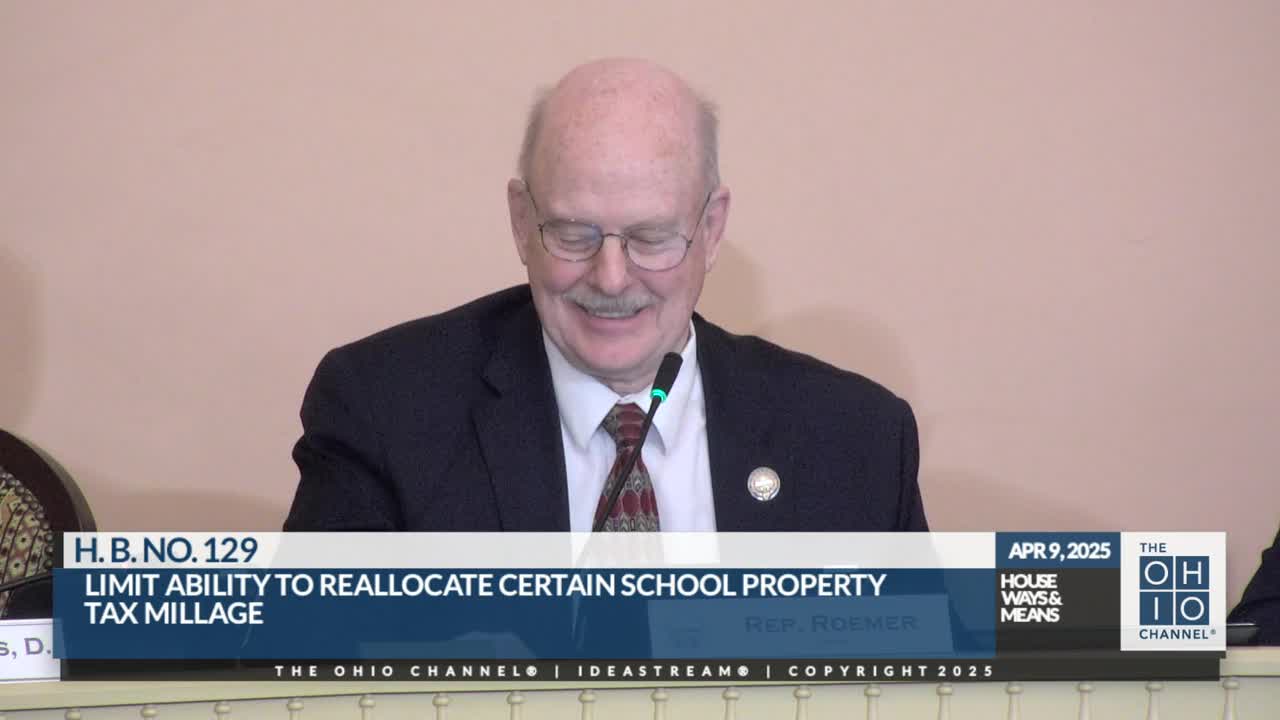
Vice Chair Thomas presented House Bill 129 to limit certain reallocations and unvoted emergency levies from counting toward the guaranteed 20‑mill school tax rate. Committee held a first hearing with extensive questions and no vote recorded.
Vice Chair Thomas presented House Bill 129 to the House Ways and Means Committee in a first hearing that examined whether parts of school tax revenue can be moved or raised without voter approval and still be treated as outside the 20‑mill guaranteed tax rate.
Thomas said the measure is part of a broader property‑tax reform effort and would change which levies and reallocations count toward a district’s guaranteed 20‑mill rate. Under current practice, Thomas said, some districts have used emergency levies and reallocated inside millage to increase revenue beyond what voters directly approved while remaining under the 20‑mill floor; he said the bill would require general‑expense levies approved by voters to count toward the guaranteed rate and would bar certain reallocations of inside millage that effectively raise taxes without a vote.
Committee members probed technical and timing concerns. Representative Hall asked why emergency and substitute levies — which voters authorize — should be counted toward the floor; Thomas replied that the goal is to ensure voters know the full tax burden they are approving because some taxpayers are effectively paying both the guaranteed rate and additional unvoted increases. Thomas also said portions of inside millage allocated to permanent improvement (PI) funds can be used to increase revenue subject to less voter visibility and that HB129 would stop that practice from changing what counts toward the guaranteed rate.
Members raised implementation timing and potential unintended consequences. Several representatives urged caution about sudden budget effects on school districts. Thomas acknowledged the bill’s fiscal impact could be significant in the roughly 200 districts that have emergency levies under the 20‑mill floor and said he plans to work on effective dates and technical fixes; he noted similar legislation was moving in the Senate. Representative Troy and other members asked historical questions about why emergency levies were exempted originally; Thomas said emergency levies were intended to be limited but have become recurring revenue in practice.
No formal committee action or vote took place during the hearing. Thomas said the bill’s sponsors may revise timing and language to address implementation concerns and constitutional questions that were raised regarding whether income tax levies should count toward the 20‑mill calculation.