Get Full Government Meeting Transcripts, Videos, & Alerts Forever!
Get email alerts on the Property Tax 20 Mill Floor Reform topic
No spam. Unsubscribe anytime.
Vice Chair Urges Bill to Count Certain Levies Toward School 20‑Mill Floor; Committee Hears First Hearing
Summary
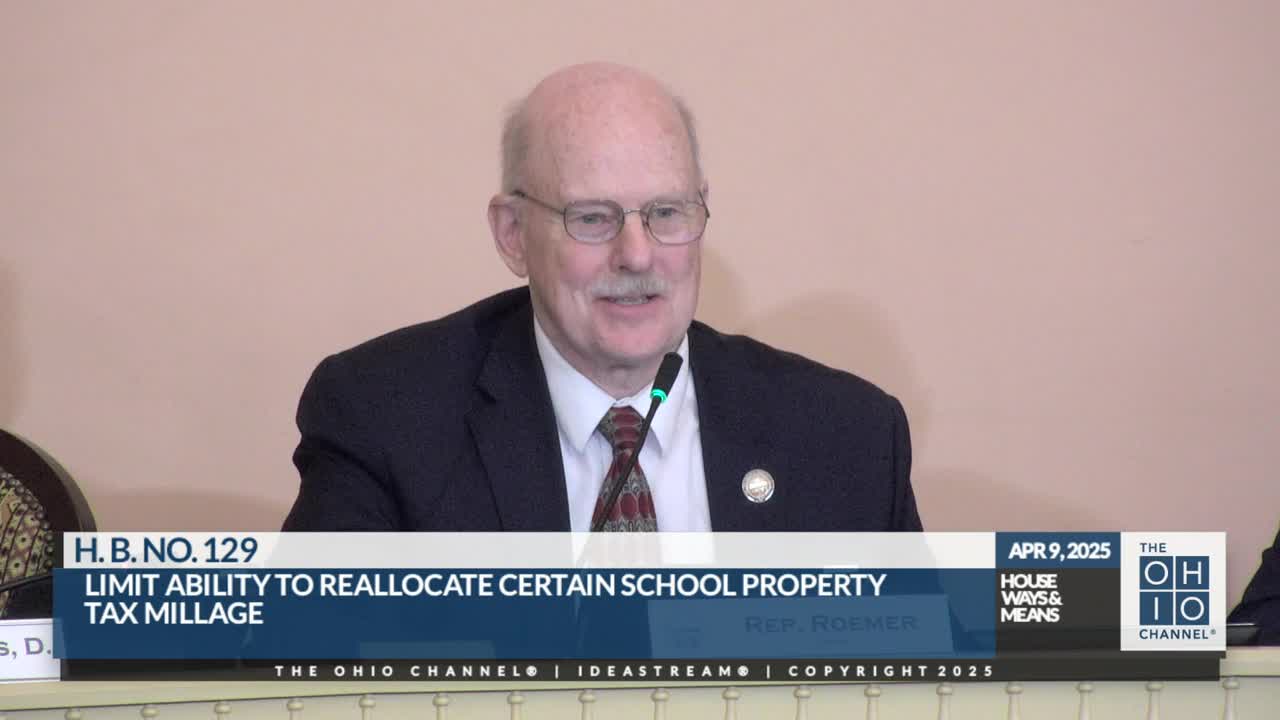
Vice Chair Thomas introduced House Bill 129, which would require certain levies that fund general school operations to count toward the 20‑mill guaranteed tax rate to improve transparency and limit repeated, unvoted increases.
Vice Chair Thomas introduced House Bill 129 in a first hearing before the House Ways and Means Committee, saying the measure would change which school levies count toward the 20‑mill guaranteed tax rate and curb what he described as recurring, unvoted revenue increases.
Thomas said the bill addresses two practices. First, it would require levies that voters approve for general operating expenses (including some emergency or substitute levies) to count toward the guaranteed tax rate so taxpayers can see the full revenue picture. "House bill 1 29 essentially says, if the voters are approving a levy that can go towards general expenses, that levy should count towards their guaranteed tax rate," he said.
Second, the bill would limit schools’ ability to shift inside millage into categories (for example, permanent improvement) in ways that remove that millage from the 20‑mill calculation. Thomas and backers said that practice can increase taxpayer burdens without direct voter approval; they noted that permanent improvement and bond levies would remain treated differently under the bill.
Thomas acknowledged the measure presents difficult tradeoffs and suggested implementation timing will matter. He recommended phasing changes in so school budgets and levy plans can adjust; he said some time‑delay language (for example, making the bill effective in 2027) might be appropriate to avoid sudden budget shocks.
Committee members pressed on specifics and potential unintended consequences. Representative Hall asked why emergency or substitute levies — which voters approve — would be counted toward the floor; Thomas responded the bill’s intent is to ensure the effective tax rate voters see matches the total revenue that schools receive. Ranking Member Troy and others asked about the history and rationale for current law; Thomas and witnesses said emergency levies evolved from true short‑term emergencies and that broader practice now often uses renewals as ongoing revenue.
Thomas said the bill would not eliminate voters’ ability to approve additional taxes. He estimated roughly 200 school districts are affected by emergency levies at or near the 20‑mill floor and said fiscal impact could be significant for affected taxpayers in those districts. The committee held the first hearing and invited further review and possible amendments.