Get Full Government Meeting Transcripts, Videos, & Alerts Forever!
Get email alerts on the School Property Tax Reform topic
No spam. Unsubscribe anytime.
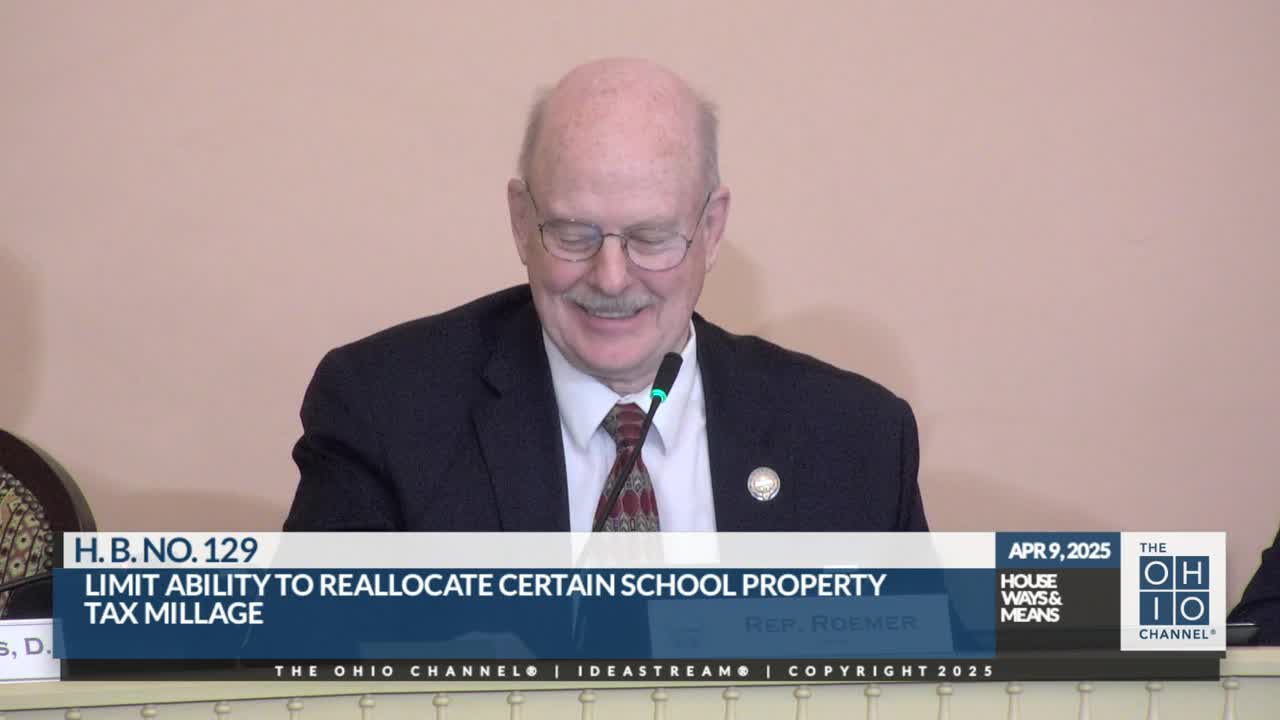
Vice Chair Details Bill to Limit Reallocation of School Property Tax Millage; Committee Hears First Hearing
Summary
Vice Chair Thomas presented House Bill 129 to restrict reallocation of school inside millage and to include certain levies in the 20‑mil guaranteed tax-rate calculation; committee members asked implementation and timing questions during the first hearing; no vote was taken.
Vice Chair Thomas presented House Bill 129 in the committee’s first hearing, outlining changes intended to limit how school districts reallocate inside millage and to require that certain levies count toward the 20‑mill guaranteed tax rate used in state school funding calculations.
Thomas said the measure targets two practices that have increased taxpayers’ bills without direct voter approval: routine use of emergency levies as ongoing operating revenue and moving portions of inside (general) millage into permanent improvement or other classifications so they are excluded from the 20‑mil calculation. He said those practices can leave taxpayers paying a higher effective tax rate than the voters explicitly approved.
Thomas described the bill’s intent: to count levies that are functionally general‑purpose operating levies (including emergency and substitute levies) toward the guaranteed tax rate and to exclude permanent improvements and bond levies from that calculation. He also said the bill’s current text includes a provision about school district income taxes that raises constitutional concerns and that the effective date will need consideration, advising that an implementation delay would allow districts to plan budgets.
Committee members asked about the rationale for prior exemptions of emergency levies from the 20‑mil calculation, the treatment of levies that expire and are renewed, and whether districts could still move funds to permanent improvement accounts. Thomas said emergency levies were originally intended for time‑limited catastrophic needs but have been repeatedly renewed in practice; he said districts would still be able to allocate inside millage or move funds to permanent improvement accounts, but those reallocations would not change what counts toward the guaranteed tax rate.
Several members urged caution on the effective date and suggested phasing in the change; Thomas said he had sought a January 1, 2027 implementation in an earlier budget amendment to give districts time to plan. He also said that roughly 200 school districts are affected by emergency levies under the 20‑mil floor and that the fiscal impact on those districts’ taxpayers could be significant.
The committee recorded the first hearing, received questions and examples, and took no formal vote.