Get Full Government Meeting Transcripts, Videos, & Alerts Forever!
Get email alerts on the Blockchain Basics Act topic
No spam. Unsubscribe anytime.
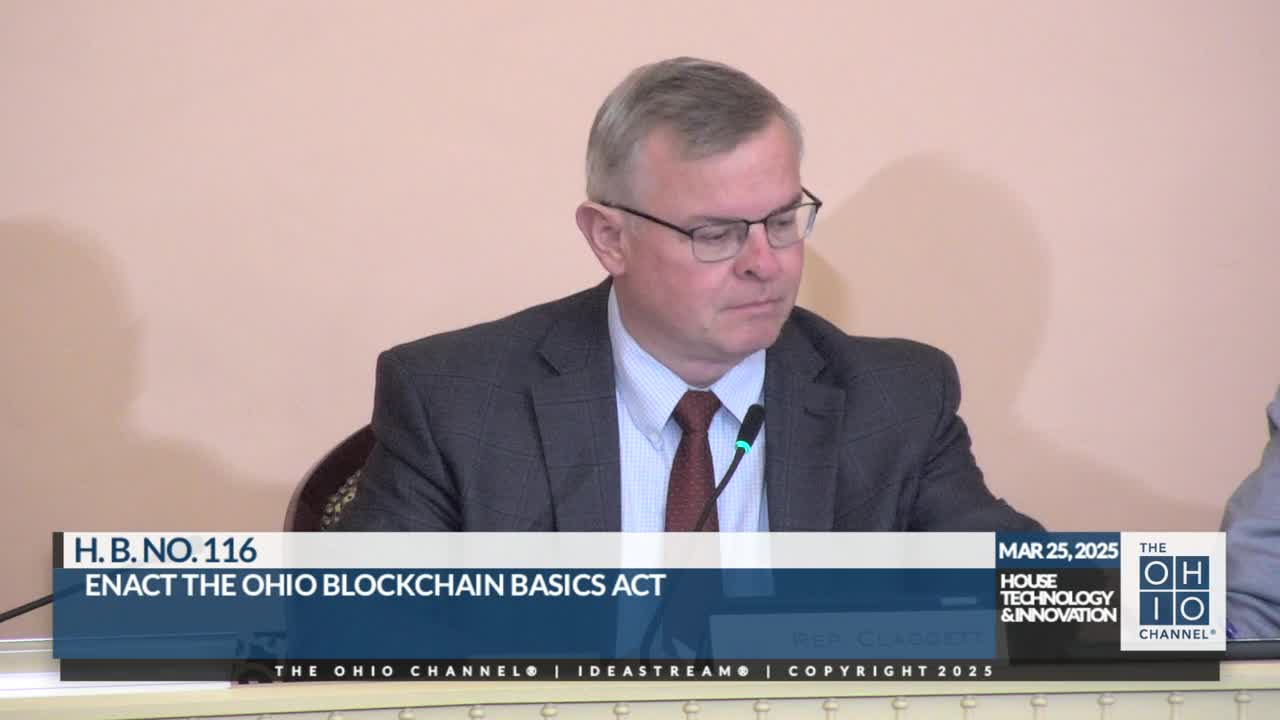
Ohio committee hears testimony on Blockchain Basics Act, HB 116, with proponents urging legal clarity for crypto and mining
Summary
Representative Stephen Demetrio, sponsor of House Bill 116, told the House Technology and Innovation Committee during a second hearing that the measure — called the Blockchain Basics Act — would "lay[] the groundwork for the blockchain technology and cryptocurrency regulation" by adding definitions and a framework to the Ohio Revised Code.
Representative Stephen Demetrio, sponsor of House Bill 116, told the House Technology and Innovation Committee during a second hearing that the measure — called the Blockchain Basics Act — would "lay[] the groundwork for the blockchain technology and cryptocurrency regulation" by adding definitions and a framework to the Ohio Revised Code.
The bill's proponents, including Donovan O'Neil of Americans for Prosperity Ohio, Eric Peterson of Satoshi Action Fund and Andrew Burchwell of the Ohio Blockchain Council, told committee members the measure aims to provide legal certainty on issues ranging from taxation and money‑transmission treatment to zoning for digital‑asset mining and protections for self‑custody of private keys.
"This legislation we view as critical to fostering innovation, economic growth, and technological advancement here in the Buckeye State," Donovan O'Neil, state director of Americans for Prosperity Ohio, told the committee, highlighting the bill's prohibition on targeted taxes and fees and its definition provisions.
Eric Peterson, policy director at Satoshi Action Fund, said HB 116 contains two tax provisions the committee should note: a capital‑gains approach that exempts transactions under a $200 threshold (tied in testimony to the federal foreign‑currency threshold) and a requirement that digital‑asset transactions be treated the same as other payment methods for local taxation purposes. "$200 is the federal limit, for, foreign currency," Peterson said, and the bill adopts that practical reporting threshold for small purchases made with digital assets.
Proponents emphasized zoning and mining provisions. Peterson described Bitcoin miners as "best understood as Bitcoin data centers" and said the bill would allow mining in industrially zoned areas and permit hobby‑scale mining where local law is met. Andrew Burchwell, executive director of the Ohio Blockchain Council, said the industry can pair with energy projects and potentially improve grid flexibility: "Bitcoin mining does a tremendous job of returning that electricity to the grid to ensure that people's lights can stay on and their homes can be heated." He also said Ohio already hosts companies that have relocated or expanded into the state.
Committee members asked about local control, tax revenue, consumer protection and the bill's treatment of pension investments. O'Neil and Peterson said the bill would stop localities from imposing discriminatory taxes on digital‑asset transactions but would not foreclose all taxation by local governments; Peterson added the bill aims to avoid a reporting burden for numerous small transactions. Representative White asked about consumer protections and custodial risks; Peterson and Burchwell discussed self‑custody protections in the bill and the distinction between custody by individuals and custody by centralized exchanges, citing past exchange failures as context for that protection.
Sponsor Representative Demetrio acknowledged concerns about language in the bill related to pensions and said he expected to work with stakeholders on that point. "We're probably gonna take that language out or or drastically change it to, sort of get those folks comfortable with the bill," Demetrio told the committee.
No formal vote was taken during the hearing. Committee members indicated they would continue consideration of HB 116 in future meetings and that bill language could be revised based on stakeholder feedback.
Ending note: The committee concluded the second hearing on House Bill 116 after public testimony and Q&A with sponsors and industry witnesses.