Get Full Government Meeting Transcripts, Videos, & Alerts Forever!
Get email alerts on the Property Tax Reform topic
No spam. Unsubscribe anytime.
Vice chair outlines bill to count emergency and reallocated school millage toward 20‑mill floor
Summary
Vice Chair Thomas told the House Ways and Means Committee that House Bill 129 would change which school levies count toward the statutory 20‑mill guaranteed tax rate to improve transparency for taxpayers.
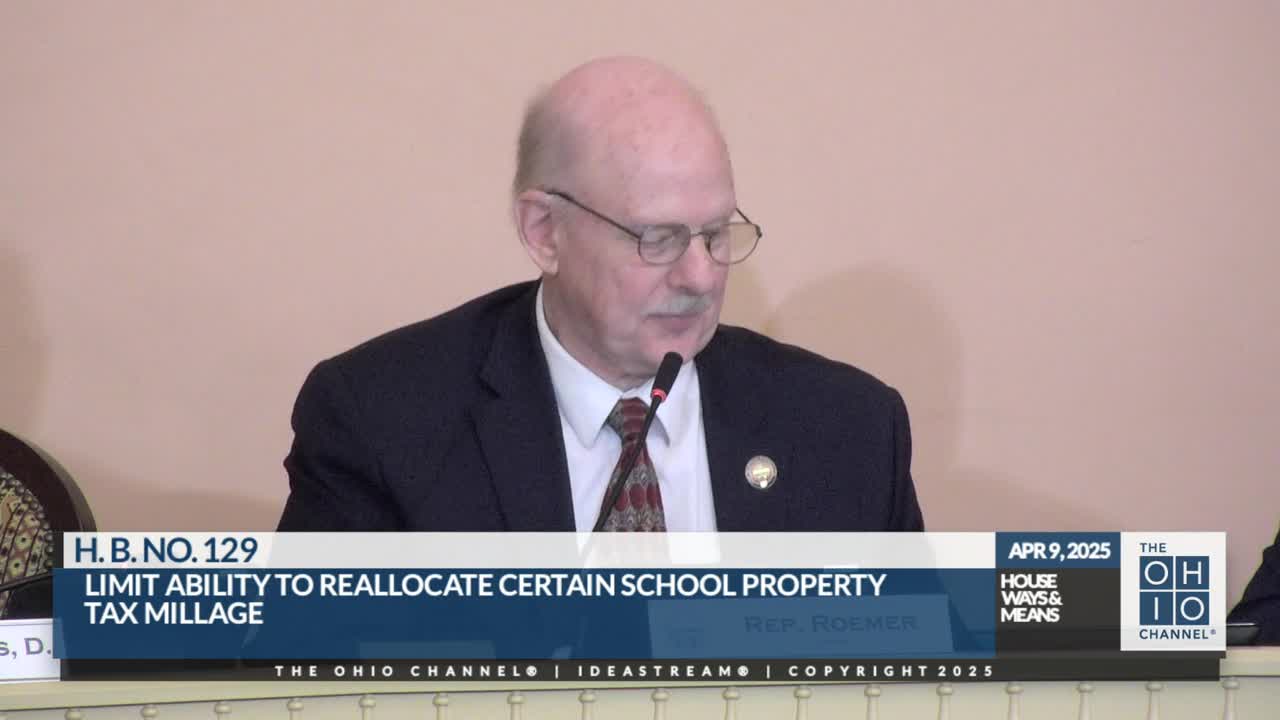
Vice Chair Thomas presented proponent testimony on House Bill 129, which would change how certain school tax levies and allocations count toward the state’s guaranteed 20‑mill school tax rate. Thomas said the bill is part of a broader property-tax reform effort and is intended to give taxpayers clearer control over school tax increases.
Thomas told the committee that under current law certain levies — notably emergency and substitute levies — do not count toward the 20‑mill floor and that some school districts have used that distinction to obtain additional recurring revenue without voters fully seeing the combined tax impact: “If you have a guaranteed tax rate, that should be a guaranteed tax rate,” Thomas said. He described two core changes in the bill: first, levies approved for general operating expenses that functionally increase recurring revenue would count toward the guaranteed tax rate; second, portions of inside millage that are reallocated (for example, to permanent improvement funds) would not be allowed to be shifted in a way that evades the 20‑mill calculation.
Thomas acknowledged the bill would affect a limited set of districts and urged caution about implementation timing. He noted the bill as introduced would be effective 90 days after passage and said some districts might need a longer phase‑in; he proposed a possible effective date of Jan. 1, 2027 to give schools time to plan. He also said the bill as introduced had language about income tax counting toward the floor that raised constitutional questions and recommended removing that language.
Committee members raised technical and fairness questions. Representative Hall questioned why voters who approve emergency levies should be insulated from the 20‑mill calculation; Thomas answered that the bill aims to ensure that everything voters approve for general operating revenue is counted toward their actual guaranteed tax burden so the total tax rate shown to taxpayers is transparent. Representative Troy asked about the historical rationale for exempting emergency levies; Thomas said emergency levies originally addressed true fiscal emergencies but are now often renewed and relied on as ongoing revenue.
Thomas estimated the number of affected districts at roughly 200 and said typical unvoted increases above the guaranteed rate in those districts ranged about 5–10 mills in examples from his testimony. He closed by emphasizing that the bill does not prevent voters from approving additional revenue; it makes the total local tax picture more transparent.