Get Full Government Meeting Transcripts, Videos, & Alerts Forever!
Get email alerts on the Blockchain topic
No spam. Unsubscribe anytime.
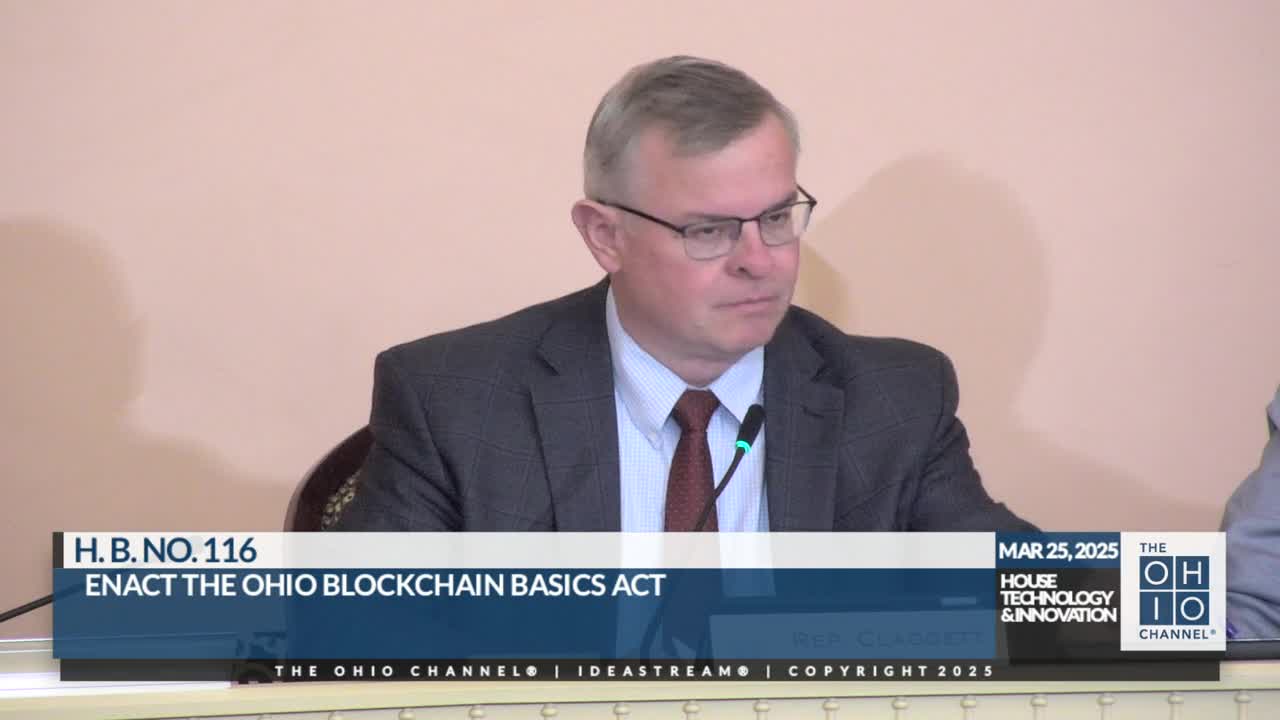
Ohio committee holds second hearing on Blockchain Basics Act (HB 116) focused on taxes, mining and custody rules
Summary
Representative Steven Demetrio, sponsor of House Bill 116, told the House Technology and Innovation Committee during a second hearing that the measure is intended to "lay the groundwork for the blockchain technology and cryptocurrency regulation" by adding definitions and a framework to the Ohio Revised Code.
Representative Steven Demetrio, sponsor of House Bill 116, told the House Technology and Innovation Committee during a second hearing that the measure is intended to "lay the groundwork for the blockchain technology and cryptocurrency regulation" by adding definitions and a framework to the Ohio Revised Code.
The bill attracted three primary proponents: Donovan O'Neil, state director of Americans for Prosperity Ohio; Eric Peterson, policy director of Satoshi Action Fund; and Andrew Burchwell, executive director of the Ohio Blockchain Council. Witnesses said HB 116 would bar targeted taxes on digital assets used for payments, protect self custody of digital assets, clarify money‑transmission rules, and permit mining operations in properly zoned industrial areas while preserving nuisance and permitting limits at the local level.
Why it matters: supporters argued the bill would provide legal certainty for businesses and individuals, align Ohio with recent state measures elsewhere, and help attract investment and jobs. Opponents and several committee members pressed witnesses on local control, pension‑fund language in the bill, reporting burdens tied to capital gains and the practical impacts of mining on energy and neighborhoods.
Supporters' claims and examples
Donovan O'Neil of Americans for Prosperity Ohio said HB 116 "bans special taxes or fees on digital assets used for payments ensuring they are treated like traditional currency" and highlighted the measure's definition provisions, exemptions from money‑transmission licensing for some actors, zoning protections for mining in industrial areas and securities exemptions for self custody. O'Neil said the uniform approach would prevent localities from creating discriminatory rules that would deter investment.
Eric Peterson of Satoshi Action Fund described provisions on tax treatment and a small‑transaction exemption, saying HB 116 would exempt transactions under $200 from capital‑gains reporting when a digital asset is used as payment and that the bill ties that threshold to the existing federal small‑transaction rule for foreign currency. Peterson said the exemption is intended to avoid a "reporting nightmare" for many small purchases and to treat transaction taxes equally across payment types.
Andrew Burchwell of the Ohio Blockchain Council framed mining as a form of industrial data center and an energy partner for grids and rural economies. He said mining can use underutilized power, revive some deindustrialized plants, and act as a flexible large industrial load that can help grid resiliency. He cited private companies and local examples and urged Ohio to clarify rules on zoning, money‑transmission licensing and tax treatment to remain competitive.
Questions and clarifications from committee members
Several committee members raised practical questions. Representative White asked whether local governments could still levy taxes; witnesses said the bill does not ban taxation outright but prevents discriminatory taxes that single out digital assets. Witnesses repeatedly distinguished prohibiting discriminatory local surcharges from eliminating local taxing authority.
Representative Mohammed and others pressed witnesses on the $200 exemption and how inflation or future thresholds would be handled; proponents said the bill ties the small‑transaction exemption to an inflation‑adjusted standard. On the question whether businesses would be compelled to accept cryptocurrency as legal tender, proponents said that accepting payment remains a private choice unless and until a form of payment is established as legal tender by higher authorities; HB 116 aims to create framework and certainty rather than mandate private acceptance.
On mining and zoning, witnesses said HB 116 would protect mining operations in industrial zones that follow local permitting and nuisance rules and would not shield facilities that violate zoning or public‑safety requirements. Witnesses described hobby‑scale miners operating in garages as permissible where they are not a nuisance.
Pension language and next steps
Representative Demetrio said he and committee staff met with Ohio Public Employees Retirement System (OPERS) representatives and that pension‑investment language in the bill would likely be removed or revised to address OPERS' concerns; he told members "we're probably gonna take that language out or or drastically change it to, sort of get those folks comfortable with the bill." No committee action or vote on the bill occurred during the hearing.
What the committee did: the hearing provided testimony and questions; Representative Demetrio and members indicated follow‑up work will continue, including possible removal or revision of the pension language. The committee concluded the second hearing and adjourned without voting on the measure.
Ending: The committee will continue consideration of HB 116 in subsequent meetings; sponsors and witnesses said they remain available to provide additional materials and responses to members' technical questions.