Get Full Government Meeting Transcripts, Videos, & Alerts Forever!
Get email alerts on the Health Care Employer Tax Credits topic
No spam. Unsubscribe anytime.
Committee Hears Proponents for Small‑Employer Tax Credit to Support Individual Coverage HRAs
Summary
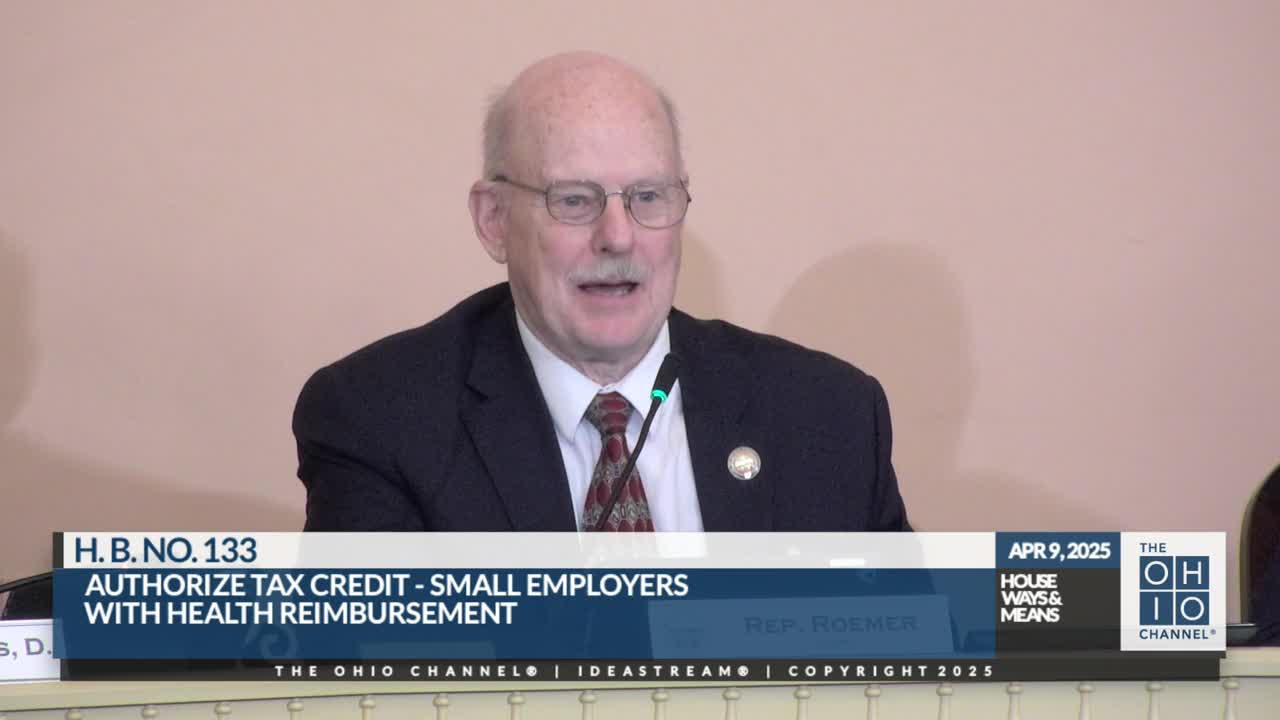
The House Ways and Means Committee took testimony on House Bill 133, a proposal to create a nonrefundable tax credit for small employers that offer individual coverage health reimbursement arrangements, or ICRAs.
The House Ways and Means Committee took testimony on House Bill 133, a proposal to create a nonrefundable tax credit for small employers that offer individual coverage health reimbursement arrangements, or ICRAs.
Witnesses from insurers, small‑business advocates and technology platforms told the committee the measure would increase awareness and adoption of ICRAs and could expand coverage for employees of small firms.
Kathy Grayson of Oscar Health said Oscar serves nearly 90,000 Ohio members and described ICRAs as a tool that allows an employer to make a defined contribution that an employee uses to buy individual-market coverage: “By putting in place a tax credit, for employers that offer this product, this body would be creating the opportunity for this product to be discussed more widely in conversations with HR professionals, with accountants, with brokers.” Grayson said the bill’s model (informed by Indiana’s 2023 approach) targets employers with 2 to 50 employees and that the committee’s bill uses a $400 annual per‑covered‑employee incentive in the initial text.
Cameron Garsick of the National Federation of Independent Business (NFIB) said the credit would be available to employers that contribute at least $400 per year to a covered employee’s account and that ICRAs are ACA‑compliant options that can help small businesses offer benefits they otherwise find unaffordable. He gave statistics summarized in his submitted materials—e.g., the small‑group market has seen insurer and enrollment declines— and urged the committee to advance the legislation to give small employers more options.
Marshall Darr, CEO and cofounder of Stretch Dollar, and Frank Spinelli, executive director of EZICRA, described practical examples and company experiences setting up ICRAs. Darr offered a client case study demonstrating how matching an employee’s health needs with a plan from the individual market made an employment option viable: “For the first time in 9 years, Jane had the option to decide where she wanted to work.” Spinelli said his platform now serves about 9,000 employees enrolled through their ICRA platform, roughly half in Ohio.
Members asked technical questions about the bill’s employer‑size definition, the credit amount and whether the credit would reduce uninsured rates or interact with Medicaid. Witnesses uniformly said the bill targets employers with 2–50 employees, that roughly 84% of employers offering ICRAs nationally were offering coverage for the first time, and that the credit aims to encourage broader adoption.
Committee members received multiple proponent statements and written submissions; the chair recorded this as the bill’s second hearing and no committee vote was taken.