Get Full Government Meeting Transcripts, Videos, & Alerts Forever!
Get email alerts on the Small Business Health topic
No spam. Unsubscribe anytime.
Committee hears broad proponent testimony for ICRA tax-credit bill aimed at small employers
Summary
Proponents including Oscar Health, NFIB, and platform providers urged passage of House Bill 133, which would create a nonrefundable tax credit up to $400 per covered employee to encourage small employers to offer individual coverage health reimbursement arrangements (ICRAs).
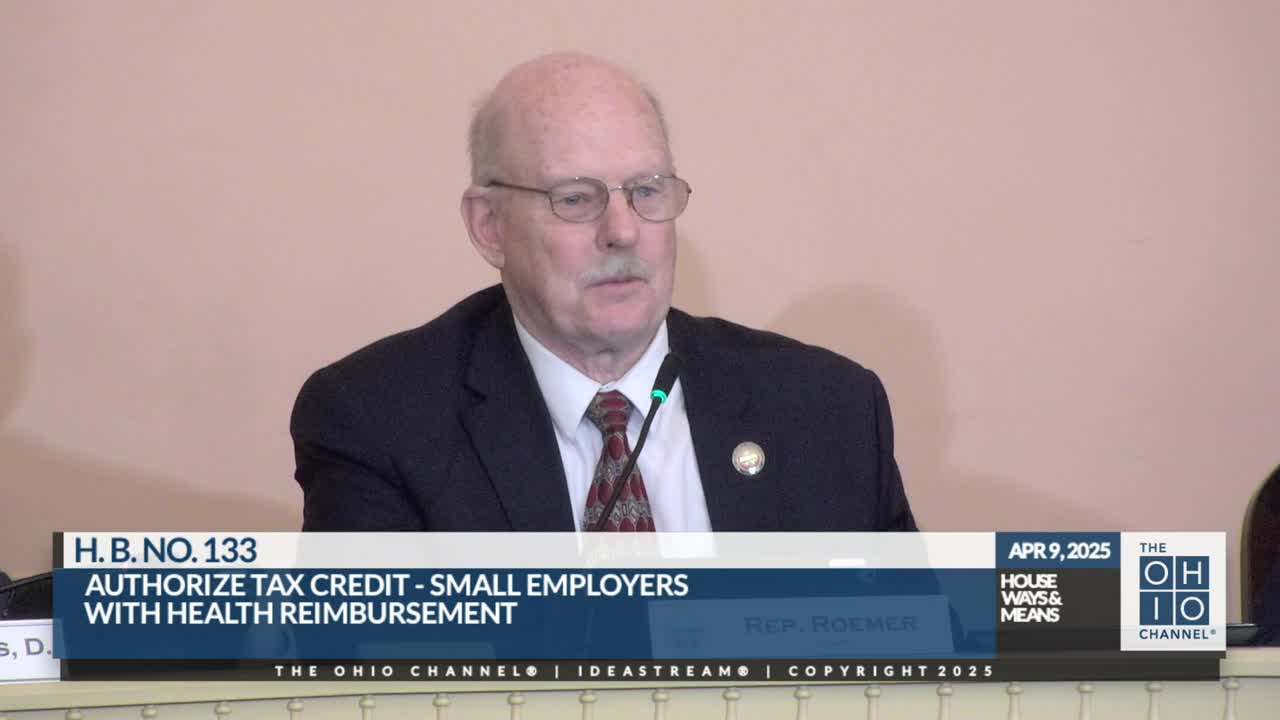
The House Ways and Means Committee heard multiple proponent witnesses in favor of House Bill 133, which would create a state tax credit to encourage small employers to offer individual coverage health reimbursement arrangements, commonly called ICRAs.
Kathy Grayson, who represented Oscar Health, told the panel that ICRAs let small employers offer a defined employer contribution so employees can shop for individual-market plans that better match their needs. “By providing a defined contribution to their employees, the employees can go shop,” Grayson said. She said Ohio would join several other states in encouraging ICRA adoption and cited national data showing lower small‑group market participation and high premium growth as reasons to expand options.
Cameron Garsick of the National Federation of Independent Business in Ohio said House Bill 133 would create a nonrefundable tax credit for businesses with two to 50 employees that contribute at least $400 per year to a covered employee’s account. “Most small businesses want to provide health insurance to their employees as it is an attractive benefit that can provide a competitive advantage,” Garsick said, but many do not because of cost.
Representatives of private-sector platforms and brokers described employer and employee use cases. Marshall Darr, CEO and cofounder of Stretch Dollar, described a client who found a plan that covered an employee’s prescription needs and thereby allowed the employee to change jobs. Frank Spinelli of EZICRA said his platform had about 9,000 employees enrolled nationwide, roughly half in Ohio, and that some employers who faced double-digit rate increases on group plans found ICRAs a sustainable alternative.
Committee members asked about the bill’s eligibility thresholds and the $400-per-employee credit level. Witnesses noted state pilots in Indiana and that the federal regulatory framework enabling ICRAs began in 2020; Oscar Health said it serves almost 2 million members nationally and nearly 90,000 in Ohio. Grayson confirmed the bill’s employer-size window as written covers businesses with 2 to 50 employees. NFIB and platform witnesses said the credit would encourage earlier adoption and improve awareness among small employers and brokers.
The committee recorded written testimony from multiple organizations and concluded the second hearing on House Bill 133 with no recorded vote or committee action in the transcript.