Get Full Government Meeting Transcripts, Videos, & Alerts Forever!
Get email alerts on the Medicare Supplement topic
No spam. Unsubscribe anytime.
Committee hears bill to let under‑65 ALS and ESRD Medicare beneficiaries buy Medigap; advocates cite patient stories and small premium impact
Summary
The Ohio House Insurance Committee heard testimony on House Bill 24, which would let Medicare‑eligible Ohioans under 65 with ALS or end‑stage renal disease buy Medigap supplemental coverage and would create a one‑time enrollment window and a carrier‑switching birthday rule.
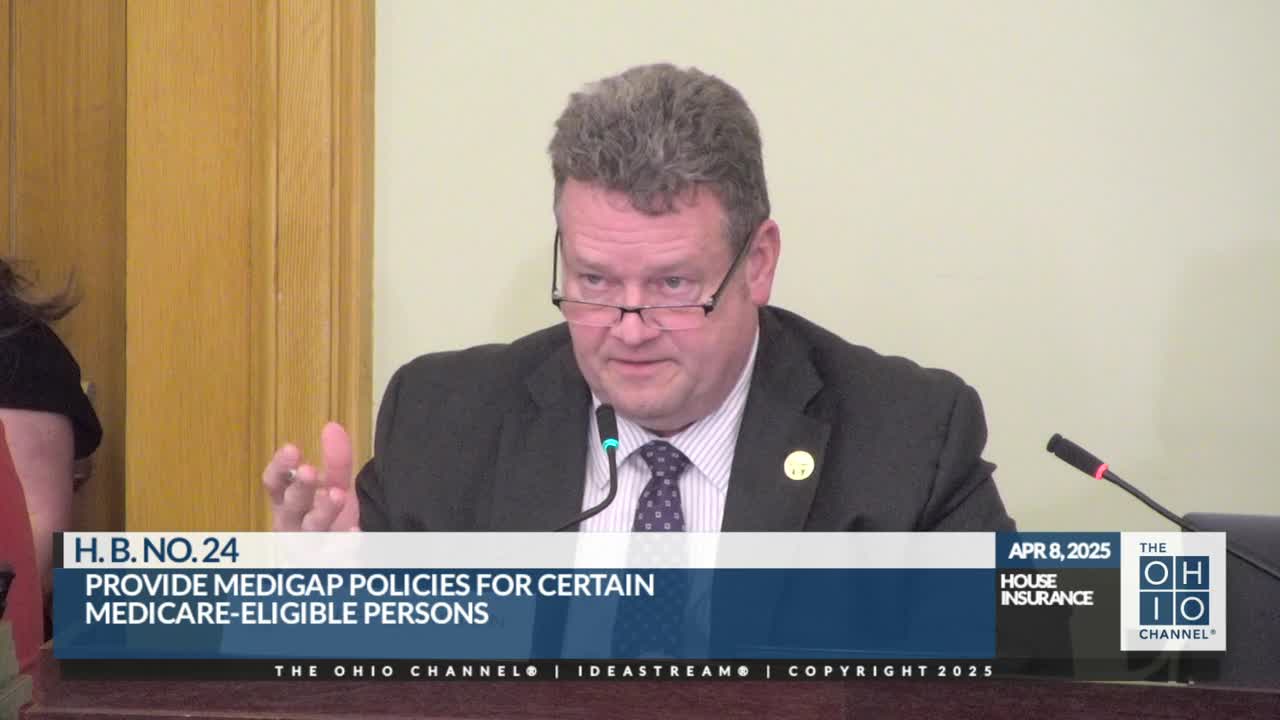
The Ohio House Insurance Committee on Wednesday heard proponent testimony on House Bill 24, a measure to allow certain Medicare‑eligible Ohioans under age 65 to purchase Medicare supplement (Medigap) coverage. Supporters said the bill would help small, high‑cost patient populations — notably people living with amyotrophic lateral sclerosis (ALS) and those with end‑stage renal disease (ESRD) — by covering Medicare’s typical 20% cost‑sharing and improving access to transplant and other services.
Alex Meixner of the ALS Association and Elizabeth Lively of Dialysis Patient Citizens testified in support. Meixner described the case of Angelina Fanus, a Strongsville resident diagnosed with ALS in her late 20s, who said she experienced delays and denials under a Medicare Advantage plan for medications, feeding‑tube formula and out‑of‑network clinical trials. Meixner said the bill would allow Medicare‑eligible people under 65 with ALS to use their own money to buy Medigap coverage the way Medicare recipients age 65 and older can today.
Lively said the bill would help about 1,700 non‑dual Ohioans under age 65 who are Medicare eligible because of ESRD and who lack automatic Medicaid coverage. Dialysis Patient Citizens said Medigap coverage can be critical for transplant access because transplant centers require evidence of secondary coverage for patients to be placed on active wait lists. Lively described an actuarial report from Health Management Associates (HMA) estimating a de minimis premium increase across the broader Medigap market of about 0.2% — roughly $0.40 per month — and projected Medicaid savings of roughly $3.2 million over five years because fewer patients would spend down assets and enroll in Medicaid.
The bill would also create a one‑time, six‑month look‑back enrollment window for people already on Medicare who missed their initial Medigap enrollment opportunity, and a birthday‑rule provision allowing people on an existing lettered Medigap plan (for example, plan G) to switch between carriers offering the same lettered plan without a new underwriting penalty. Meixner and Lively said those provisions would help people who already face immediate access barriers and give beneficiaries the ability to shop carriers for service and price.
Committee members asked whether switching between carriers would require new medical underwriting; Meixner said the bill’s intent is to preserve the initial enrollment protections so that switching between carriers for the same lettered product would not trigger new medical underwriting. Witnesses and advocates emphasized the small projected effect on aggregate premiums compared with the potential benefits for a small and vulnerable population.
Supporters also argued the bill could create downstream state savings by preventing some patients from depleting assets and moving onto Medicaid. Several written supporters and patient stories were entered into the record; no formal vote on the bill was taken at the hearing and the committee adjourned after testimony concluded.