Get Full Government Meeting Transcripts, Videos, & Alerts Forever!
Get email alerts on the Medicare Supplemental Coverage topic
No spam. Unsubscribe anytime.
Committee hears bill to let under‑65 Medicare beneficiaries buy Medigap; ALS and dialysis groups back change
Summary
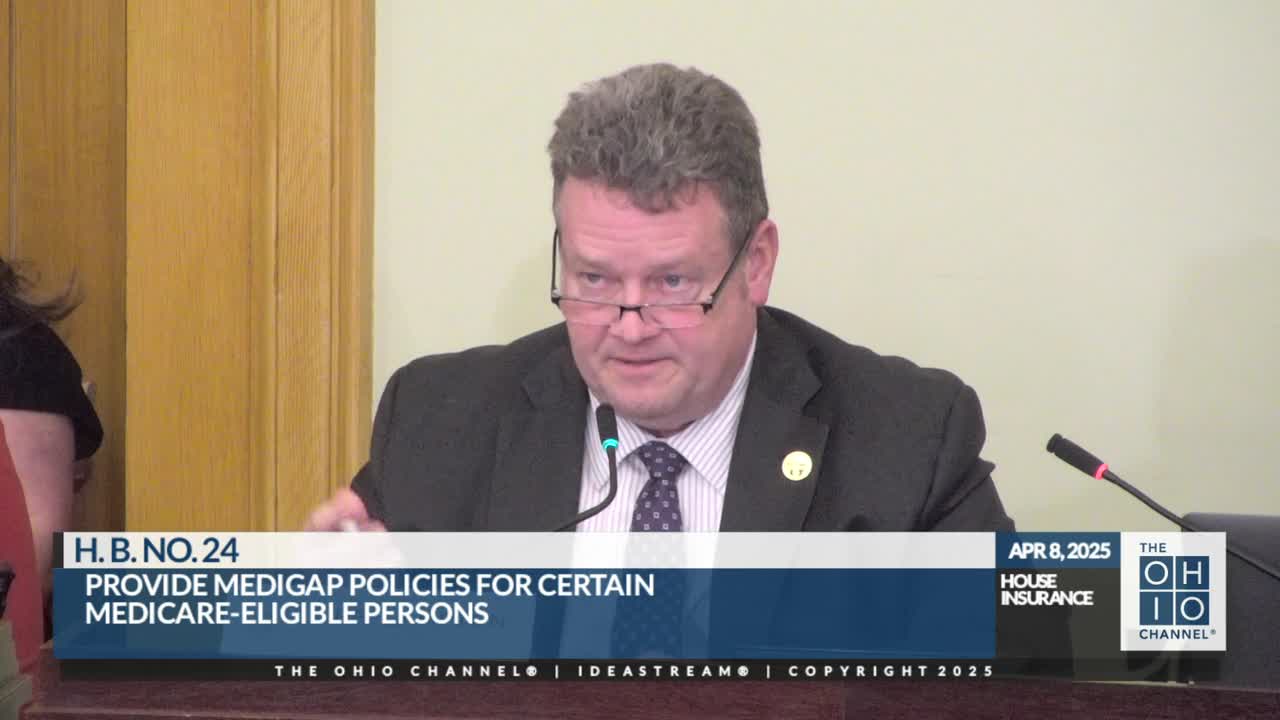
Proponents said House Bill 24 would let people diagnosed with ALS or end‑stage renal disease who are Medicare‑eligible before age 65 buy Medicare supplement (Medigap) coverage; witnesses cited a small affected population and a minimal premium impact in an actuarial study.
The Ohio House Insurance Committee received proponent testimony on House Bill 24, a measure that would allow Medicare‑eligible Ohioans under age 65 who qualify due to conditions such as amyotrophic lateral sclerosis (ALS) or end‑stage renal disease (ESRD) to purchase Medicare supplemental (Medigap) insurance and to move between carriers offering the same lettered Medigap plan. Supporters said the change would remove a documented coverage gap for a small, high‑need population and could reduce future Medicaid spending.
Why it matters: Current federal rules let people with ALS or ESRD enroll in Medicare immediately after diagnosis, but many under‑65 beneficiaries cannot buy Medigap policies or face limited options. Proponents said allowing Medigap purchases and limited portability between carriers would reduce out‑of‑pocket costs, improve access to transplant lists and specialty care, and potentially prevent some people from spending down assets and entering Medicaid.
Alex Meixner (listed in testimony as representing the ALS Association) described patient cases and the challenges of Medicare Advantage plans for people with ALS. Meixner read written testimony from a Strongsville patient, Angelina Fanus, who said she enrolled in Medicare at a younger age but could not buy Medigap; she described delays and denials under Medicare Advantage that interrupted medication and feeding formula coverage. “My only option was … Medicare Advantage,” the written statement says, and Meixner argued Medigap access would provide faster, more reliable coverage for certain services.
Elizabeth Lively, Eastern Region Advocacy Director for Dialysis Patient Citizens, testified in support on behalf of dialysis patients. She described ESRD patients’ need for Medigap to cover Medicare’s typical 20% coinsurance (which can be as much as $16,000 annually for dialysis patients) and said transplant centers commonly require secondary coverage to place patients on active transplant wait lists. Lively cited an independent actuarial analysis by Health Management Associates (HMA) estimating the bill’s effect on average Medigap premiums at about 0.2% (approximately $0.40 per month) across the broader market.
The testimony included additional data points: proponents told the committee that roughly 1,700 Ohioans under 65 who are Medicare‑eligible but not dual‑eligible for Medicaid would be directly affected; the total Ohio Medigap pool cited in testimony was about 609,000 lives; and HMA projected up to $3.2 million in five‑year Medicaid savings by reducing the number of people who would otherwise spend down into Medicaid.
Committee members asked technical questions about underwriting and portability. The chair asked whether switching between carriers for the same lettered Medigap plan would trigger new medical underwriting; the sponsor’s advocate replied that the bill’s birthday‑rule portability would preserve the original eligibility window and not permit a new underwriting event in that specific portability circumstance.
What was decided: The committee held a second hearing and received written testimony and an actuarial study; no committee vote on final passage was recorded that day. Multiple patient and disease organizations provided written or in‑person support, including the ALS Association, Dialysis Patient Citizens, the American Kidney Fund and other ALS advocacy groups.
Next steps: The committee closed the second hearing on House Bill 24 and listed additional written testimony for members to review.