Get Full Government Meeting Transcripts, Videos, & Alerts Forever!
Get email alerts on the Insurance topic
No spam. Unsubscribe anytime.
House committee hears testimony on bill to exempt Farm Bureau health benefits from state insurance laws
Summary
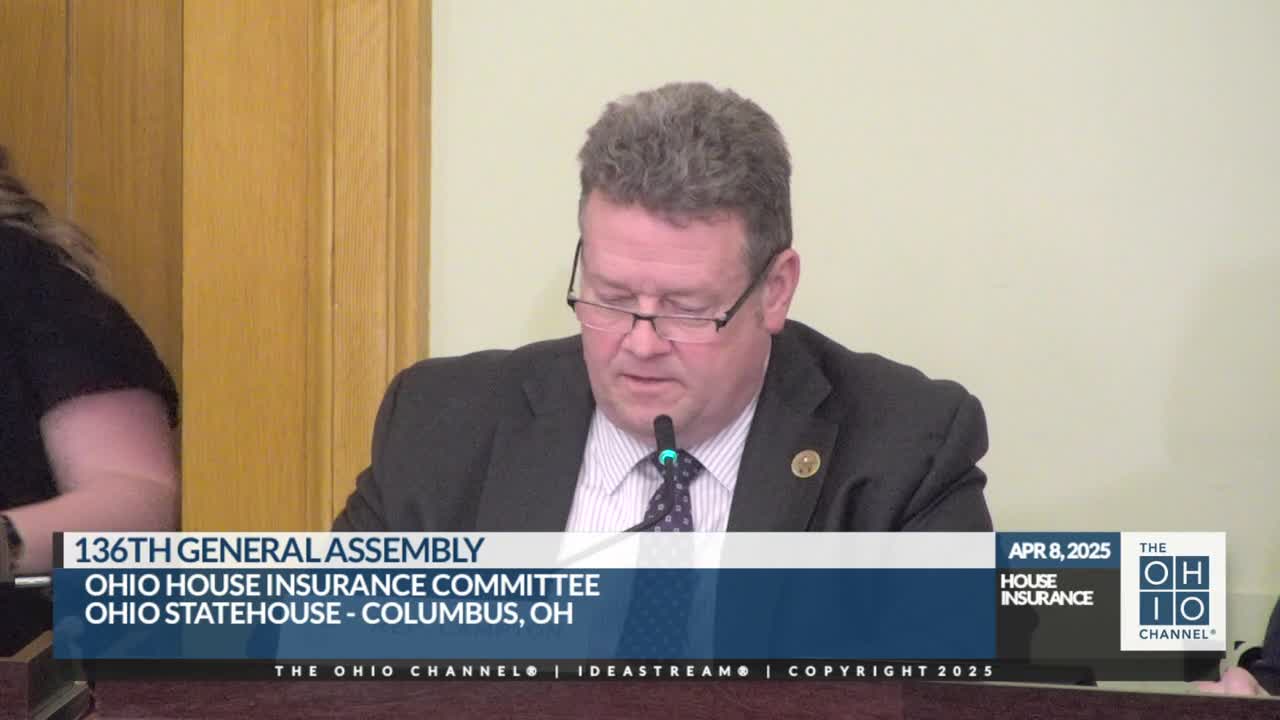
The Ohio House Insurance Committee on Wednesday took testimony on House Bill 99, which would exempt certain health benefit coverage provided through nonprofit agricultural membership organizations from state insurance laws.
The Ohio House Insurance Committee on Wednesday took testimony on House Bill 99, which would exempt certain health benefit coverage provided through nonprofit agricultural membership organizations from state insurance laws. The committee accepted amendment AM-136-0363 without objection, a change that requires applications and member contracts to be in writing and to state that the coverage is not insurance.
The amendment clarifies that coverage provided by a nonprofit agricultural membership organization — rather than the organization itself — would be exempt from state insurance laws, and adds references to the physician health plan partnership act and the law governing multiple employer welfare arrangements to the statutory list of exemptions. The amendment was offered by Representative Barhorst and accepted by the committee at the start of the hearing.
Proponent Ben Sanders of Farm Bureau Health Plans in Tennessee said Farm Bureau plans serve a subset of people who lack employer-sponsored or subsidized marketplace coverage. Sanders said the Tennessee Farm Bureau covers “a little over 100,000 covered lives” and estimated that an Ohio program might mature to about 10,000 covered lives. He described the plans as member‑driven, said they use evergreen contracts and various solvency and risk‑management tools, and said his organization voluntarily complies with state departments’ complaint processes.
Opponents, led by Lee Almeda, senior government relations director for the American Cancer Society Cancer Action Network (ACS CAN), urged lawmakers to reject the bill. Almeda told the committee that House Bill 99 would leave Ohioans, including cancer patients, exposed to medical and financial harm because the plans would not be required to follow state consumer protections that govern screenings, limits on out‑of‑pocket costs, access to clinical trials and oral chemotherapy, or protections for people with preexisting conditions.
Almeda cited anecdotal complaints from Tennessee and other states, including cases he said involved denied inpatient or imaging claims and instances where callers reported a plan treating a prior exam as a preexisting condition and imposing coverage exclusions. ACS CAN told the committee it is concerned the bill could allow plans to cherry‑pick healthier enrollees and thereby destabilize the state individual market.
Committee members pressed proponents on consumer protections, appeals and oversight. Representative King asked how members would appeal claim denials if the plans are not regulated as insurance; Sanders said members can use internal and external reviews, peer‑to‑peer consultations, and that his organization “voluntarily comply[es]” with state department complaint processes. When asked whether rejected members would have recourse, Sanders said that, after internal and external appeals are exhausted, members would have the ability to pursue contract remedies in court.
Questions also covered sales oversight and licensing. Sanders said county Farm Bureau offices in Tennessee often provide enrollment assistance, that roughly three‑quarters of those local representatives “are licensed,” and that the Farm Bureau’s home office handles premium collection and fiduciary responsibility.
Opponents repeated concerns that because the products are not state regulated, routine regulatory data collection and the department’s enforcement tools would not apply; ACS CAN said that makes it difficult to quantify consumer harms and to track claims and complaints at the state level. Opponents also warned of potential effects on the Affordable Care Act marketplace if healthier enrollees move to unregulated plans.
The committee accepted the AM-136-0363 amendment without objection. No vote on the underlying bill was recorded at the hearing; the committee concluded opponent and interested party testimony and then moved to the next item, House Bill 24.
Two dozen written opponent submissions were entered into the record by groups including the American Heart Association, the National Association of Benefits and Insurance Professionals and several oncology and diabetes organizations.