Get Full Government Meeting Transcripts, Videos, & Alerts Forever!
Get email alerts on the Workforce Development topic
No spam. Unsubscribe anytime.
Committee hears Goodwill testimony supporting grant program for nonprofits that sell donated goods
Summary
Witnesses from Goodwill organizations told the House Ways and Means Committee that House Bill 100 would let nonprofits that sell donated goods apply for grants through the Department of Development to expand job-training and placement services for people facing barriers to employment.
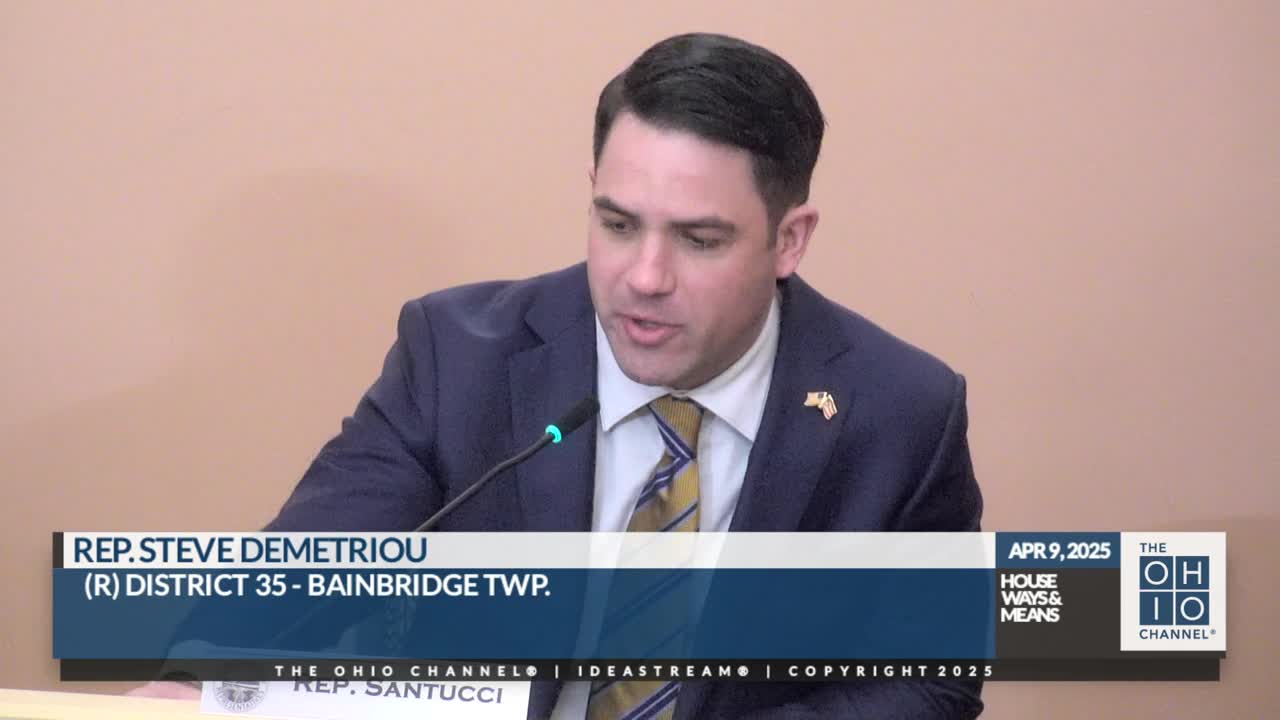
Chairman Romer and members of the House Ways and Means Committee heard testimony in support of House Bill 100, which would authorize a Department of Development grant program for nonprofit retailers that sell donated goods to create or expand job training and placement programs.
Ann Richards, president and CEO of Goodwill of Greater Cleveland and East Central Ohio, and board chair of the Goodwill International Board of Directors, told the committee Goodwill organizations already deliver workforce services across the state and would use the proposed grants to expand employer partnerships and training. “Goodwill's programs go beyond providing resume assistance and interviewing skills to provide an individualized plan for skill building and support,” Richards said. She described local programs that provided resume help, digital-literacy training and certifications for in-demand jobs.
The bill’s backers said grant funding would target people with disabilities, returning citizens, veterans and other Ohioans who face barriers to employment. Willie Knighton Jr., reentry support specialist at Goodwill Industries of Northwest Ohio, described direct services his program provides for returning citizens, including help getting driver’s licenses and birth certificates, and said Goodwill’s reentry program had a recidivism rate of 5% compared with roughly 30% for the state and a national rate of about 49% cited in his testimony: “By passing House Bill 100, you will have a direct effect on helping people in our state who need a hand up to financial independence and a true second chance,” Knighton said.
Richards urged the committee to consider local competition for donations as part of the rationale for the grant. She told members that some for‑profit collectors have entered donation markets, collect donations in local communities and export them for sale abroad, reducing supply for nonprofit retailers whose donated goods fund programming. Committee members pressed witnesses for specifics about grant use and administration. Richards said most Goodwill organizations expect to spend grant funds on program expansion rather than administrative overhead, and she cited “Prosperity to Work,” a program in Canton used to support incumbent hospital employees, as a model for expansion.
Committee members asked for more detail on scale and finances. Richards said Ohio Goodwill organizations placed about 4,500 people into competitive employment in 2024 and that Goodwill programming assisted roughly 96,000 Ohioans last year. Knighton told the committee that in northwest Ohio his organization served 592 returning citizens in 02/2024 and placed 139 returning citizens into jobs last year. During questioning, a committee member referenced a statewide ask of $5,000,000 for the grant program with a single-application cap of up to $1,000,000; Richards and Knighton said local Goodwills would use awarded funds differently according to local needs.
The committee accepted written testimony from the Ohio Chamber of Commerce and concluded the second hearing on House Bill 100; no formal committee action was recorded in the transcript.
Looking ahead, supporters asked the committee to consider the competitive pressure nonprofit retailers face and said the grant would expand proven workforce and reentry programs if funded.