Get Full Government Meeting Transcripts, Videos, & Alerts Forever!
Get email alerts on the Health Benefit Exemptions Farm Bureau topic
No spam. Unsubscribe anytime.
Committee accepts amendment to HB99; supporters tout Farm Bureau plans, opponents warn on preexisting conditions and consumer protections
Summary
The Ohio House Insurance Committee on Wednesday accepted an amendment to House Bill 99 and heard competing testimony on whether Farm Bureau-style health benefit plans should be exempt from state insurance laws.
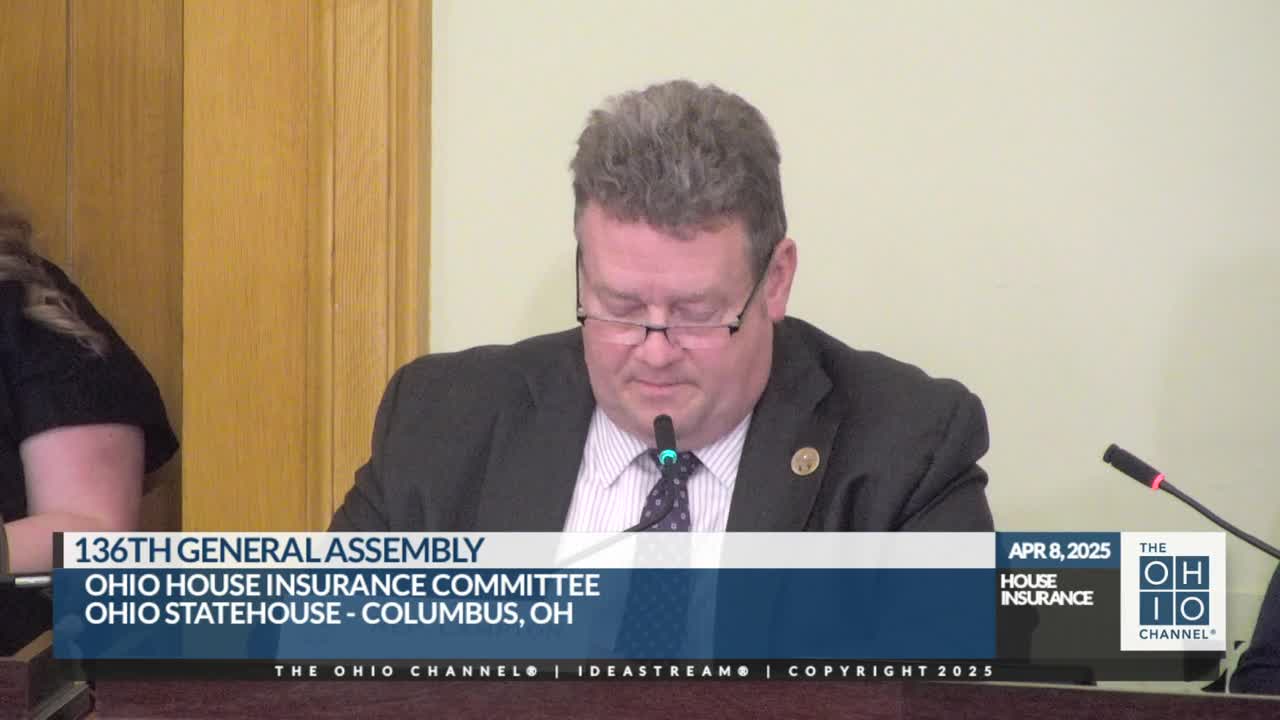
The Ohio House Insurance Committee on Wednesday accepted an amendment to House Bill 99 and then heard proponent and opponent testimony on a measure that would exempt certain Farm Bureau health benefit coverage from state insurance laws.
The amendment, AM-136-0363, was offered by Representative Barhorst and accepted "without objection," and it specifies that health care benefit coverage provided by a nonprofit agricultural membership organization's health benefit program — not the organization itself — is exempt from state insurance laws and that applications and contracts must be predominantly written to state that the coverage "is not insurance and is not subject to state insurance laws." The committee then heard proponent testimony from Ben Sanders of Farm Bureau Health Plans (Tennessee) and opponent testimony from Lee Almeda of the American Cancer Society Cancer Action Network (ACS CAN) and others, who raised concerns about protections for people with preexisting conditions and appeals and regulatory oversight.
Proponent perspective: Ben Sanders, representing Farm Bureau Health Plans in Tennessee, told the committee the Farm Bureau model serves an uninsured or unsubsidized middle market and has operated for decades. "Once someone is in the plan, their individual rate and their coverage is never affected by their individual claims experience," Sanders said, adding that the Tennessee operation covers "a little over a hundred thousand covered lives" and that the Ohio program could mature to "about 10,000 covered lives." He described several risk-management practices, including use of risk-based capital (he said his organization targets roughly ten times what statute would require), case management for high-cost claimants and voluntary cooperation with state departments of insurance on complaint handling.
Opponent concerns: Lee Almeda, government relations director for ACS CAN, said House Bill 99 "would leave Ohioans, including cancer patients, exposed to medical and financial harm." Almeda testified the plans authorized under the bill would not have to follow Ohio consumer protections that require coverage for screenings and treatments, place limits on out-of-pocket costs, or ensure access to clinical trials and oral chemotherapy. He warned that Farm Bureau plans "have no protections for people with preexisting conditions" and that those plans can charge higher premiums or decline coverage, which could push higher-cost people into the ACA marketplace and destabilize premiums there.
Committee discussion and clarifications: Committee members asked Sanders about solvency, network partners and consumer safeguards. Sanders said Farm Bureau contracts in Tennessee use UnitedHealthcare's provider network and that third-party administration arrangements and provider relationships vary by state; he said UnitedHealthcare has a dedicated claims unit in Cincinnati handling Farm Bureau business. On consumer complaints and appeals, Sanders said Farm Bureau uses an internal multi-level review and voluntarily responds to state insurance department complaint processes even though Farm Bureau plans in Tennessee are not classified as insurance under state law. He said legal recourse would remain — in extreme cases a member could sue for breach of contract — and he emphasized that Farm Bureau uses evergreen contracts and would drop members only for nonpayment or loss of membership.
Opponents countered that because the product would be exempt from state insurance laws, the Ohio Department of Insurance would not have the same oversight or formal appeals authority. ACS CAN and other health care groups submitted written opposition, pointing to documented cases in other states where members said they were denied coverage or faced large bills. Committee members questioned the availability of state-level complaint data; opponents said such data are difficult to obtain when products are outside state regulation.
Where the bill stands: The committee accepted the amendment on the record; no final vote on HB99 was recorded during this hearing. The third hearing included proponent and opponent testimony and concluded without further committee action at this meeting.
The committee also collected written opponent testimony from the American Heart Association, the National Association of Benefits and Insurance Professionals, the Association for Clinical Oncology, the American Diabetes Association, the Ohio Hematology Oncology Society and others, which the chair made part of the record.
Less-critical details and next steps: Committee members signaled continuing concern about consumer protections, appeals processes and impacts to the ACA individual marketplace. The bill remains under the committee's consideration; the amendment accepted at this hearing will be part of the bill text considered going forward.