Get Full Government Meeting Transcripts, Videos, & Alerts Forever!
Get email alerts on the Insurance topic
No spam. Unsubscribe anytime.
Committee hears opposition, support for bill letting Farm Bureau offer non‑insurance health coverage
Summary
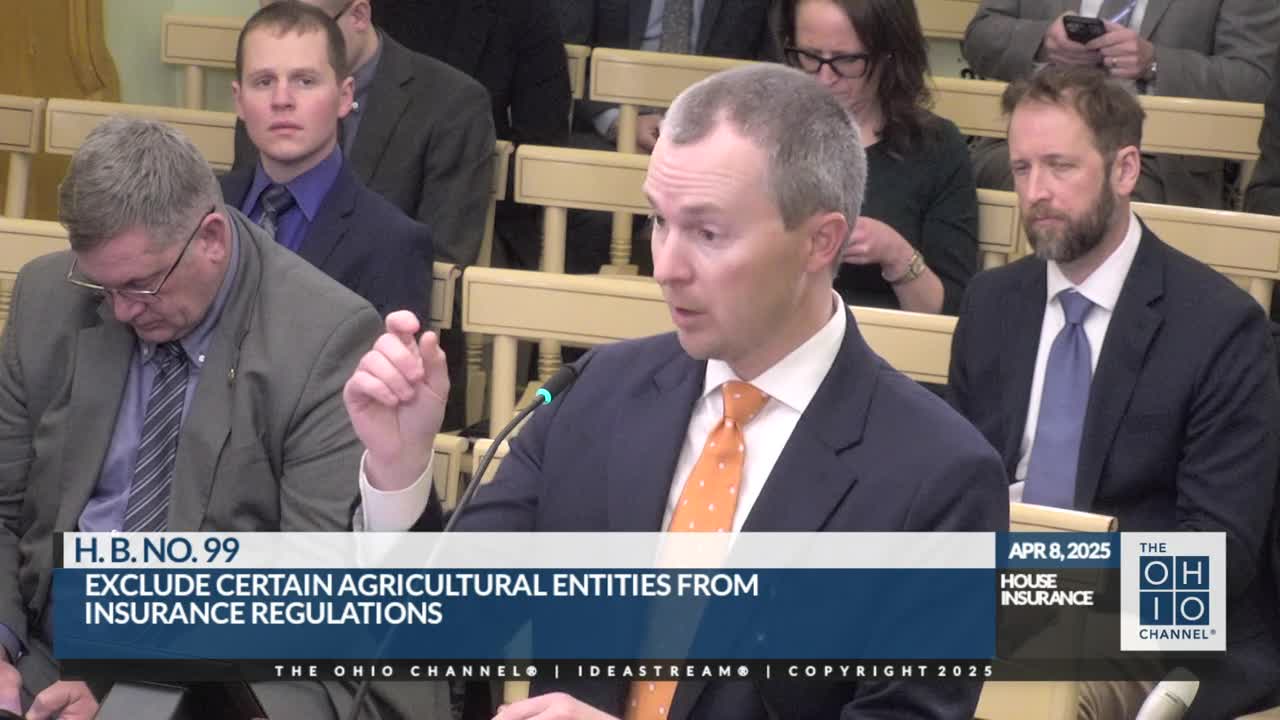
The Ohio House Insurance Committee on Wednesday took testimony on House Bill 99, which would allow nonprofit agricultural membership organizations to provide health benefit coverage exempt from state insurance laws and require written disclosures that the coverage “is not insurance.”
The Ohio House Insurance Committee on Wednesday took testimony on House Bill 99, which would allow nonprofit agricultural membership organizations to provide health benefit coverage exempt from state insurance laws and require written disclosures that the coverage “is not insurance.” The committee also accepted amendment AM‑136‑0363 clarifying the exemption and disclosure requirements.
Why it matters: Supporters say the plans offer a lower‑cost option for some farm families and other rural residents who lack subsidized coverage; opponents say exempting these plans from insurance regulation could allow discrimination against people with preexisting conditions and leave consumers without meaningful appeals or state oversight.
Ben Sanders, with Farm Bureau Health Plans in Tennessee, told the committee the model is an established one and that Tennessee’s program covers “a little over a hundred thousand covered lives.” He said a mature Ohio program would likely cover about 10,000 lives and defended voluntary compliance with state complaint processes: “We voluntarily comply with the department of insurance in every each of these states with their complaint process.” Sanders also said the plans do not change an individual member’s rate because of claims experience: “Once someone is in the plan, their individual rate and their coverage is never affected by their individual claims experience.” He described an internal complaint count of about 250 in the most recent year and said that represented a small share of roughly 2,500,000 claims processed.
Opponents, including Lee Almeda, senior government relations director for the American Cancer Society Cancer Action Network, said House Bill 99 would create unregulated products that could “discriminate against Ohioans with pre existing conditions” and would deny consumers protections provided under Ohio insurance law. Almeda said the plans could allow higher premiums, benefit exclusions, or outright denials for people with prior conditions and warned that because these products are not state regulated, the Ohio Department of Insurance would have no authority over appeals or enforcement.
Committee members pressed proponents on enrollment, consumer protections and marketplace effects. Representative Peterson noted that the amendment adopted earlier in the hearing says the coverage “is not insurance” and “is not subject to the laws and rules of the state governing insurance,” and asked whether that language is sufficient notice to consumers; Sanders said the Farm Bureau uses a standalone form signed by members to acknowledge that the product “is not insurance.” Representatives asked how members with denied claims would appeal; Sanders said members can use internal and external reviews and that Farm Bureau voluntarily responds to department of insurance inquiries, and that a contractual private right of action would remain as a last resort.
Opponents raised anecdotal accounts from Tennessee and other states where people on Farm Bureau plans reported large unpaid bills after denials or claims classified as preexisting conditions. The American Cancer Society provided quoted examples of denied hospital or treatment charges and urged the committee not to pass HB99.
No vote was taken. The committee recorded multiple written opponent testimonies from national and state health organizations and concluded the third hearing on HB99.
What was amended: Amendment AM‑136‑0363, offered by Representative Barhorst and accepted without objection, adds language that the coverage provided by a nonprofit agricultural membership organization “is not insurance,” requires the application and member contract be in writing and predominantly state that the coverage is not subject to state insurance laws, and adds cross‑references to the physician health plan partnership provisions and rules related to multiple employer welfare arrangements to the list of statutes from which such coverage would be exempt.
Context and next steps: Supporters pointed to 10 other states with similar laws and said some of those programs have been operating for years; opponents said data collection is limited because these plans are not state regulated. The committee did not vote on the bill during the hearing.
Ending: Committee members asked staff to keep the record open for additional written testimony; the hearing then moved on to other bills on the agenda.