Get Full Government Meeting Transcripts, Videos, & Alerts Forever!
Get email alerts on the Criminal Justice Health topic
No spam. Unsubscribe anytime.
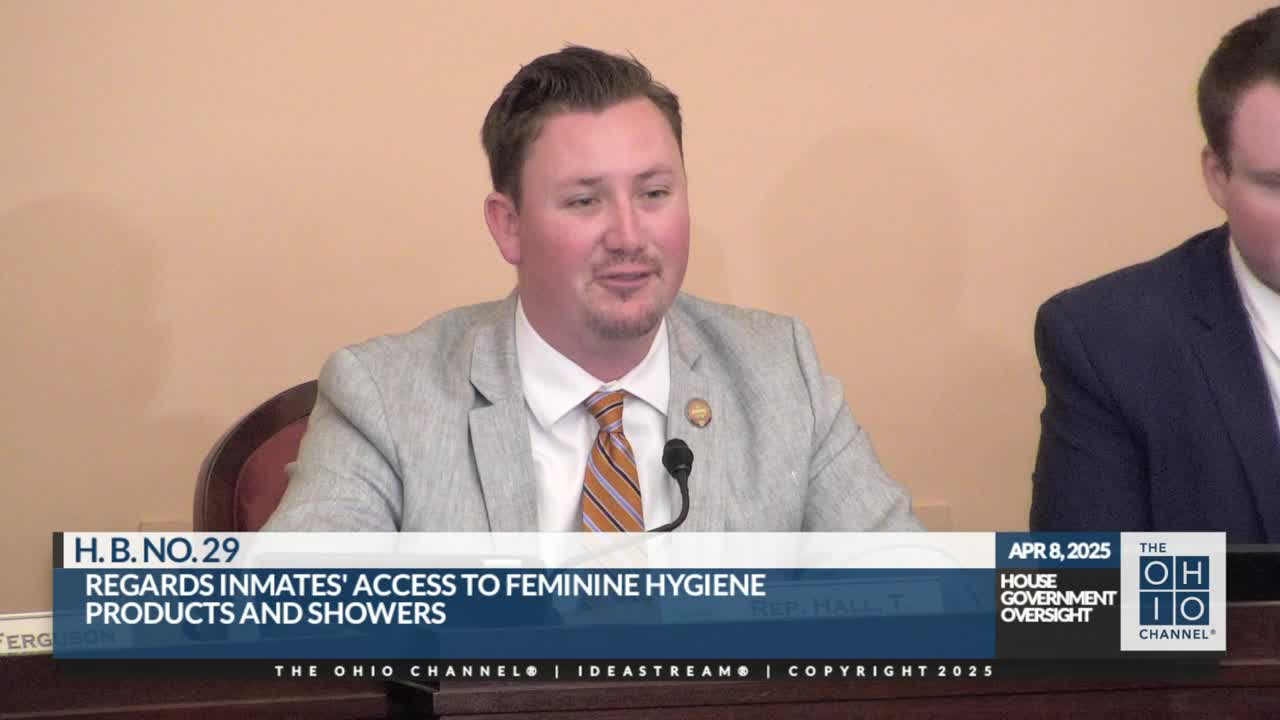
Committee holds second hearing on bill to guarantee free menstrual products, showers for incarcerated people
Summary
The House Government Oversight Committee on April 9 held a second hearing on House Bill 29, which would require free menstrual products, a variety of product sizes, daily showers and proper disposal in Ohio jails and prisons.
The House Government Oversight Committee on April 9 held a second hearing on House Bill 29, which would require correctional facilities in Ohio to provide free and adequate access to menstrual products (in multiple sizes), daily showers when needed, and suitable disposal receptacles for those who menstruate.
Multiple formerly incarcerated women and reentry advocates gave emotional firsthand testimony describing inconsistent access, poor-quality products, and health consequences inside county jails and state prisons. "I entered the advocacy space as a second career... I implore you to do everything that you can to make House Bill 29 an official law in Ohio," Ainsley Johnson Brown testified. Courtney Ostbl described using a state-issued wash rag as a makeshift pad on arrival because she had no sanitary supplies and said the experience was "one of the most dehumanizing moments of my life." Likewise, several witnesses reported being denied tampons or pads, being forced to make improvised products, or to beg other inmates or officers for supplies.
Dianera Garcia recounted long-term medical consequences that she attributed in part to denied or inadequate menstrual care while incarcerated: "I entered prison with semi good health and left with stage 3 uterine cancer," she said. Garcia and other witnesses said medical requests were denied or dismissed and that inadequate supplies and limited clinical attention delayed diagnosis and treatment.
Formerly incarcerated witnesses and advocates including Erin Knoll, Jessica Grieco, Heidi Arnold, and representatives of ARCH and the Ohio Justice and Policy Center urged the committee to require quality products in sufficient quantities, consistent statewide implementation, and routine access to showers and sanitary disposal. Wendy Tarr of ARCH noted that providing adequate products can reduce preventable infections and downstream healthcare costs and that inconsistency across county facilities left many women without reliable supplies.
Committee members and staff noted an earlier amendment adding daily shower access (introduced in a prior session by Representative Plummer) and asked clarifying questions about implementation in restrictive housing and emergency conditions. The ranking member said the shower provision was included and would allow for limited exceptions in emergencies.
No committee vote was taken at the second hearing. Sponsors and advocates said they had submitted written testimony and supporting materials and urged the legislature to move the bill to protect health, dignity and public safety for people who menstruate while incarcerated.