Get Full Government Meeting Transcripts, Videos, & Alerts Forever!
Get email alerts on the Insurance topic
No spam. Unsubscribe anytime.
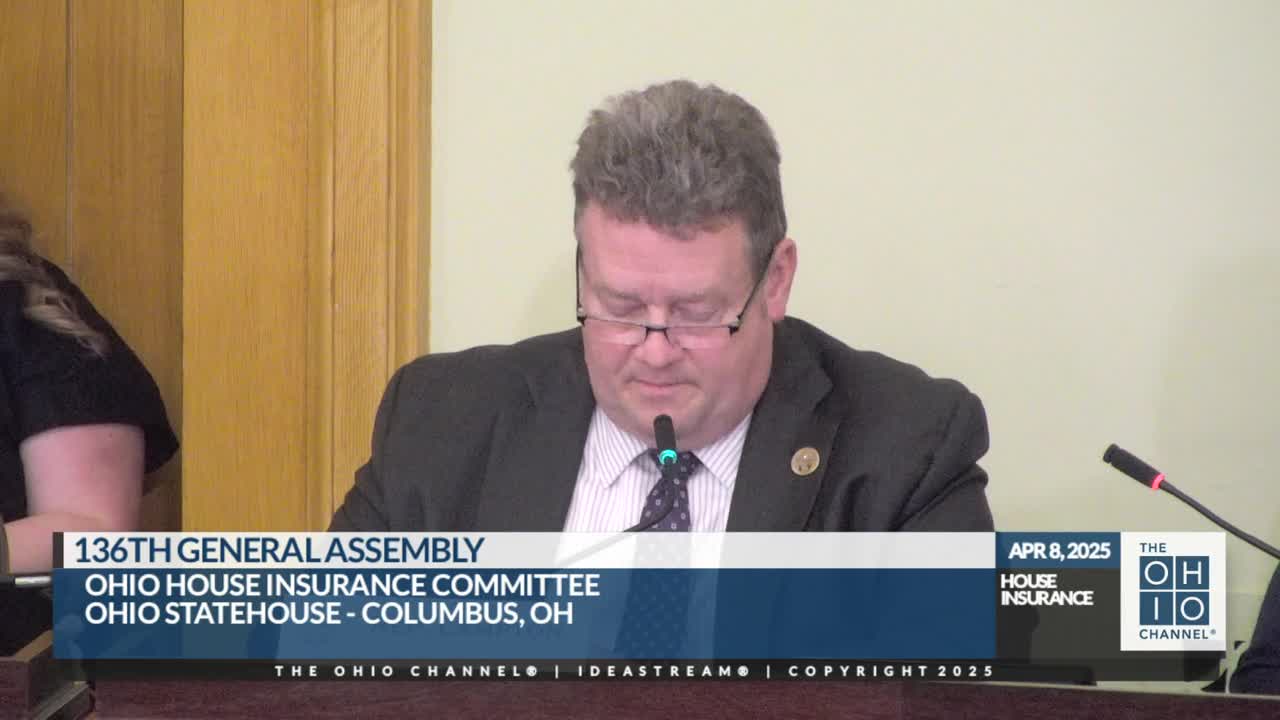
Committee accepts amendment to House Bill 99 after testimony on Farm Bureau health plans
Summary
The House Insurance Committee accepted an amendment to House Bill 99 and heard proponent and opponent testimony about Farm Bureau–offered health benefit coverage that proponents say serves rural members and opponents say would leave patients without state regulatory protections.
The Ohio House Insurance Committee on the third hearing of House Bill 99 accepted an amendment clarifying that health care benefit coverage provided by a nonprofit agricultural membership organization is exempt from state insurance laws, and that members must receive written notice that the coverage is not insurance.
The amendment (AM-136-0363) was moved by Representative Barhorst and accepted without objection. The committee then heard proponent testimony from Ben Sanders of Farm Bureau Health Plans (Tennessee) and opponent testimony from Lee Almeda of the American Cancer Society Cancer Action Network (ACS CAN) and other written opponents.
The amendment “specifies that health care benefit coverage provided by a nonprofit agricultural membership organization, as opposed to the organization itself, is exempt from state insurance laws,” Representative Barhorst said while explaining AM-136-0363. It also requires that applications and member contracts be in writing and “predominantly state” the coverage is not insurance, and it adds references to the Physician Health Plan Partnership Act and the law governing multiple-employer welfare arrangements to the list of statutes from which the coverage is exempt, Barhorst said.
Ben Sanders, who identified himself as representing Farm Bureau Health Plans in Tennessee, told the committee his organization has offered similar plans since 1947 and described the products as an option for members who fall into an “unsubsidized pool” that lack employer coverage or marketplace subsidies. Sanders said Tennessee Farm Bureau’s model covers slightly more than 100,000 covered lives, that he estimates an Ohio plan “at maturity” could cover about 10,000 lives, and that Farm Bureau processes roughly 2,500,000 claims per year with about 250 complaints annually.
Sanders said the plans are not classified as insurance in Tennessee, that his organization voluntarily complies with state departments’ complaint processes, and that Farm Bureau uses risk-management tools and third‑party administrators (he named UnitedHealthcare as a current network and third‑party administrator in Tennessee). He told lawmakers the organization uses “evergreen” contracts and does not change an enrolled member’s rate because of individual claims experience.
Opponents, represented in person by Lee Almeda of ACS CAN and by several written statements from health-care and specialty medical organizations, argued Farm Bureau–style plans lack the consumer protections cancer patients and others rely on. "House Bill 99 would leave Ohioans, including cancer patients, exposed to medical and financial harm," Lee Almeda said, adding concerns that the plans could discriminate against people with preexisting conditions, impose higher out‑of‑pocket costs, and allow denials of coverage for screening, treatment and oral chemotherapy that existing state‑regulated insurers must cover.
Almeda said the bills in other states produce limited public data because those plans are not regulated by state insurance departments, and he provided anecdotal accounts from patients in Tennessee who reported large denials or premium surcharges tied to prior medical history. Opponents urged the committee to weigh the potential for such plans to “cherry pick” healthier members and shift risk into the ACA marketplace.
Committee members asked Sanders about solvency, claim denials, complaint and appeals processes, and whether Tennessee experience showed disruption of local provider networks. Sanders said Farm Bureau uses risk‑based capital standards, has care‑coordination units for high‑cost claimants and a multi‑level internal review and external peer review process for disputes, and that 3 in 4 of Farm Bureau’s county office representatives who handle sales are licensed in Tennessee.
Representative Peterson noted the amendment language requires notice that the product “is not insurance” and asked whether that was sufficient consumer protection; Sanders replied that Farm Bureau uses a stand‑alone acknowledgement form for members. In response to questions about whether these plans would be subject to Ohio law or remain governed by Tennessee law, Sanders said the legislation authorizes the Ohio Farm Bureau to offer a plan and that Ohio rules would apply to Ohio members, though he noted legal counsel would better address conflict‑of‑law questions.
The committee recorded written opponent testimony from the American Heart Association, the National Association of Benefits and Insurance Professionals, the Association for Clinical Oncology, the American Diabetes Association, the Ohio Hematology Oncology Society and others. No formal vote on the bill itself occurred at the hearing; the recorded committee action was acceptance of AM-136-0363.
The committee concluded the third hearing on House Bill 99 after in‑person and written statements from proponents and opponents.
Votes at a glance: Representative Barhorst moved to adopt amendment AM-136-0363; amendment accepted without objection (no roll call voting recorded).