Get Full Government Meeting Transcripts, Videos, & Alerts Forever!
Get email alerts on the Insurance topic
No spam. Unsubscribe anytime.
Ohio committee hears competing views on Farm Bureau health plans that would be exempt from state insurance rules
Summary
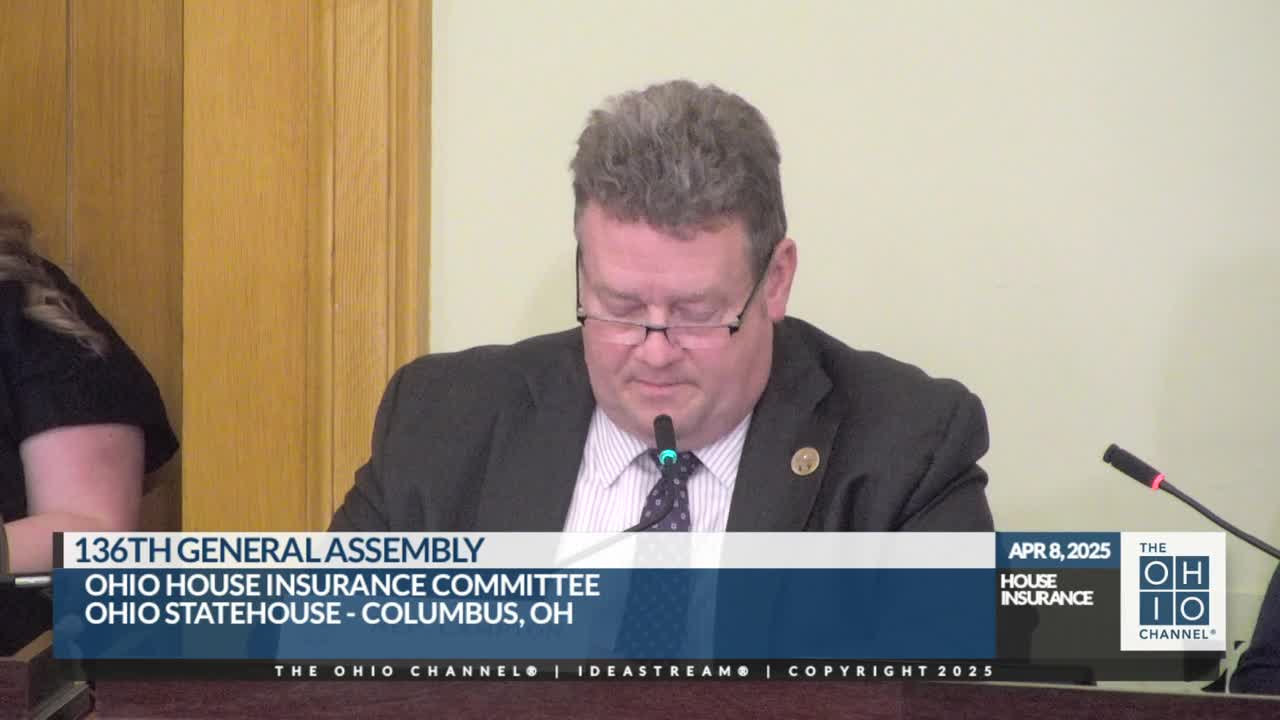
Columbus — The Ohio House Insurance Committee held a third hearing on House Bill 99, which would permit nonprofit agricultural membership organizations to offer health care benefit coverage that is explicitly exempted from state insurance laws and must be labeled in writing as “not insurance.” Representative Barhorst moved and the committee accepted an amendment (AM-136-0363) clarifying the exemption and adding references to the physician health plan partnership act and laws governing multiple-employer welfare arrangements.
Columbus — The Ohio House Insurance Committee held a third hearing on House Bill 99, which would permit nonprofit agricultural membership organizations to offer health care benefit coverage that is explicitly exempted from state insurance laws and must be labeled in writing as “not insurance.” Representative Barhorst moved and the committee accepted an amendment (AM-136-0363) clarifying the exemption and adding references to the physician health plan partnership act and laws governing multiple-employer welfare arrangements.
The measure matters because it would create a legal pathway for Farm Bureau–style membership plans that operate outside the Ohio Department of Insurance’s regulatory authority, and opponents say that could leave people with cancer and other serious conditions without state consumer protections. "House Bill 99 ... would leave Ohioans, including cancer patients, exposed to medical and financial harm," said Lee Almeda, government relations director for the American Cancer Society Cancer Action Network, during opponent testimony.
Ben Sanders, who testified for Farm Bureau Health Plans of Tennessee, told the committee his organization has offered similar plans for decades and said the products serve a narrow, unsubsidized segment of the population. "We cover a little over a hundred thousand covered lives" in Tennessee and the Ohio Farm Bureau plan, he said, "would likely, at maturity, cover about 10,000 covered lives." Sanders said the organization uses risk-management tools, voluntarily complies with state insurance departments' complaint processes and that once enrolled, members' coverage "is never affected by their individual claims experience" except for nonpayment.
Opponents countered that because HB 99's plans would not be subject to state insurance requirements they could deny coverage, charge higher premiums for people with preexisting conditions, or place limits on benefits important for diagnosing and treating illnesses. Almeda warned the plans "won't have to follow consumer protection laws other insurers have to follow" and said the Ohio Department of Commerce and Insurance would have no authority to help consumers with complaints under the bill's framework. The American Cancer Society cited examples it collected from Tennessee in which members said claims were denied as preexisting conditions and where patients faced large bills.
Committee members pressed proponents and opponents on consumer protections, complaint and appeal pathways, and market effects. Representative King asked whether members could file complaints to the state department; Sanders said the Farm Bureau voluntarily responds to department complaint processes but acknowledged the plans are not classified as insurance under Tennessee regulation. Representative Peterson noted the amendment requires that applications and contracts must "predominantly state that the coverage is not insurance and is not subject to state insurance laws," and Sanders confirmed his organization uses standalone forms to acknowledge that to members.
Several committee members raised concerns about market stability and cherry-picking of healthy enrollees, which opponents say could shift risk into the ACA individual market and raise premiums there. Opponents also said data are difficult to obtain because the plans are not regulated by state insurance departments and therefore are not included in routine state reporting. Written opponent testimony was filed by multiple medical and patient groups, including the American Heart Association, the American Diabetes Association and oncology societies; the committee accepted those written submissions into the record.
The amendment to HB 99 (moved by Representative Barhorst) was accepted without objection; no bill vote was taken at the hearing. The committee then closed the third hearing and proceeded to other agenda items.