Get Full Government Meeting Transcripts, Videos, & Alerts Forever!
Get email alerts on the State Budget topic
No spam. Unsubscribe anytime.
House Finance Committee approves amended state operating bill after school funding warnings
Summary
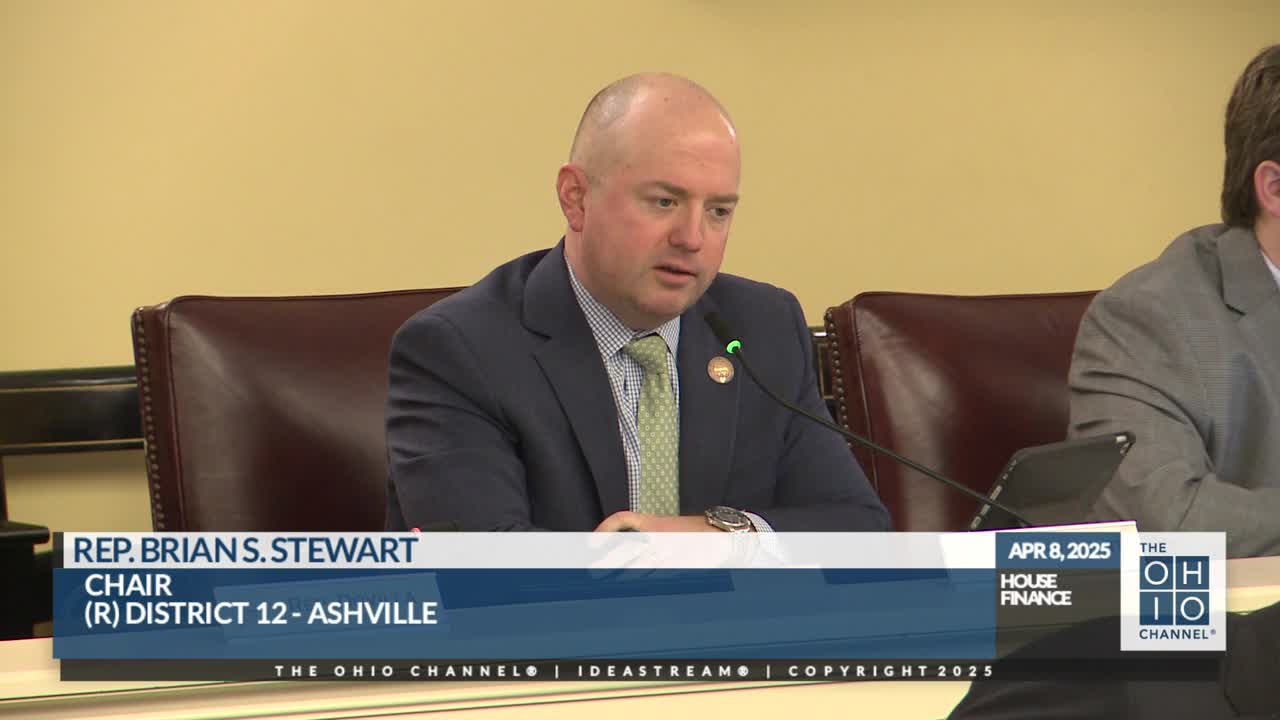
The House Finance Committee on April 8 adopted an omnibus amendment to amended substitute House Bill 96 and favorably reported the bill 19–10 after school officials warned a proposed 25% cash-balance cap would force major cuts in districts that used federal COVID-era funds to sustain staff.
The Ohio House Finance Committee on April 8 adopted an omnibus amendment to amended substitute House Bill 96 and, following debate and testimony, voted 19–10 to favorably report the bill to the Rules and Reference Committee.
The outcome followed testimony from Westerville City School District Superintendent Angie Hamburg, who told the committee her district—serving nearly 15,000 students in Franklin and Delaware counties—relies on accumulated cash balances to smooth recurring operations and pay staff as federal pandemic funding phases out. Hamburg said an amendment that would “require the auditor to suspend property tax collections for any district with a cash balance over 25%” could force immediate, deep cuts.
Hamburg said the district’s higher-than-usual balance is not the result of property reappraisals but of legacy uses of ESSER (federal pandemic) funds to cover positions that are now being shifted back into the general fund. “The only band aid we have right now is our cash balance, and like many districts, losing it abruptly would be catastrophic for us,” she said.
Why it matters: House Bill 96 is the state operating bill. The committee accepted amendment 2698-1 as its omnibus amendment and then voted to report the amended substitute favorably, moving the package to the Rules and Reference Committee for possible floor action. Committee leaders said they expected additional floor debate.
Hamburg gave specifics about Westerville’s finances in response to member questions. She said the district employs nearly 2,000 people, that salary and benefits make up about 82% of the district’s budget, and that the district spends about $638,000 a day. She said the district is “deficit spending year over year by over $20,000,000 throughout the life of our forecast” because districts have used federal funds to cover recurring staff costs and are now shifting those costs to local general funds. Hamburg said the district lost about $4,000,000 in state funding this school year even while it realized roughly $2,700,000 in increased property tax revenue after reappraisal, for a net decrease.
Members pressed Hamburg on cash-flow timing and reserve policy. She said Westerville maintains a multiyear plan that uses reserves to keep the five-year forecast balanced and to preserve borrowing capacity; the district also banked $25,000,000 in credits with the Ohio Facilities Commission. Hamburg said the district planned to use reserves to accompany a “small no new millage bond” for aging buildings after a November ballot issue failed, and that without the reserves the district would likely need to return to voters frequently for levies.
Representative Sweeney, the ranking member, praised the process while noting policy disagreements remain, and committee leadership thanked members, staff and witnesses for a lengthy set of hearings leading to the omnibus vote. Vice Chair Davila moved amendment 2698-1, the committee accepted it without recorded objection, and then moved to favorably report the amended substitute. The clerk called roll for the final committee vote; the committee recorded 19 affirmative votes and 10 negative votes.
The committee’s vote does not finalize the budget; reporting the bill sends it to the Rules and Reference Committee and sets it up for floor consideration. Committee leadership said further debate is expected on the House floor.