Get Full Government Meeting Transcripts, Videos, & Alerts Forever!
Get email alerts on the State Budget topic
No spam. Unsubscribe anytime.
House Finance Committee adopts omnibus amendment and advances HB 96 after testimony on school funding and proposed 25% cash rule
Summary
The Ohio House Finance Committee on April 8 accepted an omnibus amendment to the state operating budget and voted 19-10 to favorably report amended Substitute House Bill 96 to Rules and Reference.
The Ohio House Finance Committee on April 8 accepted an omnibus amendment to the state operating budget and voted to favorably report amended Substitute House Bill 96 to the Rules and Reference Committee.
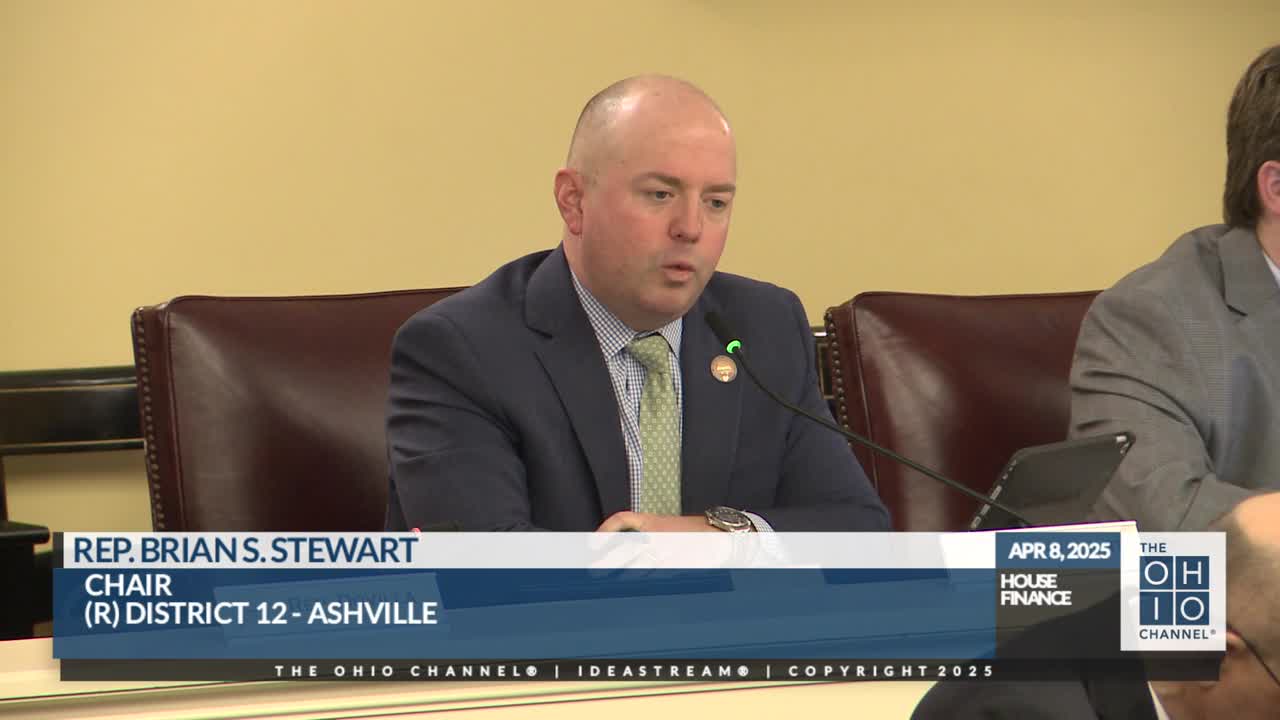
Chair Scott Stewart opened the session and the committee later adopted the omnibus amendment by unanimous consent before taking a roll-call vote on the amended substitute bill. Vice Chair Davila moved to amend the substitute with Amendment 2698-1, and later moved that the committee favorably report the amended substitute and recommend passage. The roll call on the final committee recommendation produced 19 affirmative votes and 10 negative votes; committee staff granted LSC harmonizing authority for the committee report.
The committee heard testimony from Angie Hamburg, superintendent of the Westerville City School District, who raised concerns about language in an amendment that she said “would require the auditor to suspend property tax collections for any district with a cash balance over 25%.” Hamburg told the committee her district, which serves nearly 15,000 students, has used cash balances to smooth shortfalls after federal pandemic-era ESSER funds wound down and to cover recurring operating costs while seeking voter approval for additional levies.
“Our balance is from being able to pay positions that we were able to pay out of ESSER funding,” Hamburg said. She told members her district is deficit spending over the life of its forecast and used cash to cover a $4 million reduction in state share this school year. Hamburg said the district’s cash balance kept the district’s five‑year forecast “in the black” through 2029 and that an abrupt loss of that cash would force program cuts and frequent levy requests.
Members pressed Hamburg on cash‑flow mechanics and special‑education costs. Representative Rip Glassmer asked how much the district’s cash balance drops between semiannual tax settlements; Hamburg replied the district spends about $638,000 a day and that payroll and settlements create significant intra‑year variation in cash levels. Representative Andrew White and others asked about special‑education cost drivers; Hamburg described an uptick in students with severe behavioral and medical needs and said the district had opened eight specialized elementary classrooms this school year.
Ranking Member Bob C. Sweeney acknowledged the length of the budgeting process and said his caucus opposed the committee recommendation, noting substantive differences in budget priorities. Chair Stewart thanked members and staff for the committee’s process and said further debate will occur on the House floor.
Action at a glance: the committee accepted the omnibus amendment and then voted 19-10 to favorably report amended Substitute House Bill 96 to Rules and Reference; LSC harmonizing authority was granted. The bill will proceed to the House floor for additional debate and final votes.
The committee recessed to caucus and adjourned after reporting the bill; omnibus materials were made available on the House Finance Committee web page.