Get Full Government Meeting Transcripts, Videos, & Alerts Forever!
Get email alerts on the Earned Wage Access topic
No spam. Unsubscribe anytime.
Committee hears testimony supporting House Bill 152 to regulate earned-wage-access services
Summary
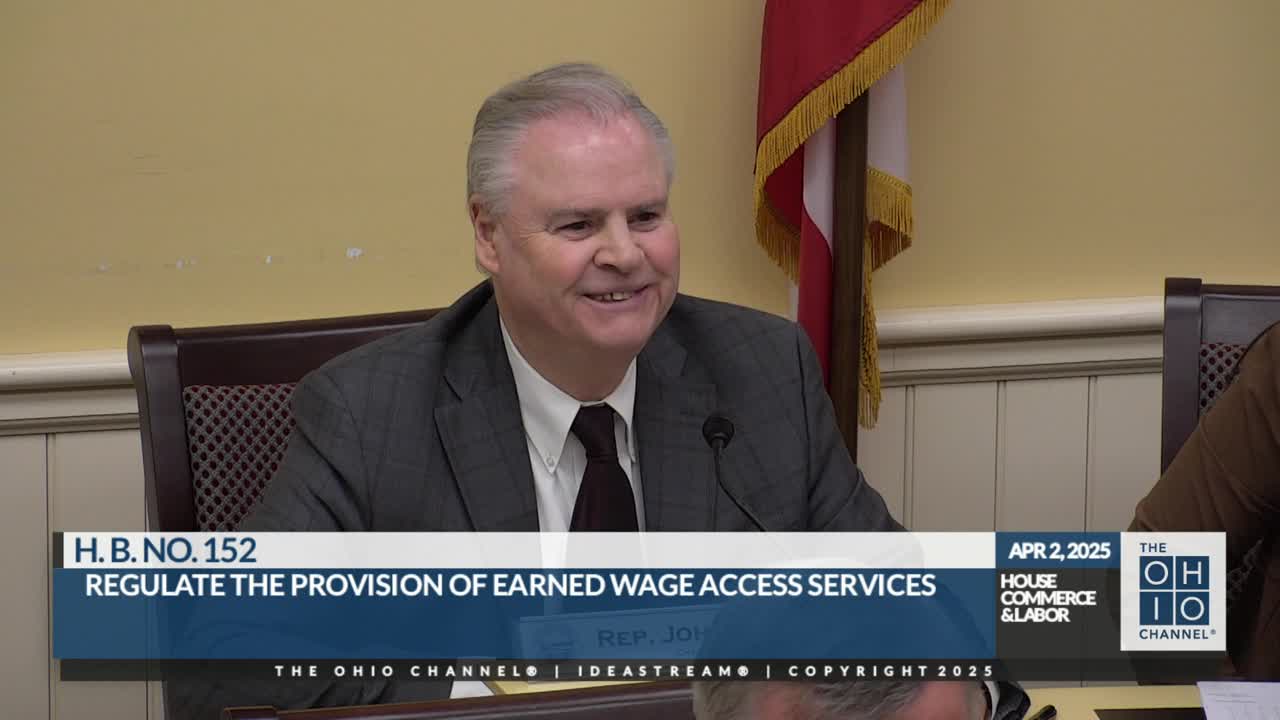
The House Commerce and Labor Committee held a second hearing on House Bill 152, which would create a registration and consumer-protection framework for earned-wage-access (EWA) providers. Witnesses from DailyPay and EarnIn described the product, optional fees, and proposed safeguards; members asked about fees, frequency of use, and employer role.
The House Commerce and Labor Committee took testimony on House Bill 152, a proposal to create a registration and consumer-protection framework for earned-wage-access services (EWA).
Elise Hicks, senior manager of public policy at DailyPay LLC, told the panel HB 152 would provide legal certainty for employer-integrated EWA programs and require consumer protections such as a mandatory free option, prohibitions on credit-report requirements, and strong disclosures. Hicks said DailyPay serves more than 4.4 million users nationally and works with 675 Ohio businesses, providing access to roughly 194,000 Ohio workers.
Andrew Herff, testifying on behalf of EarnIn through Schumacher Advisors, described the direct-to-consumer and employer-integrated models and said several states have enacted similar EWA frameworks. He said EWA providers generally do not charge interest or assess late fees, and that an ACH transfer option is typically free (1–3 business days), while an optional instant-transfer fee enables same-day or immediate access.
Witnesses described common industry features: optional instant-transfer fees (DailyPay said $2.99–$3.49 on the high end for instant transfers; EarnIn cited fees as high as $5.99 in some cases), a required free-disclosure option in the bill, and voluntary “tips” or gratuities that some providers ask for on a subset of transactions (witnesses said fewer than half of transactions include a tip and the average tip is about $1). Both witnesses said the EWA provider assumes credit risk in employer-integrated models: the employer remits payroll as usual and the provider is repaid at payday; if a worker is removed from payroll before an outstanding advance is reconciled, the provider may absorb some of that loss.
Committee members asked about safeguards and consumer protections. Representative McNally and others asked whether providers cap fees or frequency of use; DailyPay said it does not set per-user frequency caps and that typical early users take advances two to three times per month initially. Panel members asked whether multiple EWA products could be used simultaneously (so-called “product stacking”); witnesses said product stacking exists in direct-to-consumer models and acknowledged it as an industry concern.
Representatives also discussed consumer education and enforcement. Witnesses said DailyPay provides free money-management tools to users and that HB 152’s registration and disclosure requirements are intended to discourage bad actors. EarnIn and other witnesses supported guardrails that prohibit interest, late fees, collections, or credit reporting on EWA advances.
No committee vote on HB 152 was recorded during this second hearing; testimony concluded and the committee closed the hearing.