Get Full Government Meeting Transcripts, Videos, & Alerts Forever!
Get email alerts on the Labor Law Posting topic
No spam. Unsubscribe anytime.
Committee advances bill letting Ohio employers post state labor notices online
Summary
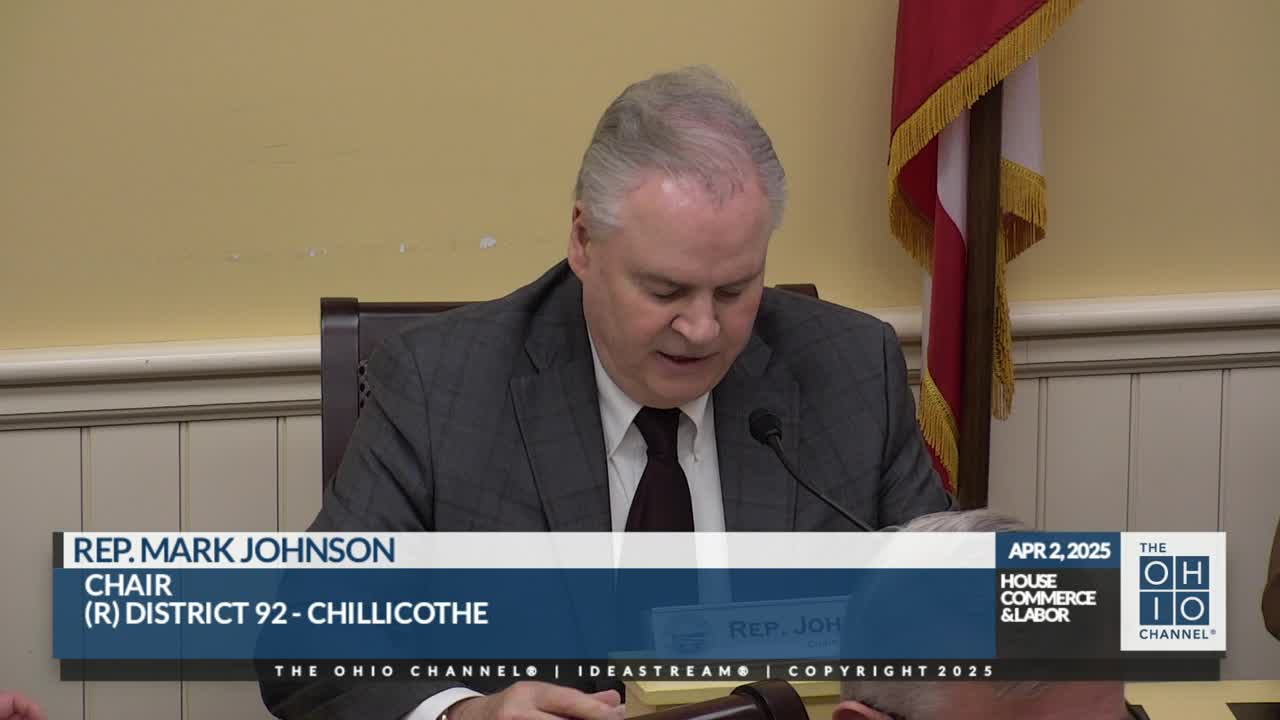
Senate Bill 33, which would allow Ohio employers to post specified state labor-law notices on the Internet rather than only in a conspicuous physical location at the workplace, advanced out of the House Commerce and Labor Committee after sponsor testimony, witness remarks and committee votes.
Senate Bill 33, which would allow Ohio employers to post specified state labor-law notices on the Internet rather than only in a conspicuous physical location at the workplace, advanced out of the House Commerce and Labor Committee after sponsor testimony, witness remarks and committee votes.
The bill’s sponsor, Senator Wilson, told the committee the measure is “a simple, straightforward bill” that would permit employers to make the Department of Commerce’s workplace notices available electronically to employees and would not change the content of those notices. He said the bill mirrors a prior version that passed Senate committee and the full Senate in the last General Assembly but did not reach the House floor.
The bill responds to workplace changes since the COVID‑19 pandemic, including remote and hybrid work arrangements, by allowing employers — at their option — to post required Ohio notices via an online portal, QR code, or employee timesheet tab rather than only on a physical poster in a break room. Senator Wilson told the panel that the Director of the Ohio Department of Commerce already publishes the notices online and updates them annually; SB33 would make electronic availability an acceptable alternative to the existing physical-posting requirement.
Committee members asked how the change would affect enforcement and access. Representative White raised concerns about “bad actors” who might hide required notices behind multiple web pages; she proposed an amendment requiring that online access be no more than one click from an employer’s employee portal. Ranking Member McNally offered the one‑click amendment (identified in the hearing as amendment 136‑0327) and a second amendment (136‑0371) to require employers to keep physical postings in place until online notices are active and employees are notified. Vice Chair Lear moved to lay both amendments on the table.
Roll-call votes reported in the transcript show members’ individual votes. For amendment 136‑0327, the roll call recorded these votes: Chair Johnson (yes), Vice Chair Lear (yes), Ranking Member McNally (no), Representative Abrams (yes), Representative Brent (no), Representative Claggett (yes), Representative Creech (yes), Representative Dean (yes), Representative Hoops (yes), Representative Kishman (yes), Representative Pizzoli (yes), Representative Rader (no), Representative White (no). The amendment was placed on the table (recorded roll-call tally: 9 yes, 4 no).
A second table motion on amendment 136‑0371 produced the same recorded roll-call pattern in the transcript (yes: Chair Johnson, Vice Chair Lear, Representative Abrams, Representative Claggett, Representative Creech, Representative Dean, Representative Hoops, Representative Kishman, Representative Fazuli; no: Ranking Member McNally, Representative Brent, Representative Rader, Representative White), and the amendment was laid on the table (recorded roll-call tally: 9 yes, 4 no).
After testimony from business witnesses, including a representative of the Ohio Chamber who placed SB33 in the context of other post‑pandemic labor‑law changes, the committee voted to favorably report the bill and recommend its passage. The roll call for the favorable report recorded these votes: Chair Johnson (yes), Vice Chair Lear (yes), Ranking Member McNally (yes), Representative Abrams (yes), Representative Brent (no), Representative Claggett (yes), Representative Creech (yes), Representative Dean (yes), Representative Hoops (yes), Representative Kishman (yes), Representative Fazuli (yes), Representative Rader (no), Representative White (yes). The transcript records the favorable‑report vote as 11 yes and 2 no based on the individual votes listed.
Supporters argued the bill modernizes compliance and can help reach remote workers, while allowing employers to keep evidence of employee receipt (for example, requiring employees to click a link or acknowledge they have read the notice). Opponents and some committee members pushed for guardrails — the one‑click concept and an explicit requirement that employers not remove physical postings until employees are able to access the notices online and have been informed of the change.
The committee did not adopt either amendment; both were placed on the table after motions to table. The committee then recommended SB33 favorably with the votes noted above. The bill will proceed to subsequent House steps per committee procedure.
Votes at a glance
- Amendment 136‑0327 (one‑click accessibility requirement): Introduced by Ranking Member McNally; motion to lay on the table by Vice Chair Lear; roll-call votes recorded in the transcript; laid on the table (recorded tally 9 yes, 4 no).
- Amendment 136‑0371 (require employers keep physical posting until online version active/notification): Introduced by Ranking Member McNally; motion to lay on the table by Vice Chair Lear; roll-call votes recorded in the transcript; laid on the table (recorded tally 9 yes, 4 no).
- Motion to favorably report Senate Bill 33 and recommend passage: Moved by Vice Chair Lear; roll-call votes recorded in the transcript; recommended for passage (recorded tally 11 yes, 2 no).
Ending
Committee members and witnesses agreed the bill does not change the required content of Ohio workplace notices, and proponents said it adds flexibility for employers and remote workers. Detractors emphasized the need for accessibility safeguards and clearer enforcement mechanisms. The committee’s favorable report sends the bill forward; further amendments or clarifications could appear in later House proceedings.