Get Full Government Meeting Transcripts, Videos, & Alerts Forever!
Get email alerts on the Utilities Rates topic
No spam. Unsubscribe anytime.
City staff updates council on water and sewer finances; Jacobs projects 11% rate increase
Summary
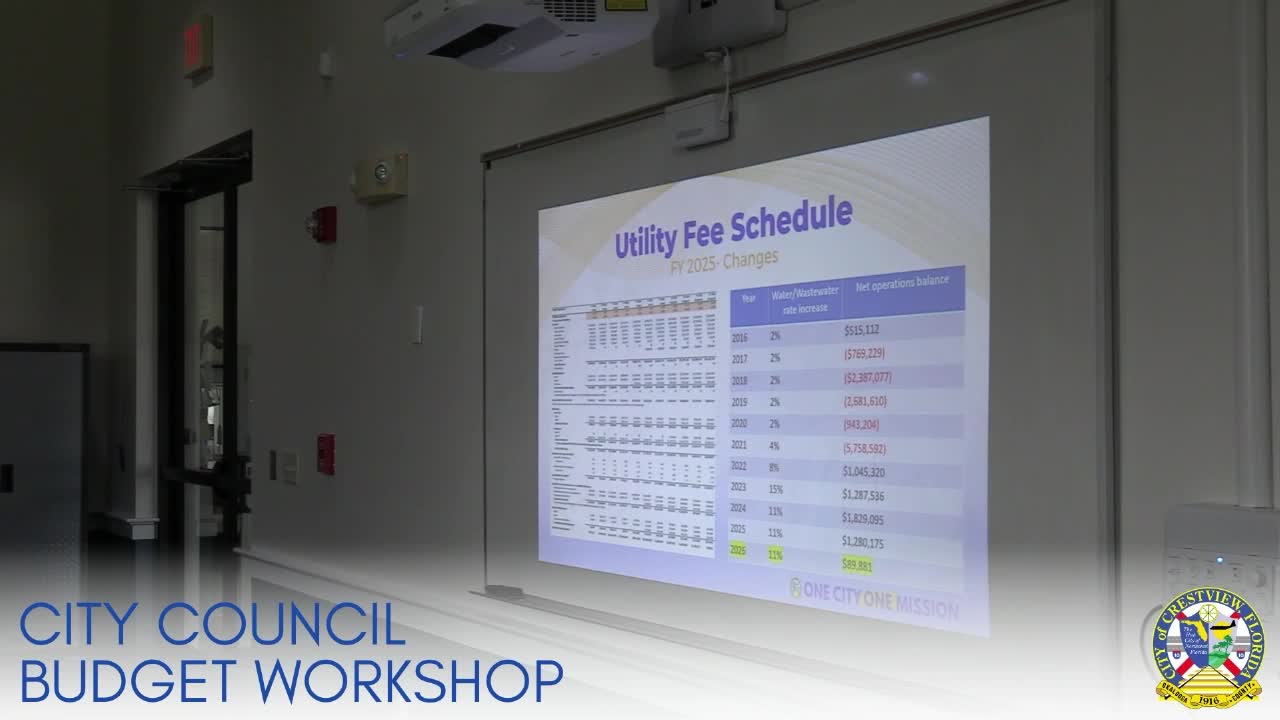
Crestview staff presented a 10-year utilities pro forma prepared by Jacobs Engineering projecting an 11% increase to keep water and sewer operations balanced; council members expressed concern about cumulative recent increases and requested a customer-bill example.
City of Crestview staff told the council the city's utility fund is on a multi‑year trajectory that may require rate increases to support operations and the capital program.
Jess (city staff) said the city provided Jacobs Engineering with an updated project list and is awaiting refreshed numbers; Jacobs' 10‑year pro forma prepared last year recommended an 11% increase to keep operations solvent. "Last year and this year, it was projected that we would need to go up 11% to keep operations in balance," Jess said.
Staff traced the trajectory of prior years' actions: a large 2022 recommended increase (staff negotiated a smaller increase and stretched financing), use of impact and tap fees in 2020–2021 to cover capital, and a phased approach to bond issuance and cost allocations. Finance staff confirmed the utility fund did not transfer its full administrative cost allocation to the general fund during heavy capital years; the study to reapply cost allocations was completed last year and is ready to be implemented when sustainability benchmarks are met.
Council concerns and requests Council members pressed for concrete, resident‑facing estimates. Councilman Bullard and others asked staff to present what an average residential bill would look like under an 11% increase and to itemize how utility, garbage and other line items contribute to the total bill. Council members noted that bills have already risen substantially in recent years and asked staff to show the bond amortization curve (how increases fall as debt is paid down).
Why it matters Utilities operate as a user‑fee fund; insufficient rates can force transfers from the general fund (property tax revenue) or deferred maintenance. Staff said the 11% figure is a working projection from last year's study and that Jacobs will provide updated numbers for council review in July.
Clarifying technical points - The utility study covers combined water, sewer and solid‑waste package rates rather than a single service in isolation. - Staff said a 2020–2021 negative operating balance was covered by impact fees and tap fees to sustain construction projects; the city then adopted phased rate increases and bond issuance to spread costs. - Examples given: the cost of a water tower built in 2020 rose substantially by 2024; a current water tower under construction is roughly $5 million, illustrating material cost inflation in capital items.
Next steps Staff will supply Jacobs' updated pro forma and customer-bill examples at the next meeting, show the debt-service curve and clarify which operating costs (including cost allocation to the general fund) would change under different rate scenarios.