Get Full Government Meeting Transcripts, Videos, & Alerts Forever!
Get email alerts on the Antisemitism topic
No spam. Unsubscribe anytime.
Weston parents and students demand action after third antisemitic vandalism; board to review action plan in April
Summary
Dozens of Weston residents pressed the Weston Board of Education on March 17 after a third swastika was found this school year. The board chair waived time limits for public comment and the superintendent pledged to present a district action plan at the April meeting.
Dozens of parents, students and community members told the Weston Board of Education on Monday, March 17, that repeated antisemitic vandalism in district schools requires faster, clearer and tougher action.
At the meeting, community speakers said this year’s third appearance of a swastika — following incidents at the high school last fall and the middle school in January — has left Jewish students and families afraid and calling for accountability, improved investigations and clearer communication from district leaders.
The black-clad audience asked the board for multiple remedies: a districtwide action plan with timelines and measurable goals, stronger and consistently applied disciplinary consequences, an anonymous tip line for reporting, clearer transparency about investigations and consideration of outside investigators. Several speakers urged the board to involve the Anti-Defamation League’s resources beyond the No Place for Hate curriculum to include targeted education about antisemitism and history.
Maria Robotham, who identified herself as representing the four parent-teacher organizations in Weston, said the PTOs “stand united” and requested a comprehensive plan with “concrete steps, clear and actionable timelines, and measurable goals.” Naomi Richardson, a former student who served on the district’s DEI committee, said the pattern of incidents reflects “an institutional problem” and urged “double down” responses rather than repeated short-term remedies. Other commentators asked whether the district has considered rewards for tips, the involvement of detectives beyond the school resource officer, and small-group discussions rather than assemblies alone to teach students about impact and accountability.
Superintendent Lisa Barbiero acknowledged the community’s pain and said the district has policies that address hate-based conduct, bullying and nondiscrimination and that administrators follow established investigation protocols. Barbiero said administrators conduct interviews, perform threat assessments and involve police as needed; students found responsible are subject to discipline “up to and including suspension or expulsion,” and the district pursues restorative practices aimed at accountability and repairing harm. She said the district is working with the Anti-Defamation League on the No Place for Hate initiative, that community leaders including Rabbi Michael Friedman have been engaged, and that the district will present an action plan at the board’s April meeting.
Barbiero also said some staff professional learning is already underway: “Two high school teachers went this month. There are five people going at the end of the month to continue this work and to continue the educational and professional learning we need.” She asked for continued partnership with families, and she declined requests to publicize the names of minors who might be responsible for incidents, saying she would not “publicly shame children aged 3 to 19.”
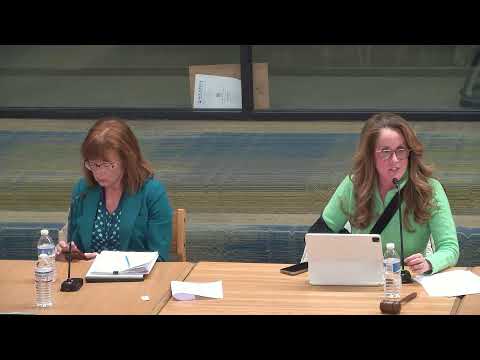
The board chair, Sharon (Board chair), made two procedural motions before public comment: to extend the board’s usual 20-minute-per-topic limit for the evening, and to move the superintendent’s district update to follow public comment so the community could hear administration responses. Both motions passed on voice votes.
Speakers across decades of experience with the district said earlier responses have been insufficient. Several callers described classroom or staff incidents in prior years where they felt antisemitic remarks were downplayed, and at least one former student said the pattern of brief responses followed by inaction stretches back more than a decade. Multiple speakers asked whether the district would commission an external review or independent investigation; several also recommended installing or publicizing an anonymous tip line so students or community members could report threats or vandalism.
Neighborhood parents pressed for immediate deterrence — including stronger school discipline, restrictions on student activities, and, in extreme comments, public naming and permanent records to create consequences later in life — while other speakers urged supportive, educational approaches matched with accountability. Multiple parents said their children now fear going to school or use alternate names or avoid visible religious symbols to protect themselves.
What’s next: The board will hear an action plan from Superintendent Lisa Barbiero at its April meeting; Barbiero said the plan will be reviewed in that session. The district’s ongoing collaboration with the Anti-Defamation League, scheduled parent programming led by Rabbi Michael Friedman on April 9, and additional staff training were presented as immediate steps already underway.
Ending: Community members left the meeting asking the board to make the response to each future incident more transparent and to ensure the April plan includes timelines, measurable goals and clarity about investigation protocols.