Get Full Government Meeting Transcripts, Videos, & Alerts Forever!
Get email alerts on the Environmental Health topic
No spam. Unsubscribe anytime.
Resident urges commissioners to reject Steamboat Landing Phase 2 environmental report over contamination concerns
Summary
At the Jan. 14 Flathead County Commissioners meeting a resident, Sandy Graham, urged rejection of a Phase 2 environmental site assessment for the Steamboat Landing development, citing alleged sampling errors, Superfund-area testing, and vapor-intrusion risks.
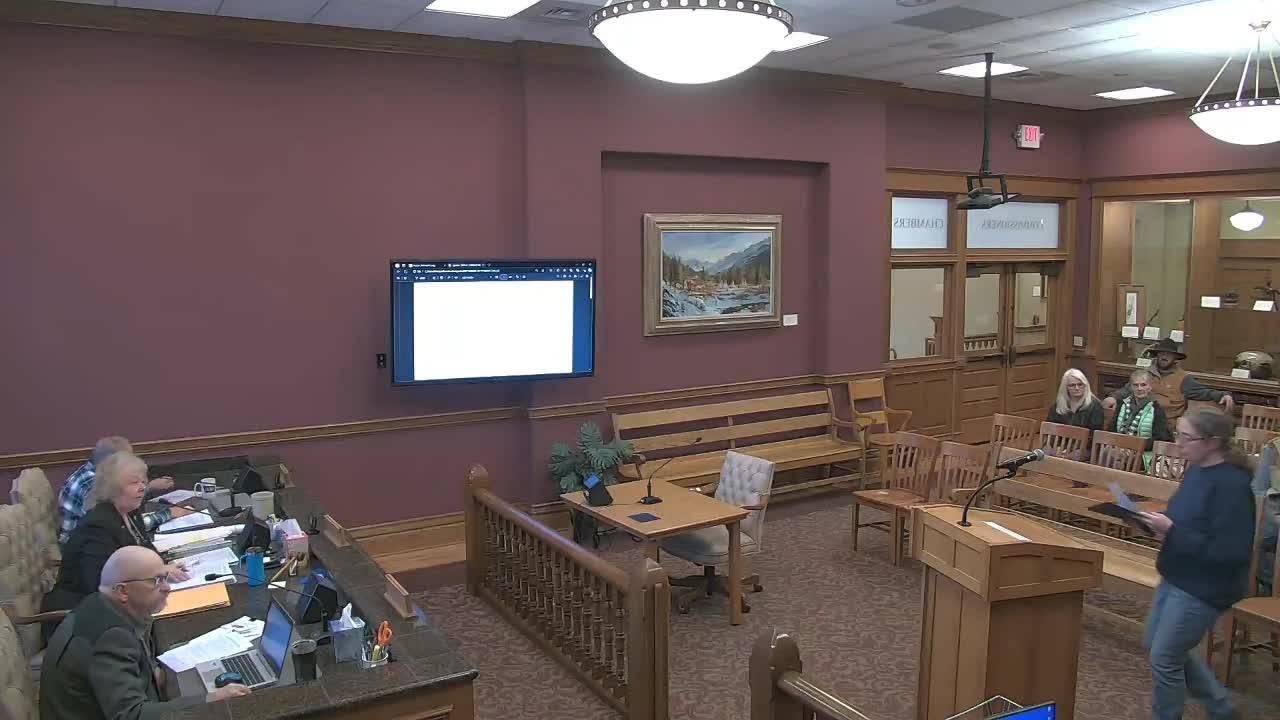
Sandy Graham, a resident of 559 Summers Road, told the Flathead County commissioners on Jan. 14 that the Phase 2 environmental site assessment (ESA) for the Steamboat Landing development contains "misinformation" and should be rejected as new evidence.
Graham said the Phase 2 ESA reported that test pits encountered an observed groundwater table at about 5 feet below ground surface. She said a Department of Environmental Quality official identified in her remarks as "Sloan" told her the minimum depth of the alluvial upper groundwater aquifer is roughly 40 feet below ground surface, and that water found at 5 feet likely represented surface water from a nearby slough rather than groundwater. "The phase 2 ESA states, quote, the last test pits were evaluated to an observed groundwater table, which was encountered at approximately 5 feet below ground surface," Graham said.
Graham told commissioners she submitted photos on Dec. 12, 2024, showing heavy equipment digging shallow open pits and their proximity to the slough; she said those pits could have been filled by surface water from the slough. She also told the panel she had provided BNSF Superfund Site surface-water testing results from 2017–2023 and said either the developer’s consultants did not test for contaminants or they produced a report that did not identify site contamination. "Per the United States EPA website, research suggests that adverse health effects are most likely to occur within 1.8 miles of a Superfund site," she told the commissioners.
Graham cited text from the BNSF five-year review that discusses off-site residential exposure inside the controlled groundwater area, including risks from drinking contaminated groundwater, dermal contact during household use, and vapor intrusion. She warned that heavy equipment operations could change ground temperature and increase volatilization of benzene and naphthalene, creating a pathway for vapor intrusion into nearby homes. "I urge you to reject the Phase 2 ESA as new evidence," Graham said, and to require sampling of the upper alluvial aquifer using proper methods before allowing houses to be built on the property.
The speaker provided specific reports and photographs to the public record during her remarks; commissioners did not take formal action on the matter during the meeting. At the start of the public-comment period the chair had reminded attendees that the commissioners were "here to listen, not necessarily have answers for you this morning."