Get Full Government Meeting Transcripts, Videos, & Alerts Forever!
Get email alerts on the Education topic
No spam. Unsubscribe anytime.
Sponsor, advocates urge 'bell-to-bell' ban on personal devices in classrooms at first hearing
Summary
Senate Bill 158 drew sponsor testimony and proponent witnesses advocating a statewide ban on personal electronic devices during the instructional day, while committee members asked about local control and carve-outs for instruction and safety.
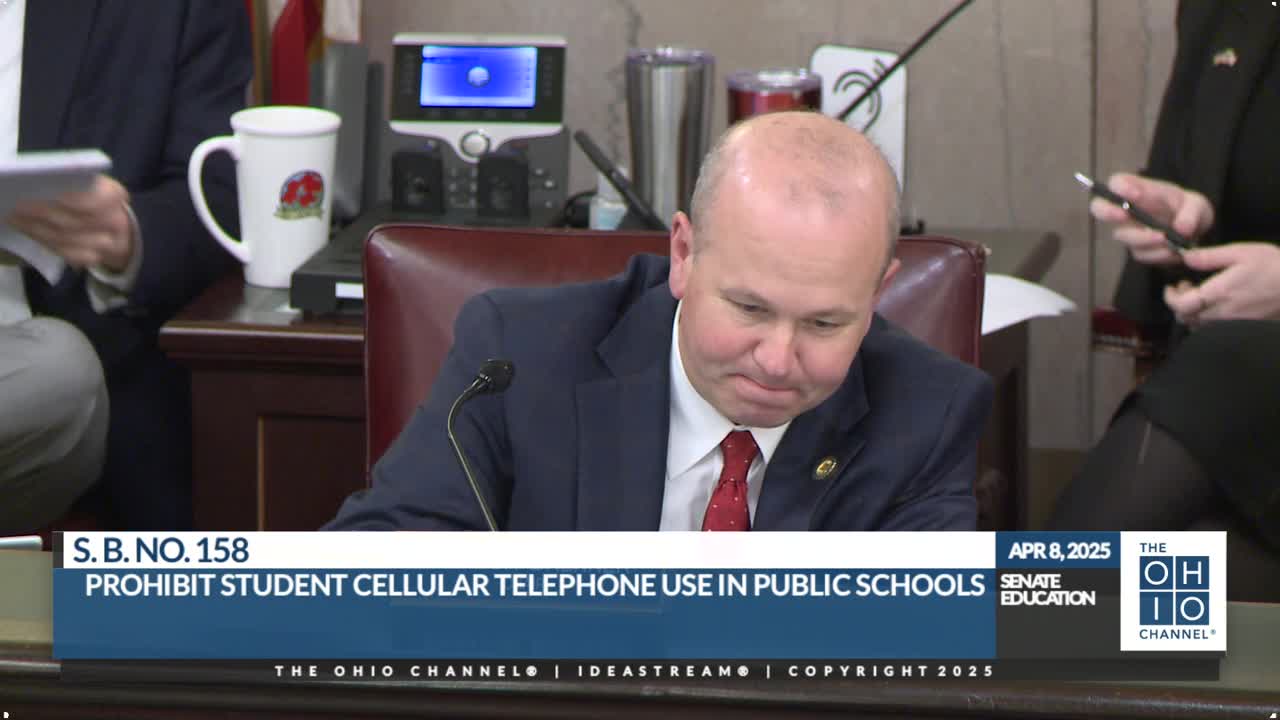
Senate Bill 158, introduced by Senator Timken, received its first hearing in the Senate Education Committee with sponsor testimony and proponent witnesses urging a statewide “bell-to-bell” prohibition on personal electronic devices during the instructional day.
Senator Timken told the committee that modern smartphones and social media have increased distractions in classrooms and said the bill is a “common sense approach to unplug our children” so they can focus on instruction and social interaction. "It will reduce the distractions from instruction and facilitate the building of in person relationships," Timken said in sponsor testimony.
Christine Venise, chief executive officer of Unite for Safe Social Media, testified in support and described research the group cites showing stronger academic outcomes in schools with full-day device bans. Venise said the bill would extend beyond cell phones to other personal internet-connected devices such as smartwatches and tablets, and she cited sources including teacher surveys, the Anxious Generation research, and organizations such as the National Education Association and the American Psychological Association to support claims about distraction and student mental health.
Committee members raised questions about local control and classroom use of phones for instruction. Ranking Member Ingram said many districts already use restrictive policies, noting examples such as pouches that store phones until the end of the day, and asked why a state law is necessary rather than leaving decisions to superintendents. Senator Smith asked for data on the share of districts that have adopted similar bans and whether outright prohibition could limit instructional uses in courses like computer science.
Senator Timken and witnesses said the bill contains carve-outs for student health and individualized education plan (IEP) or Section 504 needs; the committee also clarified the bill does not restrict school-issued devices or district-provided Chromebooks and is specific to personal devices. Venise and others said school resource officers and safety organizations advise against student device use during emergencies because devices can cause distraction or spread false information.
No formal committee vote was recorded on SB 158 at the first hearing. Committee members requested additional proponent and stakeholder testimony, and the chair noted written testimony from Superintendent Marshhausen of Dublin was available on the committee iPads.