Get Full Government Meeting Transcripts, Videos, & Alerts Forever!
Get email alerts on the Energy Regulation topic
No spam. Unsubscribe anytime.
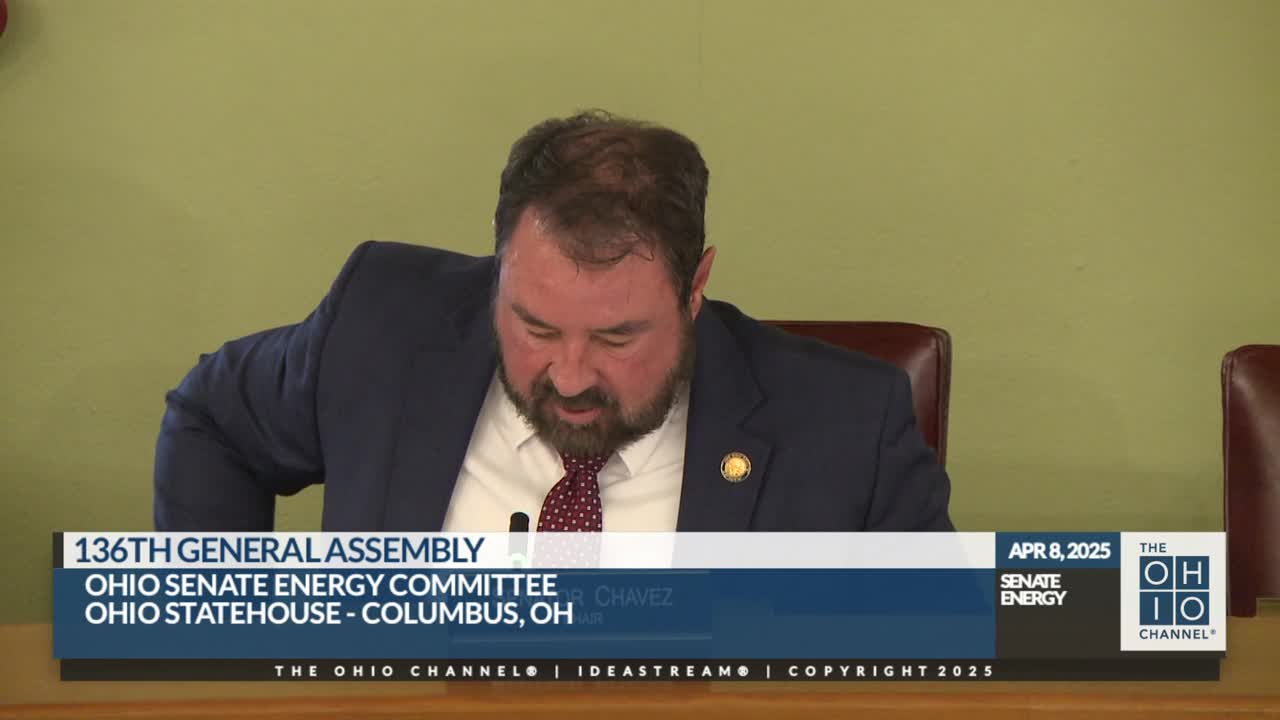
Senate Energy Committee holds first hearing on substitute House Bill 15 to revise Ohio rate-making, transmission siting and tax rules
Summary
Representative Klopfenstein, the bill sponsor, told the Senate Energy Committee the aim of substitute House Bill 15 is to “modernize this structure” that governs Ohio electricity regulation and to ensure “reliable, affordable, and available energy for all Ohioans.”
Representative Klopfenstein, the bill sponsor, told the Senate Energy Committee the aim of substitute House Bill 15 is to “modernize this structure” that governs Ohio electricity regulation and to ensure “reliable, affordable, and available energy for all Ohioans.” The committee held the first hearing on the substitute bill and heard proponent, opponent and interested-party testimony but took no formal action.
House Bill 15 would rewrite large parts of Ohio utility law, including rate-making procedures, Ohio Power Siting Board (OPSB) jurisdiction, tax treatment of new generation and transmission, and several consumer- and utility-facing processes. The bill would: create a shot clock and new deadlines for Public Utilities Commission of Ohio (PUCO) proceedings; permit multi-year rate plans with annual true-ups; prohibit electric distribution utilities (EDUs) from bidding into wholesale markets with assets paid for by distribution customers; reduce the tangible personal property (TPP) tax on new generation and related equipment; expand OPSB review to lower-voltage transmission projects; repeal an OVEC rider; require quarterly capacity “heat maps” from EDUs and an annual statewide reliability report; and establish a community energy pilot and expanded eligibility for brownfield remediation funds for generation projects.
Why it matters: Sponsors said Ohio faces rising demand — including data center growth — and that the 1999 regulatory framework needs updating. Representative Klopfenstein cited a projected need of 5,000 megawatts (as spoken in testimony) and argued the bill would enable dispatchable generation and other measures to avoid future shortages. Supporters said the bill brings oversight to transmission spending and modernizes rate-making; opponents warned that some provisions risk retroactive impairment of contracts, could raise costs or regulatory conflict with federal authorities, and that refund language could reduce consumer access to refunds.
Major provisions described at the hearing
- Rate-making and PUCO shot clocks: The bill would set statutory shot clocks for rate cases and require staff reports within defined periods; it would authorize multi-year rate plans with a forecasted test year and annual true-ups. Representative Klopfenstein described a structure that would allow utilities to propose changes “for up to 3 consecutive 12 month periods with an annual true up process.” Proponents and utilities generally supported modernization but urged clearer language on the true-up process and a shot clock on true-up proceedings. Maureen Willis, director of the Ohio Consumers' Council, urged stronger statutory protections for true-ups, transparent discovery rights and independent third‑party audits for reconciliations: “Please don't make it harder than it already is to get refunds for consumers,” she said.
- Refund timing and consumer protections: The bill includes a limitation that refunds would be issued from the date a court rules rates unlawful rather than from the date the rates were first collected, language several witnesses said could narrow current refund practice. OCC warned the change might preclude existing refund remedies where PUCO placed tariff language making charges “subject to refund.” Several witnesses asked the committee to preserve an effective mechanism for refunds and to clarify the scope of refunds tied to PUCO orders and court remands.
- Taxes and economic development incentives: Representative Klopfenstein described reductions in the tangible personal property tax — from 25% to 7% for new generation and energy conversion equipment, and a reduction for transmission, distribution and pipeline infrastructure from 88% to 25% beginning in tax year 2027 — plus a 5‑year TPP tax exemption for transmission projects designated as priority investment areas by the Department of Development (as summarized in testimony).
- OPSB jurisdiction and transmission oversight: The bill would expand OPSB review of transmission projects to lower voltage thresholds (testimony referenced a change from 100 kV to 60 kV) and create expedited review paths in some circumstances. Proponents including the Ohio Energy Leadership Council argued that projects in the 69 kV range have previously received little state oversight while costing Ohio ratepayers billions; David Porano called the jurisdictional change “a very reasonable reform” to provide more oversight of transmission spending. Utilities warned expanded state siting or review could conflict with Federal Energy Regulatory Commission (FERC) and PJM rules and might slow necessary projects.
- OVEC rider and legacy generation: The bill would repeal the OVEC rider immediately on the bill's effective date and revive an audit process for legacy generation riders. Supporters argued Ohioans have paid large sums under the OVEC arrangements; Kim Boiko (representing the Ohio Manufacturers Association) testified repeal would save customers “hundreds of millions of dollars.” Utilities asked for transition or recovery of costs already deferred under current law, with AEP Ohio’s representative estimating unrecovered costs could be in the tens of millions.
- Behind‑the‑meter generation and community energy pilots: The substitute bill would limit or eliminate EDU ownership of behind‑the‑meter generation and create a community energy pilot program. Utilities urged either grandfathering of projects filed under current law or explicit transition language; AEP Ohio asked for grandfathering to avoid retroactive impairments for contracts already pending at PUCO.
- Heat maps, data and reliability reporting: HB 15 would require EDUs to publish capacity heat maps at least quarterly and require PUCO to run annual stakeholder meetings on map design and produce an annual statewide reliability report. Manufacturers and economic development proponents said heat maps would aid siting decisions for large customers.
- Demand response and alternative options: Environmental and consumer groups urged adding residential and small‑commercial demand response programs to the bill so utilities can bid additional load reduction into PJM; the Environmental Law & Policy Center cited potential near‑term capacity savings that could be delivered more quickly than building new generation.
Positions and points of disagreement
- Consumer advocates: Maureen Willis (Ohio Consumers' Council) supported many reforms but pressed for a clearer true‑up, open discovery, independent audits and preservation of refund remedies. She warned the bill’s refund language, as written, could curtail existing refund practices.
- Utilities: Chris Holland (senior counsel, AES Ohio) and Steve Nourse (AEP Ohio) both said they supported modernization in principle but sought clearer true‑up timelines, grandfathering for projects filed under existing law, and limits on provisions that could duplicate or conflict with FERC or PJM jurisdiction. AEP stressed the need to avoid unlawful retroactive impairment of contracts.
- Manufacturers and large energy users: Kim Boiko (Ohio Manufacturers Association) and David Porano (Ohio Energy Leadership Council) supported repeal of certain subsidies, urged retaining reforms that increase oversight of transmission spending, and requested tweaks to the multi‑year rate provisions to protect predictability for large customers.
- Environmental groups and local advocates: Robert Kelter (Environmental Law & Policy Center) supported the bill overall and recommended adding residential/small commercial demand response to reduce peak load quickly; Kathy Cowan Becker (citizen) urged retention of community energy pilot language and longer OPSB accelerated review timelines for local notice.
What the hearing did not do
The committee held a hearing and received testimony but did not vote on the bill or adopt amendments. Several witnesses called for statutory clarifications — especially on true‑ups, refund timing and grandfathering language — and for alignment where the bill might intersect with federal jurisdiction.
Next steps
This was the first Senate hearing on the substitute House Bill 15. Committee members and stakeholders repeatedly asked for clarifying language on true‑ups and refunds, for concrete grandfathering language for projects already pending at PUCO, and for resolution of potential conflicts with federal jurisdiction. The bill will proceed through the committee process; sponsors and witnesses signaled a willingness to work further on drafting fixes before any final action.