Get Full Government Meeting Transcripts, Videos, & Alerts Forever!
Get email alerts on the Health Insurance Ag Plans topic
No spam. Unsubscribe anytime.
Committee advances bill to let farm bureau offer health plans exempt from state insurance rules
Summary
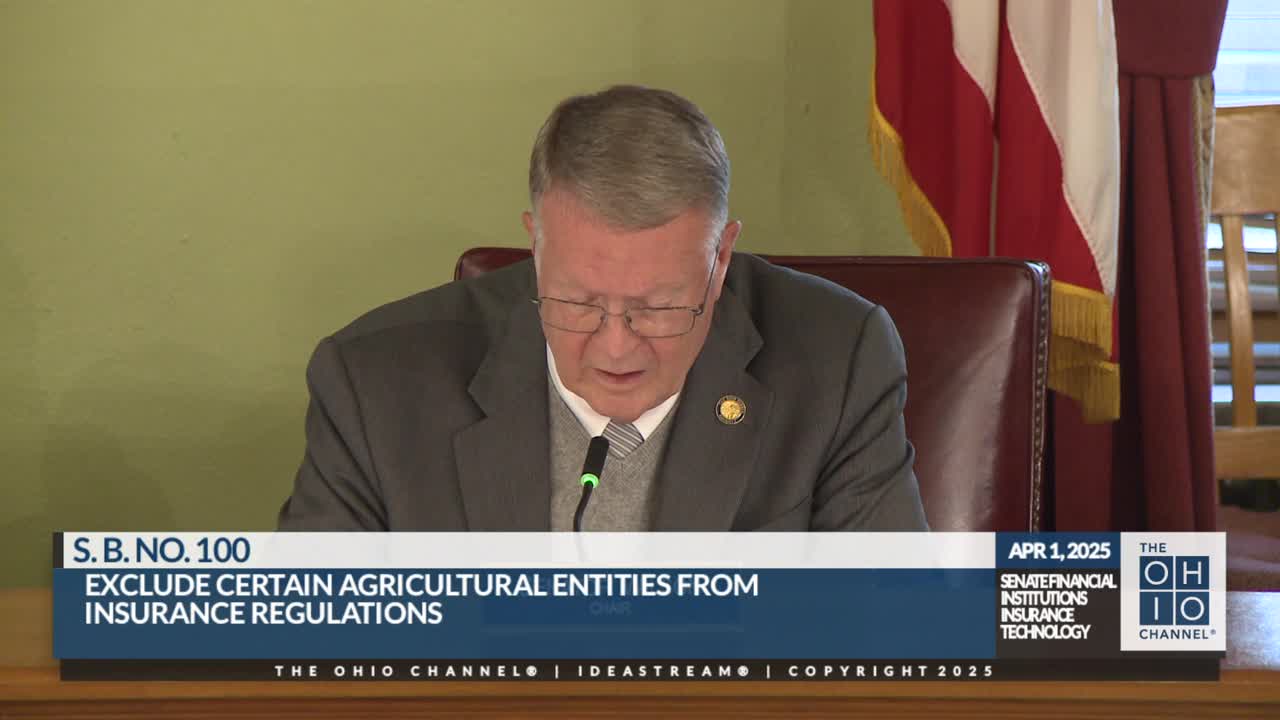
The Ohio Senate Financial Institutions, Insurance and Technology Committee unanimously adopted an amendment and favorably reported amended Senate Bill 100 to the committee on rules and reference after proponent testimony from the Ohio Farm Bureau.
The Ohio Senate Financial Institutions, Insurance and Technology Committee voted unanimously to favorably report amended Senate Bill 100 to the committee on rules and reference after hearing proponent testimony and adopting amendment 0348.
The bill, as amended, would exempt health care benefit coverage provided by a nonprofit agricultural membership organization from certain state insurance laws, require written disclosures that the coverage is not insurance, and add references to the Physician Health Plan Partnership Act and the law governing multiple employer welfare arrangements to the list of state insurance laws from which the coverage is exempt.
Rose Hartshoe, a member of the Ohio Farm Bureau Board of Trustees and a Northwest Ohio dairy farmer, testified in support of the bill. “We will now come to order...,” she opened her testimony and later asked the committee to “imagine a world with no farmers. What would you eat? What would you wear?” She said she represents farmers in 24 Northwest Ohio counties and described her family’s experience moving from employer-sponsored coverage to the health insurance marketplace after both she and her husband became full-time self-employed farmers.
Hartshoe told the committee she had studied the Tennessee Farm Bureau plans and found their coverage, networks and premiums comparable to her family’s current plan, and said her organization does not intend to implement lifetime coverage caps. “Options are always a good thing,” she said, urging the committee to allow agricultural membership organizations to offer an alternative for members who do not find a suitable option in the marketplace.
Senators adopted amendment 0348, which (1) specifies that health care benefit coverage provided by a nonprofit agricultural membership organization as defined by the Legislative Service Commission is exempt from specified state insurance laws; (2) prohibits such organizations from representing the coverage as insurance in written materials or verbal communications; (3) requires that applications and any contracts for coverage be in writing and prominently state that the coverage is not subject to state insurance law; and (4) adds explicit references to the Physician Health Plan Partnership Act and the law governing multiple employer welfare arrangements to the exemption list.
After adopting the amendment, Senator Chavez moved to favorably report the amended bill to the committee on rules and reference. The clerk called the roll, and Senators Craig, Blessing, Chavez, DeMorrow, Liston and Manning recorded yes votes. With a unanimous vote recorded on the roll call, the committee favorably reported amended Senate Bill 100 to the committee on rules and reference.
During testimony Hartshoe noted that the amended program likely would not benefit her own household because her family’s marketplace subsidy makes their existing plan less costly; she said that fact does not undercut the value of providing another option for other farmers and small-business owners. Hartshoe also told the committee that the Farm Bureau’s review of similar plans in Tennessee found no material coverage gaps and that the organization does not plan to include lifetime benefit caps in its offering.
The committee’s fourth hearing on the amended bill concluded after the favorable report. Members were directed to written testimony files on the committee’s official website; the clerk noted the committee had received five or six pieces of written-only testimony (the cover statement said four but the chair said five on the iPad notice).