Get Full Government Meeting Transcripts, Videos, & Alerts Forever!
Get email alerts on the Indigent Defense topic
No spam. Unsubscribe anytime.
Ohio Public Defender urges funding and statutory changes, proposes Northwest regional hub pilot
Summary
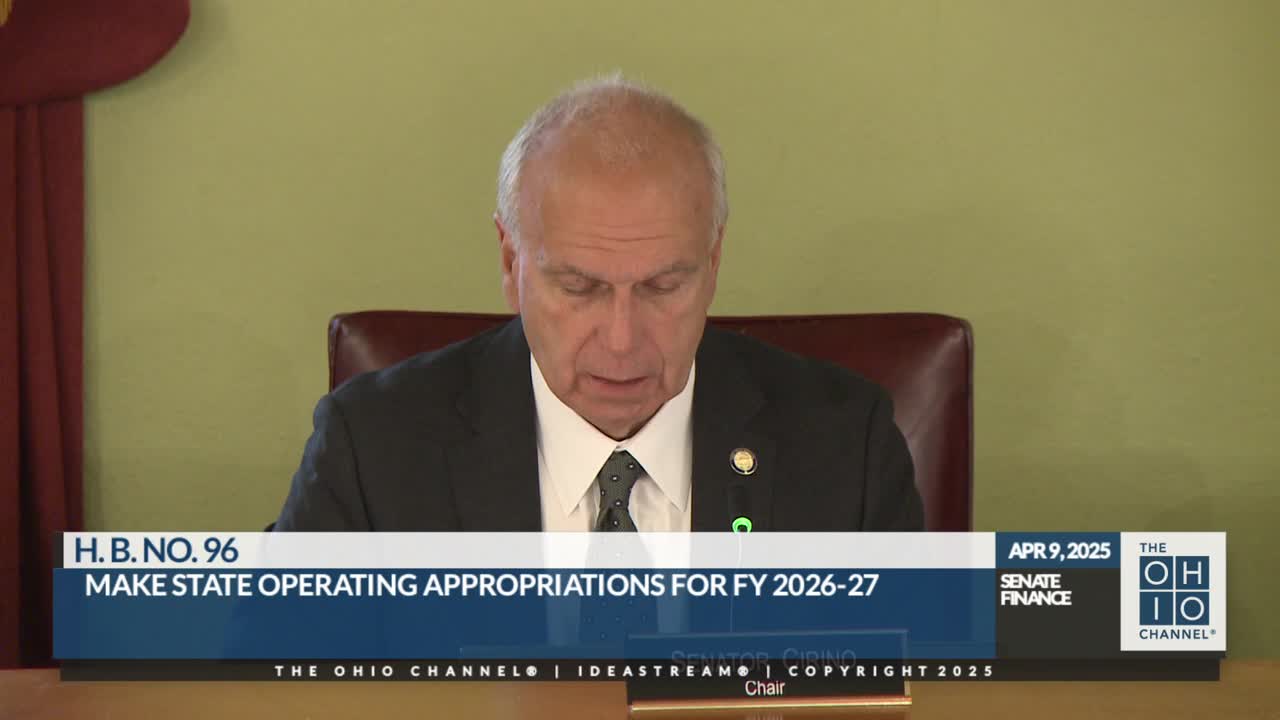
Ohio Public Defender Elizabeth Miller told the Senate Finance Committee that Sub House Bill 96 must preserve operating funds and statutory changes to support indigent defense, a new Northwest Regional Hub pilot and adjustments to hourly reimbursement caps to help rural counties recruit attorneys.
Elizabeth Miller, state public defender and head of the Ohio Public Defender (OPD), asked the Senate Finance Committee to preserve several elements of Sub House Bill 96 that support the state's indigent-defense system.
"We're small but mighty," Miller said of the OPD's roughly 200 employees spread across five offices. She outlined five budget components the agency administers: the central operating budget, multi-county branch office funding for contracted counties, the county reimbursement budget that reimburses all 88 counties for a portion of indigent-defense costs, a pass-through to the Ohio Access to Justice Foundation, and a new pilot model: the Northwest Regional Hub.
Miller said the executive budget includes $40,000,000 for OPD's operating budget over the biennium; she told senators that amount would cover about 84% of OPD payroll and that cuts to that line would mean staff reductions. The OPD also seeks continued reimbursements to counties: Sub House Bill 96 appropriates an additional $21,000,000 each fiscal year, which OPD projects would sustain county reimbursement rates in the high 80s to 90% if monthly submissions remain between $19 million and $21 million.
Miller described the Northwest Regional Hub pilot: Allen County would host a primary office serving Allen, Putnam and Hardin counties. The model combines an OPD-staffed public defender office with court-appointed counsel for at least 20% of cases, shared administrative services, and cross-county coverage for dockets. Miller said the hub is supported by stakeholders including the Ohio State Bar Association, county commissioners and the Access to Justice Foundation.
On compensation for appointed counsel, Miller highlighted a statutory cap that affects reimbursement. State law sets the standard appointed-counsel reimbursement at $75 per hour for regular cases and $140 per hour for death cases. Miller said rural counties that raise rates above $75 to attract counsel cannot always be reimbursed for the overage. She asked the committee to remove or modify the statutory cap to treat underserved counties equitably.
Miller also said the OPD is seeing growth in hearings for supervised-release violations, from about 200 hearings in 2012 to more than 1,200 currently, and asked statutory authority to contract with private counsel to meet the demand using existing reimbursement funds. The OPD also supports a statewide performance audit by the state auditor and said it would provide a written supplement on the number of programs and grant recipients when the committee requested more detail.
Ending: Miller and OPD staff, including access-to-justice partners, said they would provide written follow-up on application counts and metrics and requested that the committee maintain funding levels in Sub House Bill 96 for the operational budget, the reimbursement line and the Northwest Hub pilot.