Get Full Government Meeting Transcripts, Videos, & Alerts Forever!
Get email alerts on the Judiciary Budget topic
No spam. Unsubscribe anytime.
Supreme Court officials outline budget makeup, push technology and rural access priorities
Summary
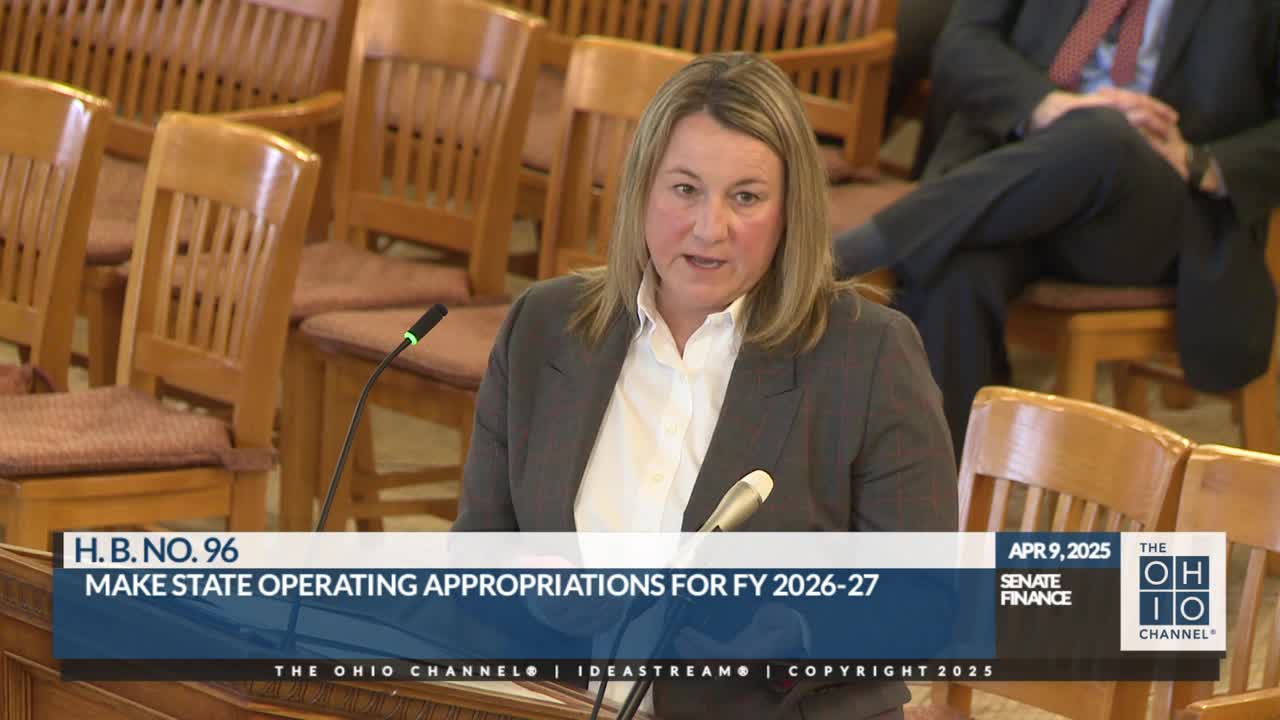
Robert Horner, administrative director of the Supreme Court of Ohio, told the Senate Finance Committee that 72% of the court's requested budget is statutorily mandated for judges and appellate staff.
Robert Horner, administrative director of the Supreme Court of Ohio, told the Senate Finance Committee that the largest portions of the court's budget are legally required. "As you may note, the largest portion of this budget, 54% of the budget, is compensation that is already statutorily required with respect to the payment of Ohio's judges," Horner said, adding that another 18% is for courts of appeals employees, bringing mandated spending to 72% of the court's overall request.
Horner and court staff emphasized three nonmandated priorities supported by the remainder of the budget: modernizing court technology, strengthening judiciary education and expanding access to legal services. He described the Ohio Courts Network (OCN) as a centralized data warehouse that connects courts statewide and noted that about 99% of Ohio courts are connected and typically upload case information daily. "The technology grants that are administered by the, Ohio Supreme Court are very important use of relevant technology and a crucial step for modernizing Ohio's courts," Horner said.
Stephanie Nelson, director of court services, described on-the-ground uses for technology grants, including e-filing and case-management systems. Rhonda Carver, the court's chief financial officer, told senators the court fields far more technology grant applications than it can fund. Carver said the court typically receives $8 million to $12 million in requests and funds roughly $2.8 million to $3.0 million from its tech-grant pool.
The court's civic-education and access efforts were also highlighted. Horner noted the court's "rural practice incentive" partnerships with the Department of Higher Education to promote lawyers in counties with too few attorneys, and called the court's twice-yearly off-site oral-argument programs a civic-education tool for schoolchildren.
Senators asked about specific line items and results. Ranking Member Hicks Hudson pressed the court on a reduced civil-justice grant line and its potential impact; the court said it would supply county- and program-level details in written testimony. Sen. Manning and others asked about judge salary comparisons and the court's role in analyzing caseloads for potential reallocation of judgeships; Rhonda Carver said Ohio common-pleas judges ranked 44th of 50 states by raw salary but about 29th when adjusted for cost of living.
On appellate redistricting and judicial assignments, Horner described the court's role as data provider rather than initiator of redistricting. He said the court maintains case statistics and the OCN portal to support nonpartisan analyses, and explained that judicial assignments are made by the chief justice using structured criteria such as geographic proximity and case-specific needs. Horner said he was unaware of political affiliation being used as a criterion for visiting-judge assignments.
Senators also asked the court about the criminal-sentencing commission budget changes and public-records exemptions; the court deferred detailed answers to the sentencing commission director and noted it was not the author of the recent public-records changes in the House bill.
Ending: Horner closed by noting the court's written testimony was on record and staff (including finance and legislative counsel) were available to supply supplemental data requested by senators.