Get Full Government Meeting Transcripts, Videos, & Alerts Forever!
Get email alerts on the School Budget Override topic
No spam. Unsubscribe anytime.
Milton Public Schools outlines FY26 budget, warns of program cuts if override fails
Summary
Milton Public Schools presented a FY26 'level-service' budget that would require a $5.7 million allocation from the town override; officials said a $700,000 reduction from the district's ask will force program and staff reductions and that using one-time funds to cover deficits would create multiyear risks.
Milton Public Schools leaders outlined the district's fiscal picture and possible program reductions in a neighborhood information session, saying the school allocation in the town's proposed override is $5.7 million and that, without voter approval, the district will implement staffing and program cuts next year.
"The mission of our district, of the Milton public schools, is to educate, challenge, and empower all students to be productive, caring, and contributing members of society," said Lizzie Carroll, chair of the Milton School Committee, opening the session and framing the budget discussion around student impact.
The district presented a FY26 "level-service" budget (the cost to maintain current services) that the team said would require an 8.4% increase to fully meet projected recurring costs. Mark Loring, School Committee finance chair, said the select board set the town-wide override at 9.5% and allocated $5.7 million to the schools, down from the district's original request of $6.4 million. "With the reduction in that amount, we will need to reduce programming, slightly to to accommodate for that $700,000 cut," Loring said.
Why it matters: district leaders said the reductions will affect programs, staffing and services that directly touch students and families. Dr. Peter Burrows, who presented the list of proposed non-override reductions, warned of operational and educational impacts: "Every 1 of these positions is essential to the operations of the district and to supporting students...there's just kind of no question that in in losing these positions...we're not we're not having the level of staffing that we need to support our students." He said the district tried to minimize direct student-side impacts but that sizable cuts will be noticeable.
Planned cuts and reallocations: district staff identified a set of program and position changes that would be needed if the override fails. Items the district said it plans to eliminate or reduce include the removal of one school bus added last year; elimination of a family liaison position; program reductions in the special security department (listed in materials as related to a "neck" program); reduced nursing support at one school; and increases in athletics fees. Leaders also described internal reallocations to fund priorities: funding a new English language arts (ELA) curriculum and adding 0.3 full-time equivalent (FTE) to support English language learners (ELLs). The district estimated those two additions total roughly $300,000 and said the net effect of the cuts and reallocations aligns with the $700,000 reduction from the district's original ask.
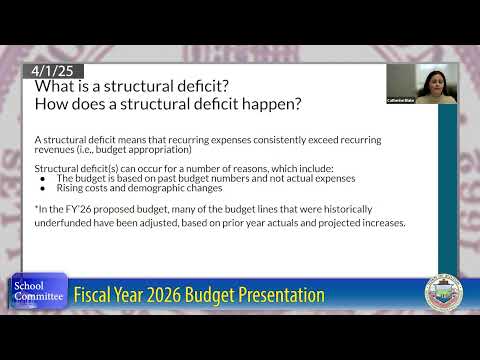
Budget history and structural deficit: staff described prior-year pressures that contributed to the situation. Katie Blake, who led the budget-history portion of the presentation, said the district closed FY24 using one-time sources and earlier in FY25 began projecting a deficit. "A structural deficit means that reoccurring expenses are consistently exceeding the reoccurring revenues or the budget appropriation," Blake said, explaining how recurring costs such as salaries, special-education placements, transportation and utilities can outrun recurring revenue. Blake said the district used special-education reimbursement (referred to in discussion as "circuit breaker" funds), Medicaid account balances and school revolving accounts to close the FY24 gap and that the FY25 deficit projection was raised publicly in January 2025.
Non-override (short-term) plan and multiyear risks: the presenters described a non-override budget option that relies heavily on one-time town "free cash" to blunt FY26 impacts. Loring and other presenters warned that using free cash is not sustainable and would likely force deeper cuts in FY27 and beyond. "So this is, gonna be kind of a multiyear devastation," Loring said, characterizing the longer-term outlook if no override passes.
Process changes and oversight steps: presenters described process improvements intended to reduce future budget surprises: reconciling year-end actuals against approved budgets in August; posting finance committee recordings on MATV's YouTube channel for transparency; bringing a third-party financial best-practices consultant to review town and school budgeting, HR and technology systems; and establishing a town-wide finance committee to coordinate Select Board, finance and school committee oversight across the fiscal year.
Per-pupil spending and efficiency context: the district shared the state's most recent (2023) per-pupil figures to frame spending. Officials said Milton's in-district per-pupil spending is lower than many peers and that Milton ranks around the 30th percentile statewide on spending. Presenters also showed a scatterplot comparing per-pupil spending to MCAS performance and said only three Massachusetts towns spend less than Milton while achieving higher performance on that combined metric.
Next steps and public engagement: the district said the presentation and recording would be posted online, and it scheduled another information session at the high school on April 7 at 6:30 p.m. Officials urged residents with questions to use the district's web page and the town's override FAQ and tax-calculator resources. They also noted an outside supporter group (referenced in the session as "Built in United") has a tax calculator for residents.
No formal votes were taken at the webinar; presenters answered submitted questions and encouraged attendance at upcoming school committee meetings and public forums for further comment and information.