Get Full Government Meeting Transcripts, Videos, & Alerts Forever!
Get email alerts on the Developmental Disabilities Funding topic
No spam. Unsubscribe anytime.
House committee advances $122.3 million DD supplemental with limits on parents-as-paid-caregivers set for later review
Summary
The Arizona House Appropriations Committee voted 11‑10 April 15 to advance House Bill 29‑45, a supplemental appropriation aimed at stopping shortfalls in the state’s Developmental Disabilities Medicaid program and at temporarily implementing federal limits on a parents‑as‑paid‑caregivers benefit.
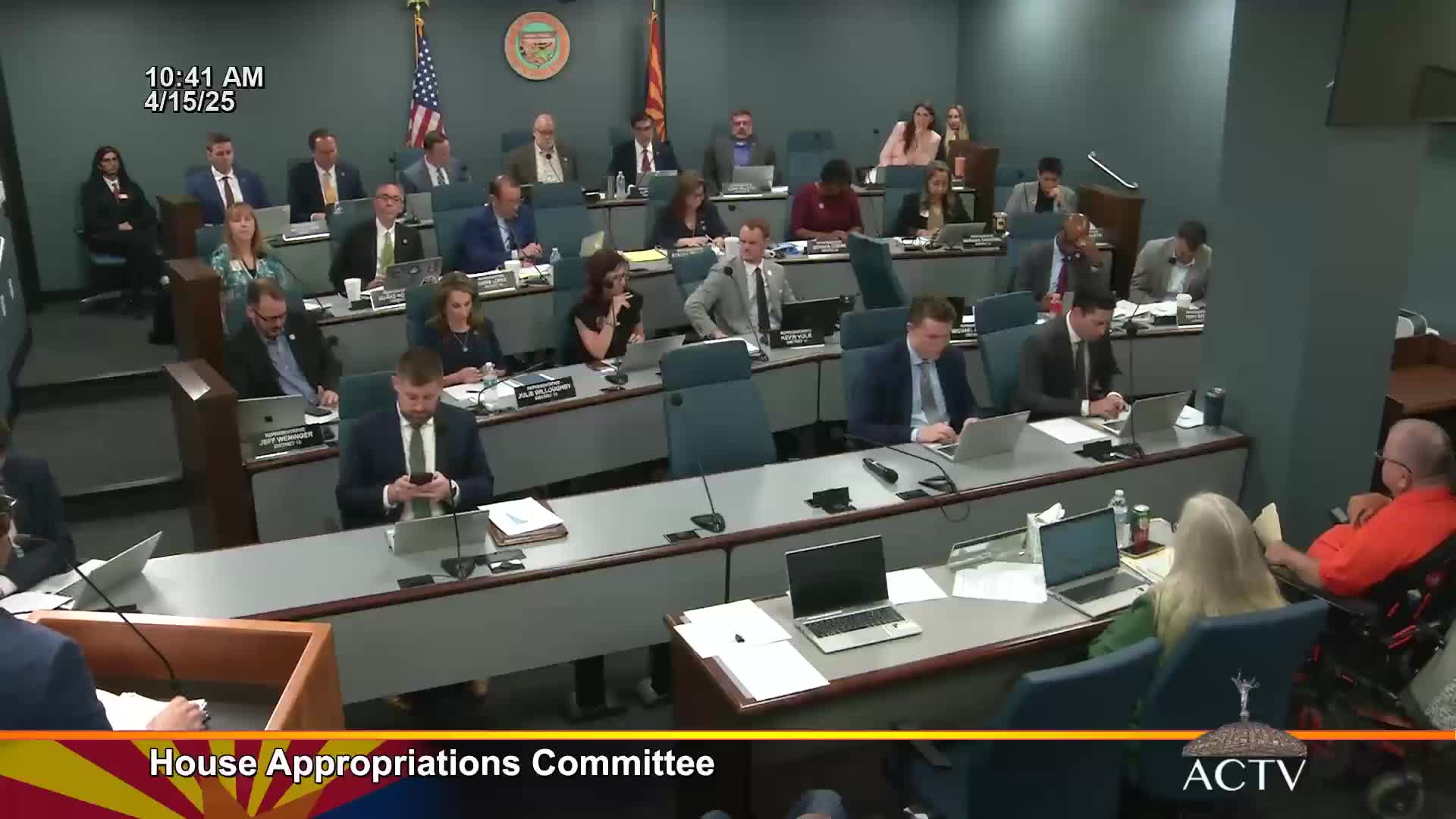
The Arizona House Appropriations Committee voted 11‑10 April 15 to give House Bill 29‑45 a due‑pass recommendation after multiple amendment votes and more than four hours of public testimony on funding and oversight of the state’s Developmental Disabilities (DDD) Medicaid program.
House Bill 29‑45 appropriates roughly $122.3 million in state funds and seeks additional Medicaid expenditure authority (about $403 million) for fiscal year 2025 to cover shortfalls in DDD, according to committee staff. The bill also directs implementation of a Centers for Medicare & Medicaid Services (CMS)‑approved 40‑hour weekly cap for the Parents as Paid Caregivers (PPCG) program by July 1, 2025 and requires a future waiver filing aimed at a 20‑hour cap; a committee amendment adopted during the hearing delays implementation of any 20‑hour cap until July 1, 2026 if CMS approves it.
Why it matters: Committee members and dozens of family members and providers testified that without an emergency supplemental, services for hundreds — potentially thousands — of Arizonans with developmental disabilities could be reduced or cut this fiscal year. Supporters said the bill buys time to negotiate longer‑term reforms; opponents said the bill lacks sufficient guardrails on PPCG and would codify policy changes introduced administratively without proper legislative review.
What the bill would do: Staff told the committee HB 29‑45 would appropriate about $122,300,300 from state sources and add roughly $402,981,400 in Medicaid expenditure authority for DDD in FY2025. The version presented to the committee used a mix of funding sources in different amendment drafts; committee staff summarized a funding split that included transfers from the Arizona Competes Fund, the Housing Trust Fund, and the prescription drug rebate fund. The bill also would require the director of the state budget office to report federal money receipts annually to the Joint Legislative Budget Committee staff.
Committee action and amendments: The committee considered four competing "strike‑everything" or partial amendments. A strike‑everything amendment offered by Representative Nancy Gutierrez that would have funded the supplemental entirely from the state general fund failed on a roll call vote (7 yes, 14 no). A subsequent Olson amendment that would have terminated the PPCG program in 2027 and moved funding sources also failed after a roll call.
Representative Julie Willoughby offered an amendment that would have moved some funding, required JLBC review rather than legislative preapproval for most waiver filings, and removed a statutory requirement that access obtain legislative approval for waiver requests; that amendment failed 10‑11. The committee adopted a Livingston amendment that clarified the bill’s intent on the timeline for a potential 20‑hour cap: if Access (the state Medicaid/managed‑care regulator) seeks a 20‑hour cap from CMS and CMS approves it, the 20‑hour cap would not take effect until July 1, 2026. The final vote on HB 29‑45 as amended was 11 yes, 10 no, giving the measure a due‑pass recommendation out of committee.
Key claims and committee discussion: Committee members and multiple witnesses — including provider representatives and family members — described rapid growth in certain DDD services, notably attendant care hours authorized under PPCG. Committee members said agency filings and communications show rapid and recent increases in authorized hours, which committee members tied to the need for a supplemental appropriation. Several witnesses warned that reducing in‑home or parent‑provided hours without an available direct‑care workforce would force families to seek more costly institutional or group‑home care.
Quotes from the hearing: • "All of the families that are in the DDD program are there lawfully and abided by Arizona state law to be in this program," Representative Nancy Gutierrez, amendment sponsor, told the committee in urging a clean supplemental. • "We need to pay our bills," Chair (Representative) Livingston said while explaining the committee’s objective to build a foundation for negotiation with the Senate and the governor. • "Lives are on the line here," Michelle Thorne, CEO of Care for the Caregivers, testified, describing increased calls to crisis hotlines and caregiver distress. • "If the supplemental funding isn't passed in time, we are going to impact all services for individuals who receive services today," Brandy Petron of the Arizona Association of Providers for People with Disabilities said.
Context and next steps: Committee members repeatedly urged executive‑branch officials to come to the negotiating table; staff and several members said they had sought but not received scheduled briefings from agency executives. The bill now proceeds to the House floor with a due‑pass recommendation and the adopted amendment clarifying the timing of any 20‑hour cap if CMS approves it. Committee members said they intend further negotiations — including a "committee of the whole" amendment and discussions with the Senate and the executive — before final passage to reconcile funding sources and guardrails.
Public testimony: More than two dozen people signed in to testify. Family members described complex medical and behavioral care needs that they said would be disrupted by funding lapses; several parents and providers testified that a shortage of direct‑care workers already exists in rural and urban areas.
Unresolved issues: Committee members and multiple witnesses requested clearer, itemized reporting from agencies on how recent program expansions were implemented and which fund balances or encumbrances changed since January. Several members asked for more detailed actuarial information on capitation and federal‑matching implications before legislative changes to waiver processes or capitation rules.
The committee’s recommendation does not finalize policy changes; it forwards HB 29‑45 as amended to the House for further consideration and possible floor amendment and to matching Senate action so the three bodies can negotiate a final, signed package.
Ending: With the committee’s vote, lawmakers said they had a narrow window to negotiate technical and policy fixes with the governor’s office and the Senate before the next fiscal deadlines; supporters and opponents signaled continuing talks in the coming weeks.