Get Full Government Meeting Transcripts, Videos, & Alerts Forever!
Get email alerts on the Bridge Project topic
No spam. Unsubscribe anytime.
DOTD: NEPA field work advancing on proposed bridge; landowners urge rejection of E‑11‑4 alternative
Summary
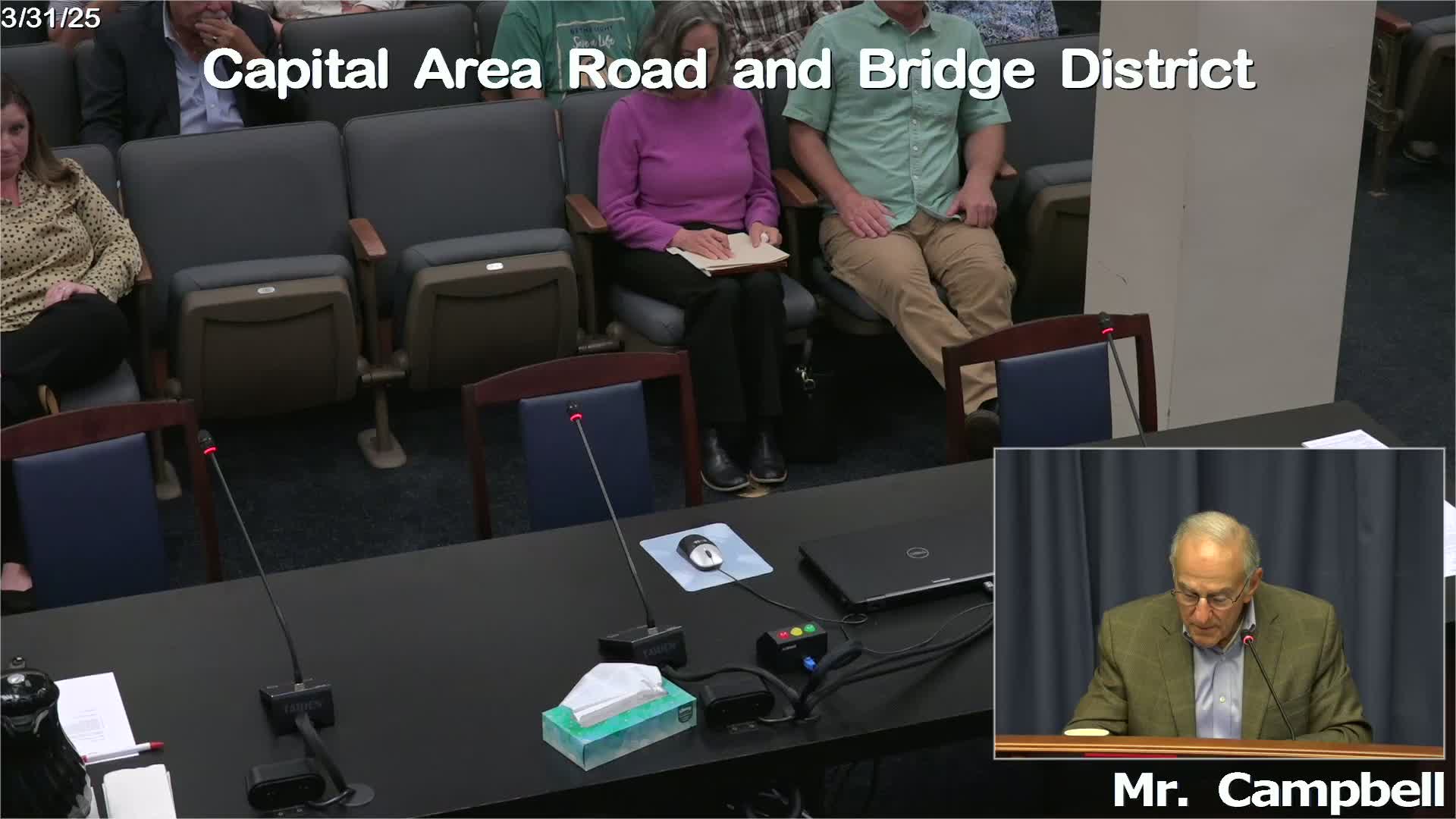
Jay Campbell, chair of the Capital Area Road and Bridge District, presided as Louisiana Department of Transportation and Development project staff and the project consultant updated the district on the status of the proposed bridge project and the NEPA process.
Jay Campbell, chair of the Capital Area Road and Bridge District, presided as Louisiana Department of Transportation and Development project staff and the project consultant updated the district on the status of the proposed bridge project and the NEPA process.
Christina Bridal, DOTD project manager, told the district the pre‑NEPA and NEPA field work is complete and that DOTD expects to submit a final geotechnical report within about two weeks, followed by bridge conceptual design, cost estimates and a hydraulics and hydrology analysis. "The traffic submittals are under review at DOTD and the tolling analysis is being finalized," she said, and the phase 1 environmental site assessment is under review at DOTD.
The consultant for Atlas Technical said those studies and analyses will be packaged and presented for all three build alternatives at the public meetings. She said DOTD and Atlas have already done wetlands and cultural‑resource field work and are preparing the associated reports. "All of those things have been, you know, done and completed," the Atlas representative added.
Why this matters: DOTD and Atlas said public meetings on the conceptual stage will be held in the third quarter of calendar 2025 (July–September) with public hearings on the selected preferred alternative to follow in the third or fourth quarter of 2025; the agencies anticipate completing NEPA in spring 2026. The Federal Highway Administration (FHWA) retains final approval authority and can require a full environmental impact statement (EIS) instead of an environmental assessment (EA) if public feedback or technical findings indicate higher impacts. "The feedback that we have received thus far has been that they anticipate an environmental assessment," a DOTD/Atlas official said, adding that FHWA could direct additional analysis.
During the district meeting many landowners and residents from Plaquemines Point and nearby parishes urged officials to avoid the alignment known in the project materials as E‑11‑4. Speakers said E‑11‑4 would cut through centuries‑old cypress forested land, harm species and cultural sites, and alter drainage. Carrie Blaze, who said she belongs to the A. E. LeBlanc family, urged preservation: "Why shouldn't Louisiana, and in particular this special small place of Plaquemines Point, in the industrial corridor surrounded by giant chemical plants, why can't this place be known for an old growth cypress forest?" she said.
Laura Como, a resident and landowner, described ecological and hydrologic concerns she said would follow cutting mature trees: "Trees that are 50 to a hundred years old drink up 700 gallons per hour per tree," she said, and warned that even small changes in elevation or drainage during piling and construction could redirect water through the point.
Other commenters cited cultural and archaeological significance. Lydia Bridal said Plaquemines Point has been classified as endangered by the Louisiana Trust for Historic Places and said studies there have already identified more than 150 plant species and 125 animals, including species listed as of conservation concern. Philip LeBlanc and other landowners said they consider the loss of old‑growth forest a significant environmental impact and urged FHWA and DOTD to weigh alternatives that do not require cutting forested land.
DOTD and Atlas said they will present all three build alternatives and the no‑build option (four alternatives in total) through the NEPA process, and that they are coordinating closely with FHWA and other agencies including the U.S. Army Corps of Engineers. The presenters said FHWA allowed advance NEPA field work on this project to help meet federal timelines, but FHWA will review draft documents and can require further study.
District chair Campbell and Secretary Donahue (district secretary) told speakers the Capital Area Road and Bridge District compiles and passes along public contact information and submitted comment lists to DOTD to ensure residents receive notices of public meetings and hearings. Several speakers requested clearer, plain‑language summaries of recent work for distribution to the public; DOTD and Atlas said they typically display that information at the public meetings.
Votes at a glance: The district approved the minutes from the December meeting on a motion by Mister Raiford, seconded by President Daigle, with aye votes recorded and no opposition. At the end of the session the board accepted a motion to adjourn (mover and seconder not recorded in the transcript).
Next steps: DOTD expects to post or present draft cost estimates and conceptual designs at the public meetings in July–September 2025, to hold public hearings after the preferred alternative is identified, and to complete NEPA in spring 2026 unless FHWA requires an EIS. The district said it will meet again in late June to review progress and will continue to forward public contact information and submit public comments to DOTD and FHWA.