Get Full Government Meeting Transcripts, Videos, & Alerts Forever!
Get email alerts on the Master Plan topic
No spam. Unsubscribe anytime.
Amite River Basin commission approves master-plan recommendations after debate over St. James projects and sequencing
Summary
The commission voted to adopt master-plan recommendations compiled by Dewberry after a February workshop and inclusion of Saint James projects; commissioners debated project sequencing and downstream impacts and a later motion to reconsider failed.
The Amite River Basin Drainage and Water Conservation District voted to approve master-plan recommendations compiled by consulting firm Dewberry, after commissioners debated whether to explicitly include projects in St. James Parish and how proposed projects should be sequenced to avoid negative downstream impacts.
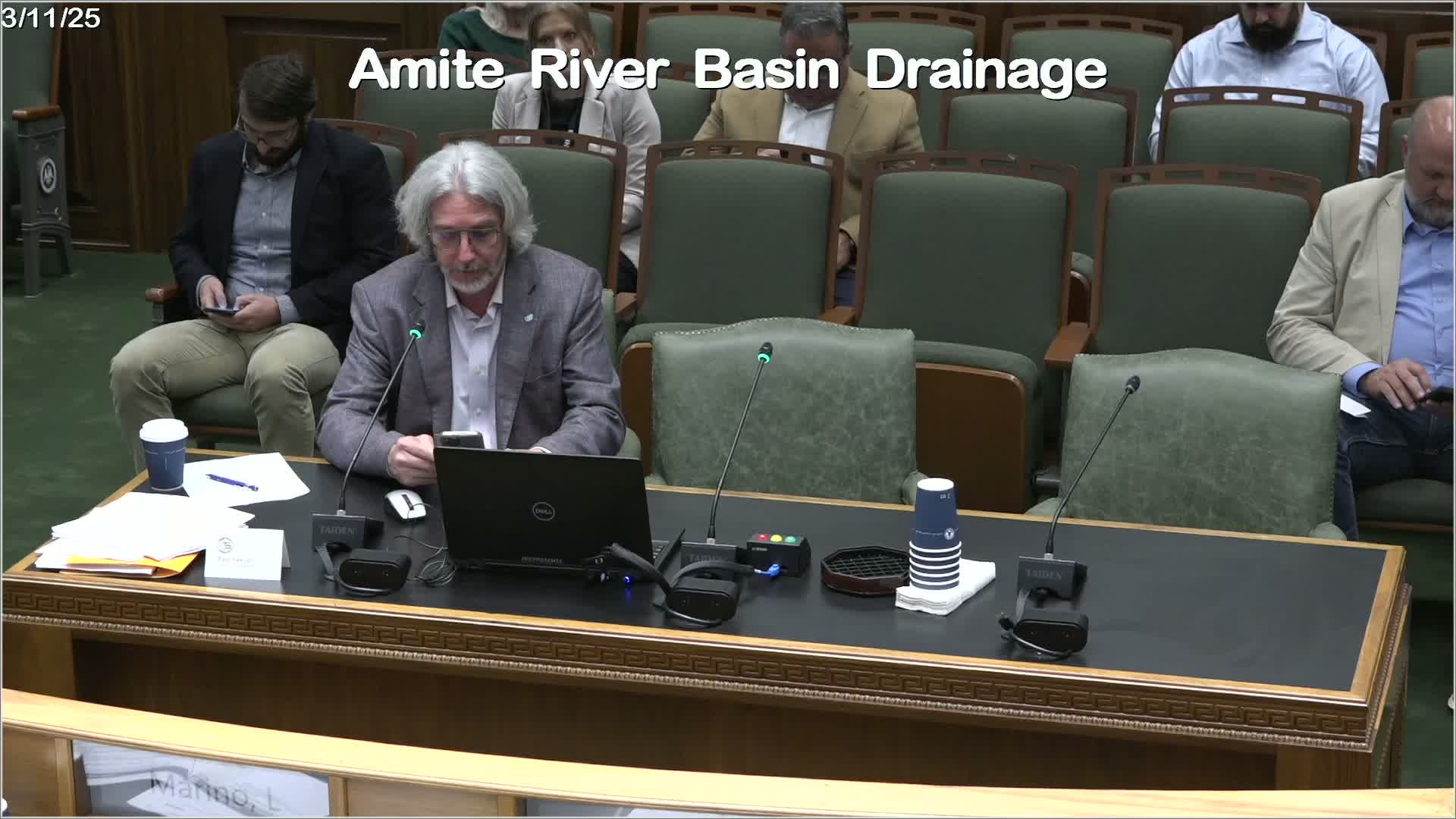
Paul Sawyer, ARBC executive director, told the commission the draft master plan — circulated in December and refined during a February 20 workshop — is a basinwide vision that lists conceptual projects and initiatives. “This list in your approval allows the contracting team to finalize the master plan,” Sawyer said, adding that the board will decide which specific projects to fund or prioritize after adoption.
The commission briefly halted the vote to add St. James projects after a member said the parish’s projects were missing from an on-screen list. Seth Bradley of Dewberry confirmed St. James projects are included in the master plan but agreed to update the distribution copy so commissioners could review the specific entries. Commissioner Quintmon moved, and Commissioner Bailey seconded, to approve the master-plan committee recommendations with the condition that St. James projects be included in the master-plan materials. The roll-call vote on that motion recorded affirmative votes from the commissioners who answered in the roll call; the motion carried.
Why it matters: The master plan is intended to assemble project concepts and an “all-projects” model that estimates structure removals, annualized flood-risk reduction and potential insurance savings if the projects were implemented together. Commissioners raised concern that some conceptual projects might shift water onto downstream communities if implemented in isolation. Several commissioners urged that sequencing and mitigation be explicit in the final plan so projects that could cause downstream impacts would not be advanced without offsets.
Details and next steps: Dewberry said its team will deliver a final draft on Friday, March 14, and will reach out to project owners next week to verify numerical tables and project details. Garvin Pittman of the Water Institute of the Gulf (Region 9 coordinator) said Dewberry and the commission had conducted a thorough review of the first draft and scheduled a March 14 master-plan committee meeting; he said some implementation items could be advanced internally by partner organizations within current budgets.
During discussion, commissioners emphasized the difference between a conceptual project list and an engineered project sequence. Several commissioners said sequencing — which projects must happen before or after others to avoid negative downstream impacts — is critical but requires additional data and project-level analysis that goes beyond a conceptual master plan. Commissioner Harrell and others said the master plan should flag projects that require upstream or downstream mitigation and propose sequencing where necessary.
A later motion to reconsider the vote failed on a roll-call vote, leaving the master-plan approval in place. The legal counsel, Larry Bankston, also reported that the district has executed an extension of the intergovernmental agreement with the Coastal Protection and Restoration Authority (CPRA) to cover master-plan funds through June 2026.
Ending: Dewberry and ARBC staff asked commissioners to review the final draft promptly and submit any edits so the plan can be finalized; Dewberry will also incorporate proposed sequencing and notes on mitigation where conceptual projects require follow-up work.