Get Full Government Meeting Transcripts, Videos, & Alerts Forever!
Get email alerts on the Library Legislation topic
No spam. Unsubscribe anytime.
Library director warns proposed state bills could curtail services, prompt policy changes
Summary
Dell Rapids Library Director Britney Mueller told the city council about two state bills — an amended funding cut (HB 1041) and a proposed criminalization of certain materials handling (HB 1239) — that could reduce training, resources and affect library programming and minor access policies if enacted.
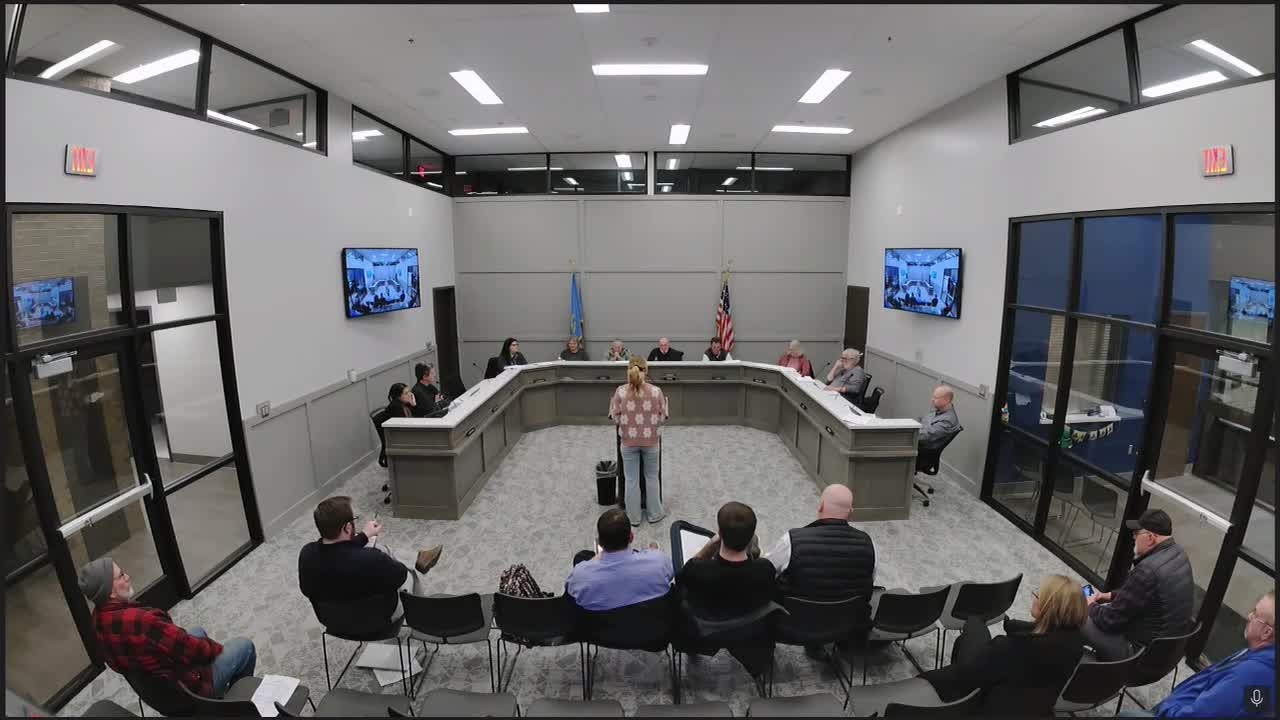
Britney Mueller, director of the Dell Rapids Public Library, updated the City Council March 3 on two state legislative measures she said would affect libraries across South Dakota.
Mueller described House Bill 1041’s recent amendments as significantly less severe than an earlier draft that would have effectively eliminated the state library’s budget. The updated bill (referred to as HB 1041b during the meeting) would cut approximately $825,000 from the state library budget and reduce staffing by about five positions compared with the current staffing level, Mueller said. "It is still cutting $825,000 from the state library budget," she said, while noting that key services such as interlibrary loan and the Libby/OverDrive e-audiobook service would remain available under the amended proposal.
She warned that the bill would reduce the state library’s capacity to provide continuing education and training for librarians in South Dakota, where no in-state degree programs for librarianship exist; the state library currently funds many training opportunities. Mueller said the local library could face increased training costs and operational strain if the state withdraws that support.
Mueller devoted most of her remarks to House Bill 1239, which she described as a proposal that would criminalize the dissemination of material deemed "harmful or obscene," exposing librarians, teachers and museum workers to misdemeanor charges and penalties including possible jail time and fines. "House bill 12 39 is basically the bill that criminalizes librarians, teachers, professors, and museum workers for the dissemination of material that is harmful or obscene," she said. Mueller explained that the legal definition of "obscene" under Miller v. California (1973) is narrow and that legitimately published books no longer meet the three-part Miller test; she said there is effectively no obscene material legally published that would meet that criteria.
Mueller and others at the meeting said the bill’s reliance on a subjective "harmful to minors" standard would likely prompt many libraries statewide to consider restrictive local policies to reduce legal risk — for example, banning unattended minors from the library and requiring that all materials for minors be checked out on a parent or guardian’s card. "If this bill passes... every library has policies in place to deal with material that guardians... have an objection to," she said, but added that the new law could push libraries to adopt more restrictive rules that would curb programming and child access to services the library currently provides.
Mueller noted that HB 1239 was scheduled for consideration in the Senate Judiciary Committee on Thursday morning and that the committee or the full Senate could still stop the bill. Mayor Early and Councilmember Wendy Nelson, who attended a legislative briefing on Saturday, echoed concerns that the bills address problems that are rare in their community and could produce unintended consequences if enacted.
Mueller said the library already follows state and federal filtering and protection laws for minors, including the Children’s Internet Protection Act (CIPA), and has a reconsideration process for challenged materials. She also said she has not received formal requests for reconsideration in her 11 years as director.
The council did not take formal action on the bills but was encouraged to contact legislators; Council members noted that Senator Pischke sits on the Senate Judiciary Committee. The legislative process could still change the measures before final action.