Get Full Government Meeting Transcripts, Videos, & Alerts Forever!
Get email alerts on the Zoning Rezoning topic
No spam. Unsubscribe anytime.
Barrington council denies rezoning request for 60 Bay Spring Avenue after unanimous planning-board opposition
Summary
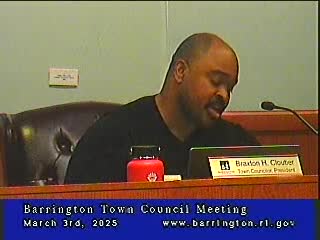
The Barrington Town Council on Monday voted 5-0 to deny a proposal to rezone 60 Bay Spring Avenue from a residential-business flex classification to a multifamily-only zone, after unanimous recommendations against the change from the Planning Board and the Economic Development Commission and extended public comment from residents and small-business owners.
The Barrington Town Council on Monday voted 5-0 to deny a proposal by Bay Spring Crossing Condominiums Association to rezone a parcel at 60 Bay Spring Avenue (Lot 101) from the existing residential-business flex zone to a new, multifamily-only district.
The council’s vote followed advisory recommendations against the rezoning from both the town Planning Board and the Economic Development Commission, which found the change inconsistent with the town’s comprehensive plan and the stated purposes of the zoning ordinance. Director Durfee and the town manager summarized those advisory recommendations before the public hearing opened.
The applicant, Patrick Majewski, told the council he represents residents at 60 Bay Spring Avenue and said many owners favor returning the property’s zoning to neighborhood-business (the zone that applied to earlier buildings on the site). Majewski said the change would better reflect the complex’s largely residential character and would address a set of regulatory consequences residents were experiencing under the current residential-business flex wording.
Multiple residents and business owners spoke at the hearing. Supporters who live in the condominium buildings emphasized proximity to services and argued the neighborhood has become primarily residential; small-business owners, including a physical therapy practice that has operated at the site for years, said their operations serve local residents and urged the council to preserve opportunities for small, first-floor businesses. A number of speakers described parking and an ADA-accessible parking dispute as a catalyst for the application but said that civil dispute should not drive a zoning change.
Council members cited the Planning Board’s and Economic Development Commission’s unanimous recommendations in explaining their votes. One councilor noted that returning a property to a neighborhood-business zone could render existing first-floor residences nonconforming, a consequence that weighed against the proposed amendment.
The motion to deny the rezoning was made and seconded by council members in the meeting transcript; the council recorded five aye votes and no nays.
The denial ends the current application; the solicitor noted a denial of a zoning change initiated by a private applicant is not generally subject to appellate review and that successive applications are limited under state law.
Outlook: The Planning Board and Economic Development Commission had previously reviewed the petition and voted unanimously to recommend denial. The applicant and neighbors were urged by the council to continue local discussions between unit owners and business tenants to address parking and ADA issues.
Votes at a glance: The council’s single motion to deny the proposed rezoning passed 5-0.