Get Full Government Meeting Transcripts, Videos, & Alerts Forever!
Get email alerts on the Healthcare Finance topic
No spam. Unsubscribe anytime.
House panel reviews LSU Health Care Services Division budget; Lolli Kemp’s outpatient volume and legacy obligations highlighted
Summary
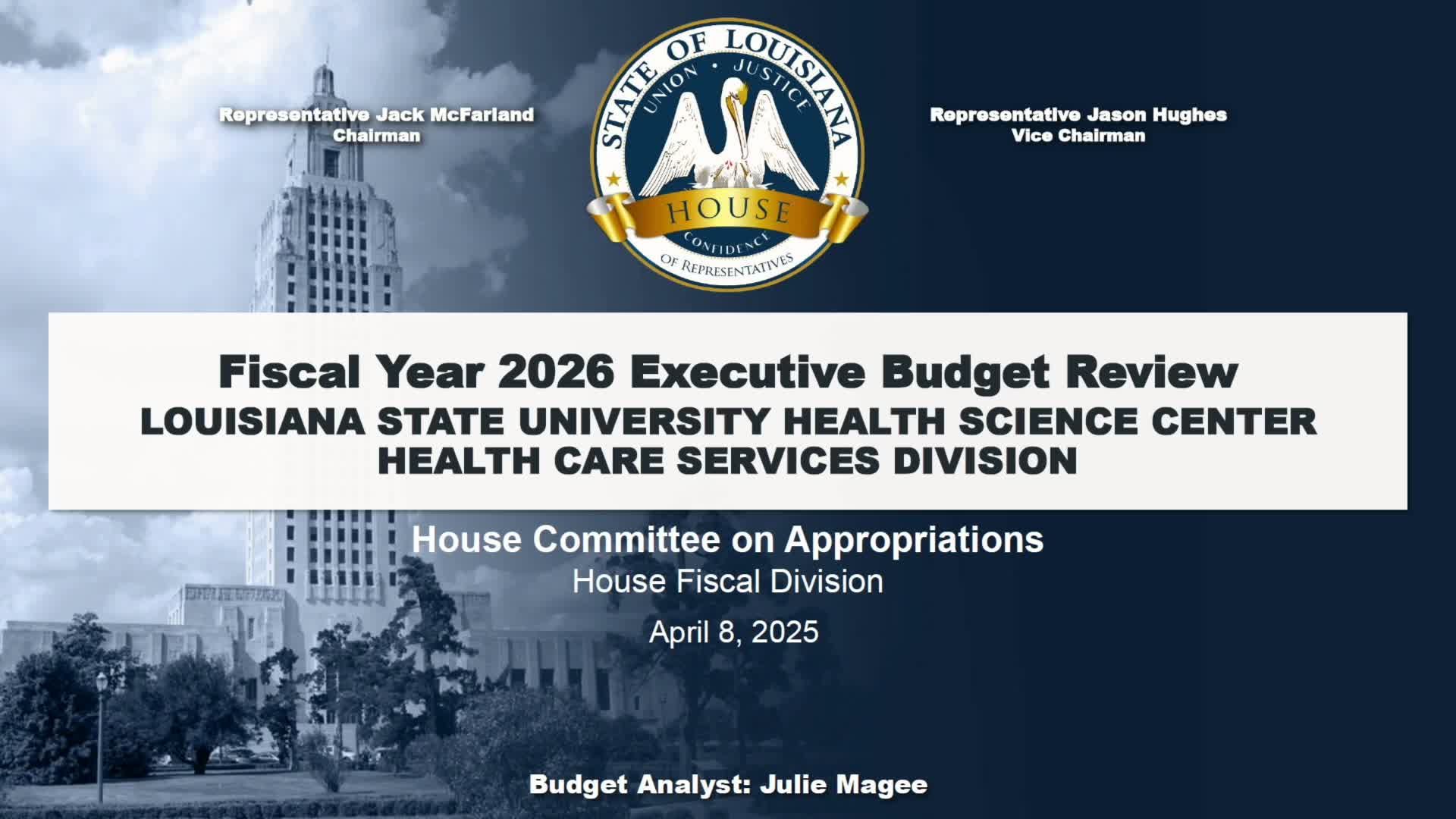
House Fiscal Division provided a walkthrough of LSU Health Care Services Division (HCSD) budget in House Bill 1: $73.6 million FY26, with state general fund and legacy costs for former hospitals and operations of rural Lolli Kemp hospital emphasized.
Baton Rouge — The House Appropriations Committee heard a budget presentation on April 8 for the LSU Health Care Services Division (HCSD), which manages legacy obligations from privatized hospitals and operates the 24‑bed Lolli Kemp hospital in Independence.
Julie McGee of the House Fiscal Division summarized the FY26 recommendation for HCSD in House Bill 1 at $73.6 million, and explained the funding mix: roughly one third state general fund, one third self‑generated fees and about a quarter interagency transfers. McGee said roughly 43% of HCSD expenditures are salaries and related benefits and about 30% are “other charges,” which include retiree group benefits and payments for medical services provided by LSU Health Science Center.
On Lolli Kemp: McGee and Lolli Kemp CEO Lisa Bruhl told lawmakers the rural 24‑bed acute hospital runs a heavily outpatient program with about 91,000 outpatient encounters annually and roughly 28,700 unique medical records over a 2‑year span. Bruhl said Lolli Kemp converted to civil‑service pay scales to remain competitive after COVID impacts and a 2022 turnover spike. When asked by Rep. Amadei about the $55 million cited as roughly the hospital’s portion of the HCSD budget, McGee and Bruhl said that figure includes many centralized and legacy costs that are not direct, per‑bed operating costs. Bruhl noted the facility’s payer mix shifted in FY25 toward more commercial insurance receipts and fewer Medicaid managed‑care payments.
Legacy obligations and costs: McGee’s slides broke out legacy costs for former LSU hospitals — including retiree group insurance — and showed those legacy costs declining as legacy members fall off rolls. She said the HCSD budget remains primarily driven by legacy obligations (retiree benefits, legal fees, IT systems and risk‑management premium costs) as well as operations of Lolli Kemp.
Committee questions: Representatives pressed on turnover, vacancies (Lolli Kemp reported 11 advertised vacancies at the hearing) and workforce competitiveness with private systems. Bruhl said Lolli Kemp has reduced turnover from the COVID spike and has worked with civil service to increase pay to remain competitive for nurses and clinicians.
Ending: The HCSD presentation concluded with McGee and the HCSD team — including Lisa Bruhl and other officials — available to provide more detailed breakout data by line item if committee members request it.