Get Full Government Meeting Transcripts, Videos, & Alerts Forever!
Get email alerts on the Wildlife And Fisheries Conservation Fund topic
No spam. Unsubscribe anytime.
Wildlife and Fisheries warns conservation fund shortfall; seeks options as royalties decline
Summary
The Department of Wildlife and Fisheries told the House Appropriations Committee that declining oil-and-gas royalties have reduced conservation fund revenues and that the department is pursuing efficiency measures, partnerships and grant opportunities to maintain programs and services.
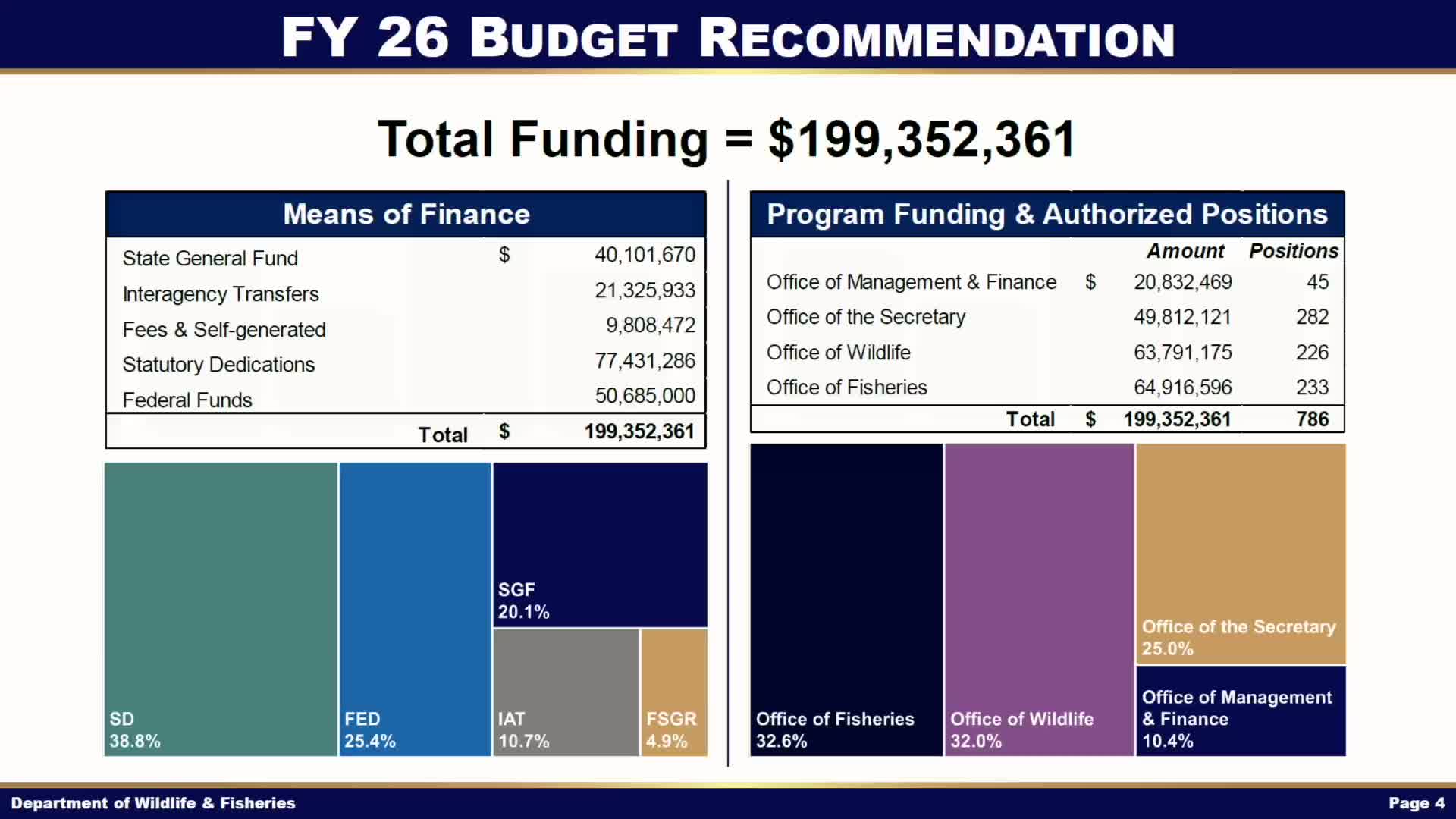
Paige Filia, House Fiscal Division analyst, presented the Department of Wildlife and Fisheries’ FY26 recommended budget on April 1, reporting a $199.4 million recommended total and highlighting a steep decline in royalties and statutory dedications that support the conservation fund.
Acting Secretary Tyler Bosworth told the committee the department is heavily reliant on oil-and-gas royalties from state lands and that declines in traditional onshore production and coastal activity have materially reduced revenue to the conservation fund. “I greatly appreciate the opportunity to lead the department,” Bosworth said, outlining structural changes and partnerships intended to stretch available funds and maintain operations.
The nut graf: Committee members focused on a long-term revenue shortfall in the conservation fund tied to declining royalties and asked department leaders about possible revenue alternatives, project prioritization and the status of land and project balances.
Undersecretary Brian McClendon explained that major producing areas for department royalties — several wildlife management areas — rely on traditional drilling that has contracted as investment patterns in the industry shifted, including consolidation of producers and preference for other production techniques. The department reported needing a treasury seed this year after steady declines in royalty receipts and has cut discretionary project spending; Filia’s slides cited a roughly $79.7 million decrease in “other charges” largely reflecting completed projects and a reduction in carryforward-funded projects.
Committee members discussed specific programs: the Outdoor Forever program has $1 million of one-time funding removed in FY26 pending project selection processes; the department described a $12 million cooperative agreement with the Coastal Conservation Association (CCA) to expand artificial reefs; and the department said it is pursuing federal NOAA grant funding to purchase additional monitoring vessels.
Members also asked about the department’s response to invasive aquatic plants, derelict vessels and derelict infrastructure. Bosworth said the department continues to use grants and federal partnerships to fund aquatic-plant control and that the agency is ready to consider new funding avenues to sustain core services.
Ending: Appropriations members signaled willingness to explore revenue options for the conservation fund and requested updated revenue projections, the Outdoor Forever project-selection timeline and details on NOAA grant applications and conservation fund balances.