Get Full Government Meeting Transcripts, Videos, & Alerts Forever!
Get email alerts on the Environmental Quality Budget Enforcement topic
No spam. Unsubscribe anytime.
Committee grills DEQ on waste-tire spending, enforcement and permitting modernization in FY26 review
Summary
The House Appropriations Committee reviewed the Louisiana Department of Environmental Quality's FY26 budget and questioned officials about waste-tire fees, enforcement resources, permitting modernization, employee morale and emergency sites including Cottonport Monte Field.
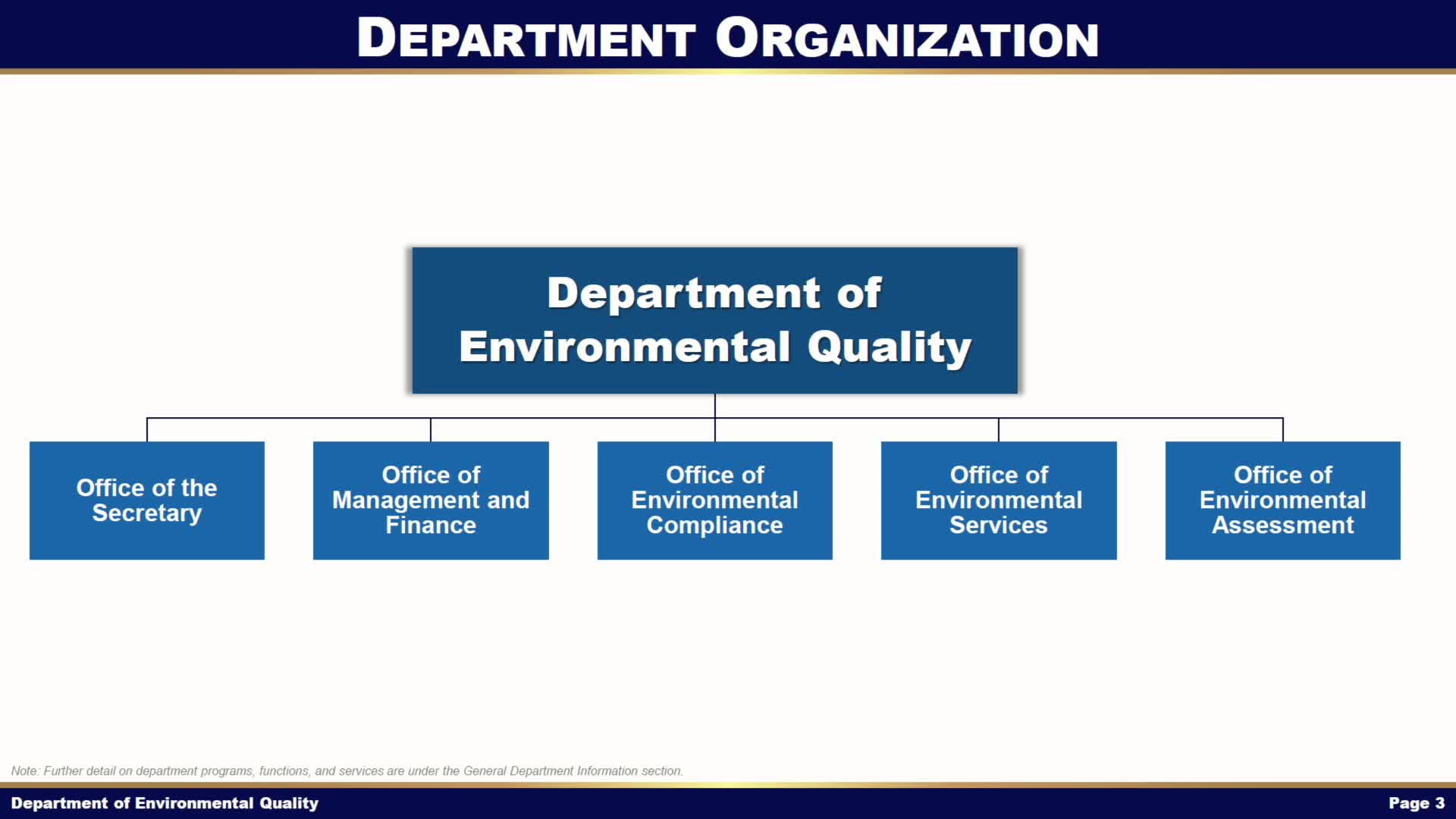
Paige Filia, fiscal analyst for the House Fiscal Division, presented the Louisiana Department of Environmental Quality’s FY26 executive budget to the House Committee on Appropriations on April 1. The department’s recommended budget was listed at about $156.2 million, with roughly 69% from fees and self-generated revenue and 13.1% from federal funds.
Madam Secretary (Department of Environmental Quality) addressed the committee about permitting, enforcement and agency priorities. “We have been laser focused on our mission of comprehensive environmental health while not skipping a beat as we prepare for the future,” she said, citing executive orders from the governor intended to streamline permitting.
The nut graf: Lawmakers pressed DEQ on waste-tire funding and enforcement capacity, impacts of higher-profile audits of employee morale, the department’s multi-system permitting IT stack, and the Cottonport Monte Field tire pile and other legacy waste sites.
Key budget details and committee concerns: DEQ reported approximately $8.8 million in current-year waste-tire fee revenue (the fund is assessed at $2.25 per tire). The department said about $6.2 million of its roughly $156.2 million budget supports enforcement activities (about 4% of the department’s budget). Michelle Barnett (Office of Management and Finance) stated processors that handle waste tires number four in the state; DEQ said one plant fire and a contractual dispute have reduced processing capacity and left some fund balances higher than expected.
Representative Bagley and Representative Freyberg pressed the secretary on timeliness and responsiveness to constituents seeking permits and clearances; officials said some delays are tied to compliance checks and regulatory requirements that must be satisfied before departmental clearance can be issued. Multiple members asked about recent legislative Act 480 (2022) and whether enforcement resources are sufficient to implement its provisions; the secretary said the department would review funding and report back.
On permitting modernization, DEQ staff described a 19–system IT landscape and an effort to map more than 900 process flows. The department plans phased rollouts of a public dashboard so applicants can track permit status and phase timing; staff expected an initial dashboard component in an upcoming cycle and a second “innovation summit” planned for July 2025.
On legacy contamination, the secretary described repeated site visits and partnership with local parishes and processors to plan removal at Cottonport Monte Field, including removing a $4.5 million lien that previously hindered cleanup. The department said it would prefer to resolve some large sites with state resources rather than escalating to federal Superfund processes, which may extend timelines.
Ending: The committee requested more detailed breakdowns of enforcement spending specifically targeted to illegal dumping, a list of pending permit-processing IT investments and a status update on waste-tire processors and the Cottonport Monte Field cleanup plan. DEQ agreed to provide the requested details.