Get Full Government Meeting Transcripts, Videos, & Alerts Forever!
Get email alerts on the Zoning Unified Development Ordinance topic
No spam. Unsubscribe anytime.
Rockdale County adopts new rules limiting gas stations, small-box retailers and vape shops; short-term rental changes deferred
Summary
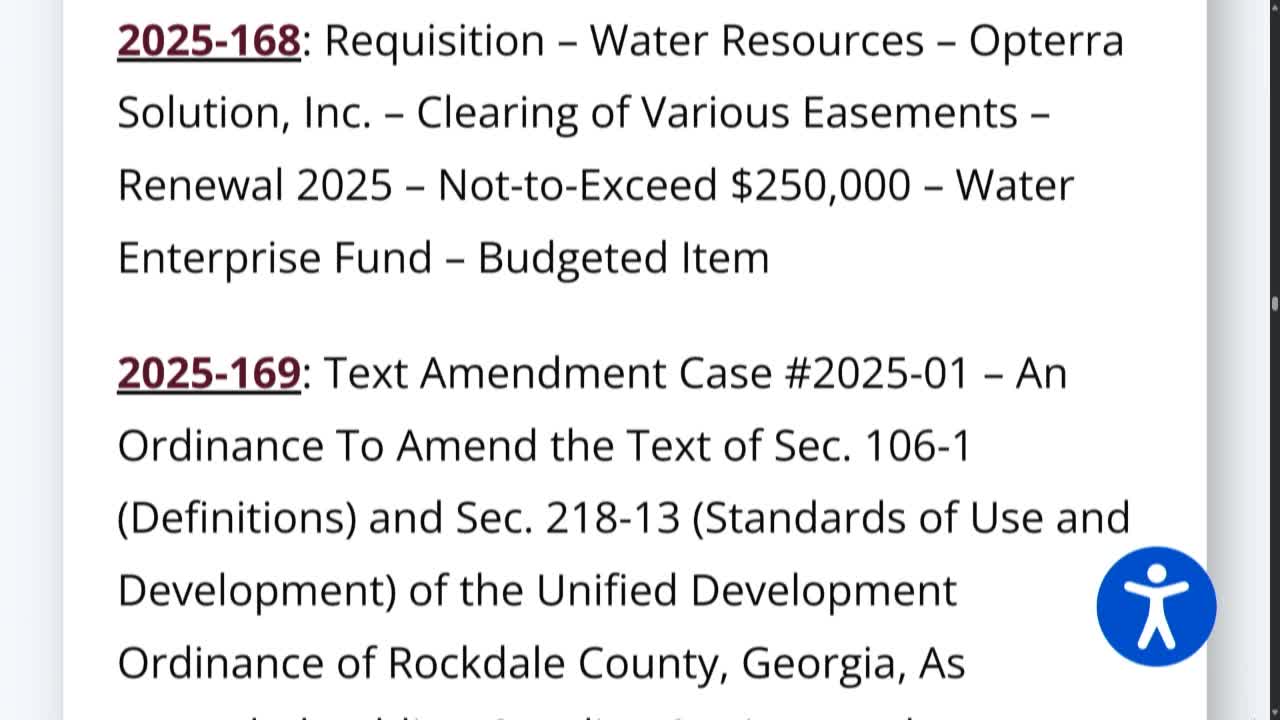
Rockdale County commissioners on April 8 approved a package of zoning text amendments that add new definitions and supplemental regulations to the county’s Unified Development Ordinance governing gasoline service stations, small-box discount retailers, vape stores and storage warehouses.
Rockdale County commissioners on April 8 approved a package of zoning text amendments that add new definitions and supplemental regulations to the county’s Unified Development Ordinance governing gasoline service stations, small-box discount retailers, vape stores and storage warehouses. Commissioners amended the gasoline-station language on the floor to increase the minimum separation between gas stations to four miles and approved the measure, with one commissioner recording an abstention.
The measures were presented during the meeting as second-read ordinances following an earlier moratorium and public review. County planning director (referred to in the meeting as Director Gardner) outlined the proposed standards that would apply to gasoline stations, including minimum setbacks for pumps and canopies, frontage and lot-size requirements, restrictions on proximity to residential zoning and places of public assembly, limits on outside storage and a prohibition on commercial-scale vehicle repair.
Why it matters: the UDO changes are intended to respond to repeated citizen feedback seeking greater control over where certain commercial uses are allowed in Rockdale County. The gasoline-station language includes operational and design rules intended to limit impacts on adjacent residential areas and to reduce clustering of like facilities. Making vape stores “nonconforming” will prevent new vape-only outlets from opening under the ordinance; existing vape shops could continue operating so long as they do not cease operations for a defined period.
Key provisions and debate - Gasoline stations: Planning staff presented a multi-part supplemental regulation. Among the requirements given in the text were: not adjacent to residences; not within 100 feet of a lot zoned residential; a 150-foot minimum primary-street frontage; canopies and pumps set back at least 25 feet from rights-of-way and at least 30 feet from buildings; pumps and related equipment must be above grade relative to adjoining streets; minimum curb width and driveway-spacing standards; paved service areas; and a prohibition on outside above-ground tanks that would make a site feel like a truck stop. The draft originally contained a 1-mile separation between stations measured in a straight line from property line to property line; while discussing the ordinance on the floor, a commissioner proposed increasing that separation to four miles and the board approved the ordinance as amended to 4 miles. - Vape stores: The board amended the UDO so vape-only stores are treated as nonconforming; existing shops may remain while in continuous operation, but the classification prevents new openings and allows those that close to lose the nonconforming status. - Small-box discount retail and warehouse/self-storage: Those text amendments were adopted on second reading as presented; they add definitions, table entries and supplemental regulations for each use. - Short-term rentals: A separate text amendment proposing limits on short-term rentals (including a 14-consecutive-day or 30-day total-per-year cap in the draft) drew pushback from commissioners. Concerns cited included the potential to unintentionally curtail legitimate businesses and the absence of an established registration process. Commissioners asked staff to explore a permitting/registration approach similar to neighboring Putnam County (which the planning discussion referenced as a model) and to consult the Sheriff’s Office for complaint history. The board voted to defer the short-term-rental amendment to the next meeting to allow staff and consultants to craft a revised approach.
Voices from the meeting - Director Gardner (Planning and Development): Presented the gasoline‑station standards and summarized the UDO rewrite process, saying these were among "low-hanging fruit" identified by a citizen-led planning and zoning committee and staff. - Chair Janice Van Ness (Board of Commissioners): Led the floor discussion and asked staff to clarify procedures for amending distance requirements; she also moved the motion (as restated on the record) to adopt the gas‑station ordinance as amended to a 4-mile separation. - Public commenters (during public comment): Some residents urged the county to limit gas stations, vape shops and “box stores” and asked for clearer long-range vision and community outreach about development plans.
What the votes mean The amendments affecting gasoline stations, small-box discount retailers, vape stores and storage warehouses were adopted on second reading. The gasoline-station ordinance was amended during the meeting to require a four-mile minimum separation between gas stations; one commissioner recorded an abstention during the roll call. The short-term-rental amendment was deferred for further work and consultation.
Next steps Staff will revise and codify the specific ordinance language to reflect the board’s on-the-record amendment (four-mile separation for gasoline stations) and prepare the finalized text for publication. The short-term-rental item will return to the board after additional research, proposed registration procedures and coordination with the Sheriff’s Office and the county’s UDO consultant.
Ending note: Commissioners repeatedly referenced an ongoing, broader rewrite of the Unified Development Ordinance. The board signaled it will continue to advance discrete text amendments as issues are identified through that comprehensive process, with additional public hearings and staff follow-up planned.