Get AI Briefings, Transcripts & Alerts on Local & National Government Meetings — Forever.
Senate hearing: INDOPACOM warns China can rehearse a Taiwan blockade as U.S. force margin erodes
Loading...
Summary
U.S. Indo-Pacific Command (INDOPACOM) leaders told the Senate Armed Services Committee that China's military modernization and frequent exercises around Taiwan amount to rehearsals for coercion, while INDOPACOM faces gaps in long-range fires, logistics and air/missile defenses that weaken deterrence.
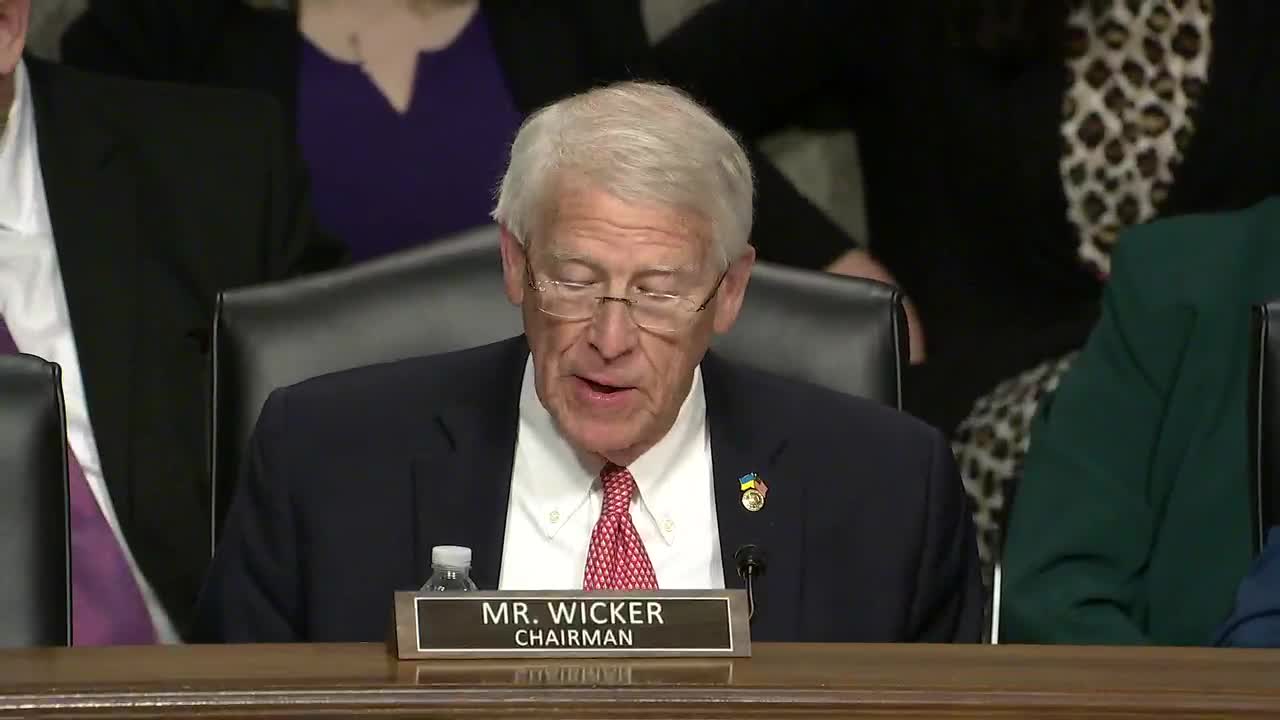
Chairman Wicker opened the Senate Armed Services Committee hearing by warning that recent Chinese exercises "demonstrated the extent to which the People's Liberation Army could execute a maritime blockade of Taiwan and pummel it with missile strikes," and said Beijing has escalated rhetoric against Taiwan.
The testimony from Admiral Paparo, commander of U.S. Indo-Pacific Command (INDOPACOM), and General Brunson, commander of United States Forces Korea, described growing Chinese military capability and an accelerating pattern of coercive operations. "China's increasingly aggressive actions near Taiwan are not just exercises. They are rehearsals," Admiral Paparo said.
Why it matters: Committee members and the witnesses said Taiwan is a strategic center of gravity for the global economy and U.S. alliances. Admiral Paparo told senators that conflict around Taiwan could disrupt global trade and critical industries such as semiconductors, and would amplify the importance of allied basing, access and integrated defenses.
Admiral Paparo and other witnesses outlined capability shortfalls that, in their view, reduce the margin for deterrence. The command seeks investments in long-range survivable fires, integrated air and missile defense, counterspace and cyber capabilities, and improvements in logistics and sea- and air-lift to sustain high-tempo operations. "To maintain credible deterrence, INDOPACOM requires additional sustained investment in long range survivable fires, in integrated air and missile defense, in force sustainment, with an emphasis on autonomy and AI-driven systems," Paparo said.
Senator Tom Cotton pressed on why Taiwan matters to the U.S.; Admiral Paparo and other witnesses warned that even a limited conflict would have broad economic and human consequences. Paparo referenced studies that estimate a conflict could cause large GDP contractions in Asia and secondary effects in the United States. "This is the importance of the regional stability to the world economy and its effect on people's lives," he said.
Committee members and witnesses discussed several weapons and posture issues intended to shore up deterrence. Senators and witnesses named hypersonic long-range fires, the Pacific Deterrence Initiative, and the SLCM-N (sea-launched cruise missile, nuclear variant) as pieces of a layered approach, though witnesses said timelines and production rates remain problematic. "2034 is too late. Sooner, please," Admiral Paparo said about the SLCM-N deployment timetable.
The witnesses repeatedly warned that China's quantitative production of platforms (fighters, ships, missiles) and growing integrated capabilities are outpacing U.S. modernization in several areas. "China's outproducing The United States in air, missile, maritime, and space capability and accelerating these," Paparo said.
The hearing also covered the role of allies and partnerships and the need to sustain diplomatic and economic instruments that support deterrence. Several senators raised concerns that recent U.S. policy shifts could undermine alliance cohesion and thus the very posture the witnesses described as essential.
The committee did not vote on legislation at the hearing. Senators said they expect the testimony to inform FY26 budget and authorization decisions.