Get Full Government Meeting Transcripts, Videos, & Alerts Forever!
Get email alerts on the Utilities Water Sewer Finance topic
No spam. Unsubscribe anytime.
Galion utilities committee weighs 15–25% water and sewer rate increases to cover shortfalls
Summary
City utilities officials and committee members discussed a projected water and sewer funding gap, possible 15–25% rate increases, use of general‑fund transfers, borrowing and a property tax option to help pay for reservoir and sewer-plant work.
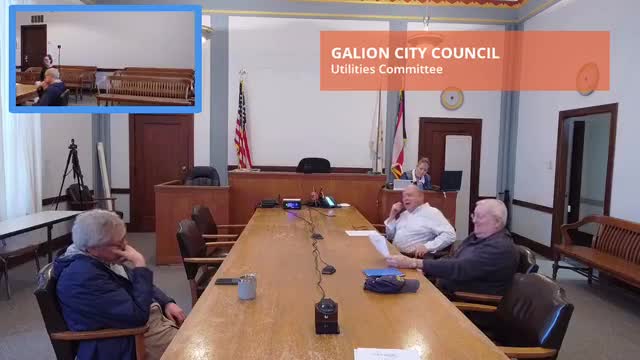
At a Galion City Council utilities committee meeting, members and staff reviewed projections showing a substantial shortfall in the water and sewer funds and discussed options including 15%, 20% or 25% rate increases, further transfers from the general fund, borrowing and a potential property-tax levy to fund large capital projects.
Committee members said staff calculations — prepared by city finance staff and reviewed with the auditor — indicate that covering operating shortfalls and upcoming capital needs solely by raising rates could require a roughly 20%–29% revenue increase under the assumptions used. Staff told the committee they compared several scenarios (15%, 20% and 25%) and modeled the effect on representative residential bills at different household usage levels.
The discussion centered on two budget pressures: recurring operating shortfalls that the committee expects will continue if not addressed, and large capital needs driven by regulatory requirements and aging infrastructure. Committee members said the group had budgeted a general‑fund transfer to utilities this year (the water transfer was discussed at about $700,000, and committee comments placed the sewer portion of the shortfall at roughly $300,000). Committee members expressed reluctance to rely repeatedly on general‑fund transfers as a long‑term practice.
The committee reviewed support and constraint options. Suggestions included:
- Scrubbing the water and sewer operating budgets for nonessential spending and reviewing capital priorities. - Phasing work in segments (doing some projects now, others later) to reduce the immediate rate impact. - Pursuing grants where feasible, while recognizing committee members’ view that large federal grants may be less certain than in past years. - Borrowing for capital needs, balanced against the committee’s reluctance to use long‑term debt when general‑fund transfers are already occurring. - Considering a property‑tax assessment (a voter-approved levy) carved out for systemwide capital such as reservoir work, which one member said could spread costs across property owners rather than concentrating them on high water users.
Staff told the committee that the capital plan includes EPA‑driven projects and reservoir improvements that will require substantial funding; one item referenced in the meeting was an estimate of about $42 million in plant improvements including engineering, and committee members also discussed reservoir costs in the roughly $10–12 million range as items likely to fall to local funding. Staff said the revenue projections used 2023 total utility revenue increased by 20% (to reflect last year’s rate changes) as a baseline for 2025 projections.
Committee members also discussed affordability and billing structure. Staff described how minimum bills and seasonal/unit‑based assumptions work for household billing and provided examples showing how a household’s water and sewer bill would change under the several percentage scenarios. The committee emphasized the importance of balancing the need for revenue with affordability for residents and noted the potential public reaction to repeated rate increases.
Operational and program details were raised: the utilities office is hiring a new water superintendent (reported to start on the 7th of the month), and committee members identified a supervisory and sign‑off issue between field crews and plant staff that they said will need resolution to ensure repairs and EPA reporting are handled consistently.
Next steps the committee identified included producing comparative rate and bill data (benchmarks with nearby communities such as Crestline and others), running more detailed affordability analyses, and preparing a formal proposal that could be considered by full council. Committee members discussed timing to get at least one revenue adjustment in effect by June so the city would capture roughly a half‑year of increased revenue for budget projections; they also discussed the possibility of a special meeting to prioritize the item and the likelihood that any ordinance to change rates would follow the standard multiple‑reading process.
Ending: Committee members agreed the issue is urgent and asked staff to return with refined numbers, comparisons and ordinance language suitable for council consideration in the coming weeks. No final rate ordinance was passed at the utilities committee meeting; the discussion was framed as direction to prepare options for council action.