Get Full Government Meeting Transcripts, Videos, & Alerts Forever!
Get email alerts on the Stormwater topic
No spam. Unsubscribe anytime.
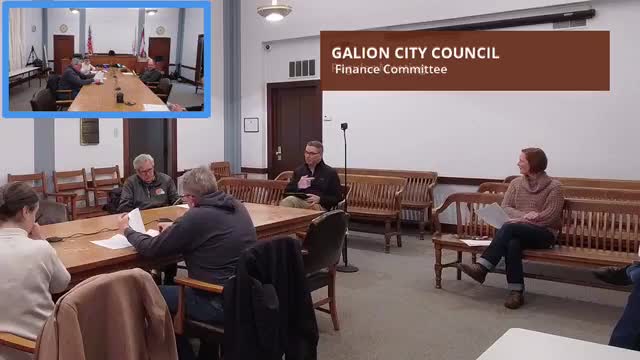
Council committee advances EPA-mandated stormwater study, recommends Wesler contract
Summary
A council committee voted to send an ordinance to full council to start a federally required study of Galion’s stormwater and sanitary system inflow; staff recommended a roughly $297,000 contract with a consulting firm labeled in meeting materials as Wesler.
A Galion City Council committee voted to send an ordinance to the full council to begin a federally required study meant to identify “no feasible alternative” findings for bypasses at the city wastewater plant.
City staff told the committee the U.S. Environmental Protection Agency is requiring a study to determine whether the city has feasible alternatives to bypassing flow during high-rain events, or whether the city must document there are no feasible alternatives. The first phase will focus on the stormwater system, staff said, because high flows occur during major rainfall events.
The committee’s discussion centered on a staff recommendation to hire Wesler for the stormwater portion of the work. A staff speaker summarized the proposal as roughly $297,000 and said Wesler had provided a responsive proposal and past satisfactory work for the city. “They’ll first take a look at some of the lift stations and run times and volume and all of that,” the staff member said, describing an initial phase that would install flow meters and concentrate analysis where inflow is highest.
Why it matters: the study will identify where rainfall-driven inflow and connections (for example, downspouts tied into sanitary sewer lines) create bypass risk at the wastewater plant. Staff told the committee the plant processes roughly 900,000 gallons on a dry day and can reach about 10,000,000 gallons during large storms, indicating substantial inflow spikes in wet weather.
Staff said the work is an EPA mandate and that the city is behind schedule by about 10 months. The planned study is the first element of an approximately eight-year program staff described to address inflow and mitigation projects; once the study identifies problem areas, capital projects and retention or processing changes would be required.
Funding and budget notes: staff said the first-phase cost will come from the stormwater fund (referred to in materials as fund 608). They cautioned that fund accounting looks “a little funky” on paper because grant and loan reimbursements are expected to offset much of the fund’s expenditures; staff also said the anticipated 2025 year-end balance in that fund was about $750,000 and that the committee’s preferred financing would not exhaust the fund.
Committee action and next steps: the committee moved the ordinance that would approve the work and refer it to the full council. The motion was seconded and the committee chair called the question with voices of approval recorded; the committee advanced the item to the full council for final consideration and appropriation.
Staff said the study vendor will concentrate initial work on a limited set of locations to narrow where the greatest inflow occurs before proposing broader work. Staff also offered to coordinate with the EPA to demonstrate the city has a tentative schedule to complete Phase 1 of the study.
The committee discussion flagged potential downstream consequences: the study will likely produce multiple capital projects, possibly overlapping with other planned East Side stormwater projects, and staff warned the resulting improvements could total millions of dollars over time. The committee asked staff to prepare the ordinance and supporting documents for the next council meeting so the full council can review contract language and funding details.