Get Full Government Meeting Transcripts, Videos, & Alerts Forever!
Get email alerts on the Higher Education Finance topic
No spam. Unsubscribe anytime.
Columbia Green Community College official details budget shortfall, warns prison-education funding is unreliable
Summary
Amanda, a presenter from Columbia Green Community College, told the Columbia County Finance Committee that the college faces a structural budget shortfall, has reduced its cash cushion after one-time receipts, and will adopt an austerity, zero-based budgeting approach for 2025–26 while reducing reliance on volatile prison-education revenue.
Amanda, a presenter from Columbia Green Community College, told the Columbia County Finance Committee that the college’s February disbursements totaled $2,000,000 and that the institution faces a “structural” deficit driven by falling revenues and rising personnel and benefit costs.
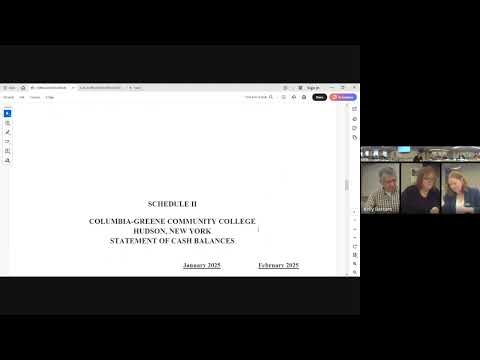
The college’s cash balance fell from $3.3 million in January to $2.8 million in February, Amanda said, but after receivables and foundation reimbursements the operating fund rose to $6.5 million as of the morning of the meeting. “On the first page is the warrant … the total disbursements for February were $2,000,000,” she said.
Amanda emphasized that one revenue source in particular is now treated as unreliable. “CGCC will no longer treat prison education revenue as a guaranteed funding stream for 25‑26,” she said, describing SUNY guidance and the recent volatility in access to correctional facilities as the reason for the change. She said the college will adopt an austerity budget for 2025–26 and move to zero‑based budgeting for departmental requests.
Why it matters: prison-education classes and county chargebacks have been a substantial and variable portion of the college’s non‑tuition revenue. Amanda told supervisors that the college is owed roughly $600,000 in chargebacks for spring and about $400,000 tied to the prison-education program, but that movement of students and temporary facility closures make that revenue unpredictable.
Key financial moves and context
- Cash and receivables: Amanda said the college received state aid, county share payments and foundation reimbursements that raised the operating fund to $6.5 million on the day of the meeting. She credited a $995,000 student-support package assembled by the college foundation and an annual $500,000 gift from the Hudson River Bank and Trust Foundation.
- Expenses and savings: Year‑over‑year expenditures were up $865,000, driven by a $633,000 rise in employee benefits and a $114,000 rise in contractual expenses. The college offered a retirement incentive (18 offers, 11 acceptances) and moved 91 retirees from Highmark to UnitedHealthcare, which Amanda said yielded initial savings of $504,000. Personnel actions and consolidations are expected to produce further savings: she projected $469,000 in immediate savings from layoffs (April–August 2025), $812,000 in annual staffing savings, and combined savings of about $1,320,000 when health care and staffing changes are fully realized.
- Layoffs and staffing: Amanda confirmed 17 employees were let go as part of an effort to align staffing with current enrollment; some positions will be combined or replaced selectively. She described the decision as part of a broader Institutional Sustainability Plan approved by the board in May 2024.
- IT contract review: Amanda said the college pays about $1 million a year to Campus Works and that SUNY‑affiliated providers ITEC and SECUS are on campus to assess the IT infrastructure; she told the committee her priority is to “get out of the Campus Works contract.”
- Bank and investment practice: Amanda described using a Bank of Greene County investment account she called their savings vehicle and reported an investment yield shown on the distributed sheet as 2.1% for February; she said the college moves cash between operating and that account to capture interest.
Prison-education specifics and contingency plans
Amanda explained that the college serves incarcerated students through contracts at Greenhaven and Greene Correctional Facility, and that recent restrictions and transfers of incarcerated students after a strike complicated delivery. She said the college cannot rely on that revenue in the 2025–26 budget and is exploring options such as later-start or 21‑week semesters, withdrawals or incomplete grades and coordination with third‑party partners. “We could be at a million dollars [in lost revenue] if they can’t go through,” she said.
Committee requests and next steps
Supervisors asked for more granular budget materials—prior‑year actuals, proposed budgets, line‑item balances and a salary breakdown. Amanda agreed to provide those materials and to meet periodically; she said the provost has a program‑side plan to right‑size the class schedule and enrollment strategy team work is underway to increase in‑person adult enrollment.
Ending
Amanda said the college will pursue revenue diversification (facility rental fee increases, a shared grant writer, and managing grants for other SUNY institutions) and emphasized a move away from relying on the fund balance. “The college will operate under an austerity budget for 25‑26,” she said, and supervisors requested follow‑up documents before formal budget deliberations.