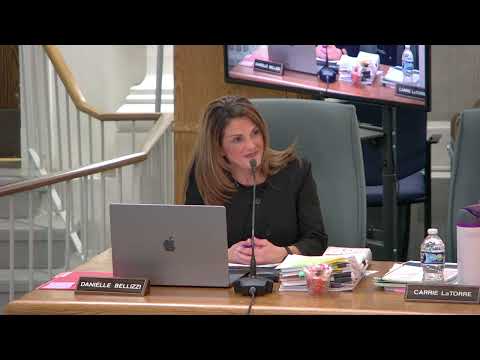
Board reviews draft educational specifications for proposed single Wallingford high school; community outreach debated
Loading...
Summary
Consultants from SLAM and Colliers presented draft educational specifications for a proposed consolidated Wallingford High School at the Jan. 27 Board of Education meeting, outlining classroom sizes, program spaces and projected student capacity while board members and public commenters pressed for more community outreach and answers on transportation and extracurricular impacts.
Consultants from SLAM and Colliers presented draft educational specifications for a proposed consolidated Wallingford High School at the Board of Education meeting on Monday, Jan. 27, outlining room sizes, program spaces and projected student capacity while board members and public commenters pressed for more community outreach and answers on transportation and extracurricular impacts.
The consultants said the ed specs describe “a statement of need” — how the school should function and what spaces it should include rather than a finished building design. Kent Moorehart of The SLAM Collaborative explained the specification approach and the two proposed classroom footprints: standard academic classrooms of about 850 square feet (for roughly 25 students) and smaller seminar rooms around 612 square feet (for about 18 students). He said the draft plan includes roughly 60 academic spaces, including 14 science labs, and assumes classrooms will be used 7 of 8 class periods to reach about 87.5% utilization.
Why it matters: the ed specs underpin later design, site and state reimbursement work. They determine what programs the new high school could support and how much building area would be eligible for state aid, a major factor in project cost.
Moorehart and Colliers’ representative (Chuck Warren) ran through a benchmarking comparison: the two existing high schools have substantially different square footage per student now, and a single proposed facility sized to the district’s projected enrollment would be smaller, per-student, than the existing buildings. The consultants said the draft targets a projected peak enrollment of 1,605 students; updated projections presented that evening showed a slightly lower eight-year projection of about 1,570 students, which changes the state-allowable area and eligibility calculations. Consultants referenced the state’s ED-50 measurement (net/gross square footage) used in eligibility calculations.
The draft also lists six CTE (career and technical education) pathways — tech ed, culinary and hospitality, early childhood/education, health sciences, business and interior design — and shows a faculty “prep/workroom” model in which teachers do not each “own” a classroom full-time but have touchdown desks in shared workrooms. The SLAM example showed an 800-square-foot faculty workroom with about 15 teacher desks and a single adjacent “phone room” for private calls; presenters said typical occupancy of a workroom will be far less than full capacity because most teachers are teaching during class periods.
Consultants also showed a flexible gym design with a retractable wall. In the example, the full gym was roughly 21,500 square feet and could be subdivided; the consultants said the larger configuration could hold the entire student body (about 1,600) for events, using telescoping bleachers plus floor seating and a portable stage. The cafeteria concept was presented as a 400-seat space used in four lunch waves for a 1,600-student school.
Public comment and board questions focused on three recurring themes: transportation and bus time, loss of small-school relationships and extracurricular opportunities, and questions about state reimbursement and comparative costs for renovation versus new construction. A letter from resident Laura Lana, read into the record, argued the board “has already voted to move forward” and asked for specific answers on transportation, student-teacher connection and extracurricular impacts. She urged the board to “restore the democratic process” and asked for details on reimbursement, their assumptions about enrollment, and the effects on programs such as agriculture and facilities such as pools and a planetarium.
Teachers and a parent who spoke in public comment said they appreciated new facilities but worried that maximizing square-foot efficiency could reduce small-class advantages and chances for one-on-one help. One teacher who spoke of in-person experience said 18 students per class is a “sweet spot” and urged the board not to sacrifice instructional space in the name of square-foot efficiency.
Board members debated timing and scope of public outreach. Several members said the ed specs are intended as a staff-led, education-focused document that the board must formally approve before the district submits any grant application, and that broader public forums typically come after key studies (site, transportation/traffic) are available so the administration can answer detailed questions. Others argued the board should plan and hold community focus groups earlier, to collect input from parents, civic groups and residents without school-age children and to build trust. Superintendent Belizzi said the district is finishing a compiled list of questions and answers gathered from staff, parents and the board and expects to share responses with the public within about a week.
No formal approval of the educational specifications occurred at the meeting. Board members agreed to continue reviewing the draft, and asked the superintendent to return with a more detailed plan — including a proposed schedule for “chunked” review sessions or workshops and a clearer outline of community outreach — at a future meeting.
Ending: Board members said the ed specs will remain a living document and stressed that any final specs submitted with a state grant application would require a formal board approval and could be revised later during design. The board did not set a final approval date and left outreach timing and the site-selection process for later discussion.