Get Full Government Meeting Transcripts, Videos, & Alerts Forever!
Get email alerts on the Puc Roles And Hb2021 Implementation topic
No spam. Unsubscribe anytime.
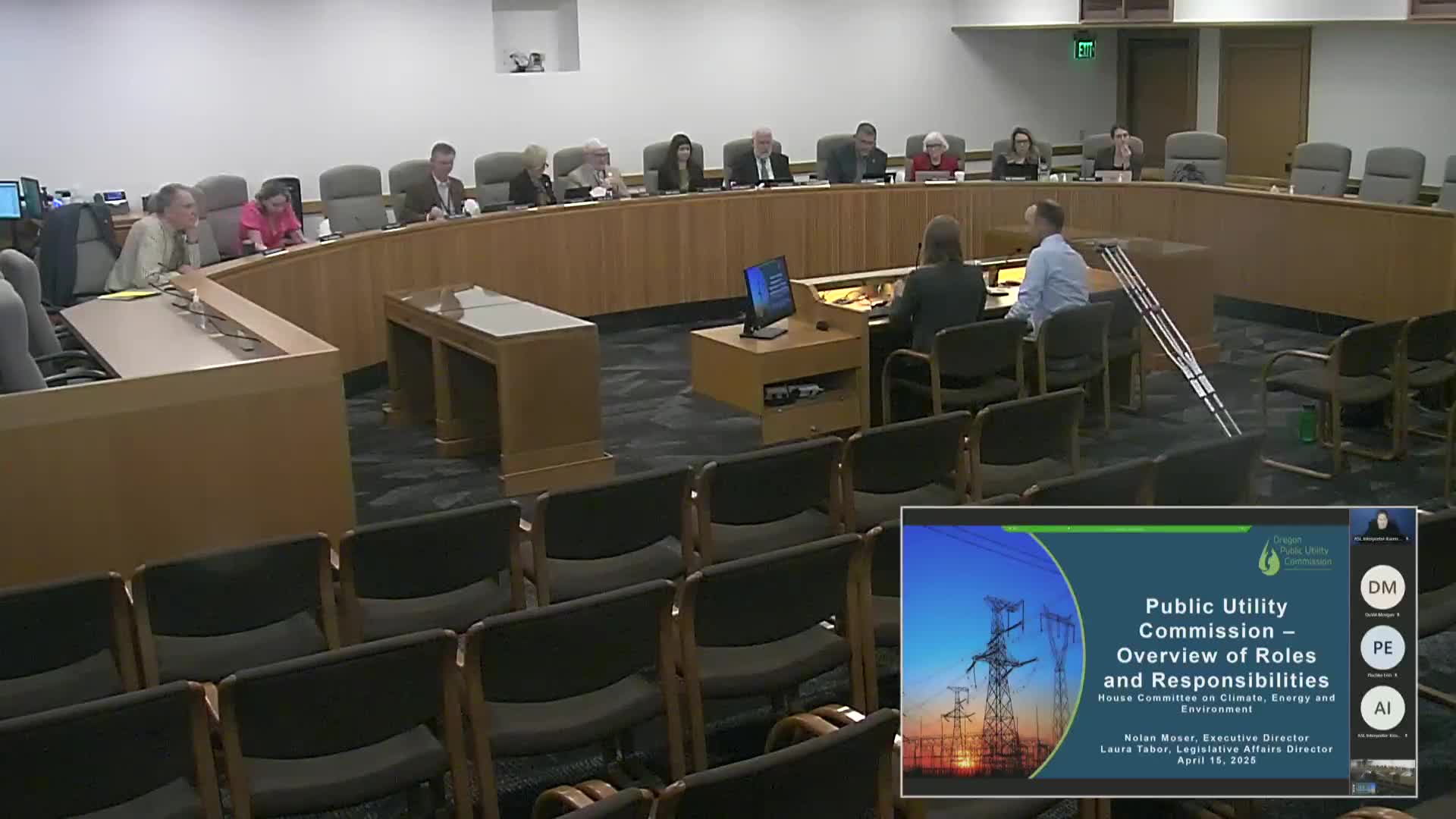
PUC staff outlines regulatory roles, wildfire duties and clean-energy obligations
Summary
Oregon Public Utility Commission staff briefed the Climate, Energy and Environment Committee on the agency's regulation of investor-owned utilities, wildfire mitigation responsibilities, and implementation of House Bill 2021.
Oregon Public Utility Commission staff gave an informational presentation describing the agency's core authorities, its oversight of investor-owned utilities, growing wildfire-related responsibilities, and work to implement the state's clean-energy law, House Bill 2021.
The briefing matters because the PUC sets rates and rules for monopoly utilities and plays a direct role in wildfire mitigation and electricity-sector decarbonization. Committee members used the session to ask how the PUC monitors utilities, enforces timelines in clean-energy plans, and will handle rising wildfire-related costs.
Laura Taber, legislative affairs director for the PUC, gave the overview: "The Oregon Public Utility Commission is the economic regulator of the investor owned utilities in Oregon. That includes electric utilities, natural gas utilities, and some telecom and small water companies." She said the commission has "three full time commissioners" and summarized the agency's work in rate setting, planning and program rules.
Taber described three decision types: contested cases (for example, general rate cases that proceed like a trial and can take about a year), rulemakings (staff-led with an extended informal stakeholder period followed by formal proceedings), and non-contested planning decisions such as integrated resource plans. She said agency staff include accountants, economists, engineers and administrative law judges who manage contested-case dockets.
Taber and Nolan Moser (executive office) told the committee the safety division has direct authority over overhead utility assets and a fast-growing portfolio of wildfire mitigation responsibilities. "Wildfire and safety is the fastest growing part of our agency," Taber said, and the PUC's review of mitigation plans and inspections has contributed to recent rate increases because utilities are making significant wildfire-related investments.
On implementation of House Bill 2021, Taber said the PUC is focused on ensuring utilities make continual progress toward the law's targets and that the agency is using available procurement tools such as ordering requests for proposals. She also described a pending contested-case appeal by Pacific Power of a PUC decision in which the commission interpreted its authority under HB 2021; the appeal is at the Court of Appeals stage.
Committee members pressed on enforcement and process. Vice Chair Gamba asked whether the agency has processes to "sanity check" utility presentations; Taber said the PUC and staff are designed to be skeptical and test utilities' proposals, and that third-party ownership and competitive procurement are options the commission can promote. She told the committee the agency will undertake a wholesale review of procedural rules (rulemaking AR641) and will explicitly examine a committee amendment's goals about clearer findings of fact and statements of reasons.
Taber said the PUC will prioritize taking up those procedural issues in AR641 and that staff and ALJs have already begun conversations with stakeholders who previously worked on related legislation. She added the agency intends to use the authority it has to advance procurement and compliance under HB 2021 to the extent permitted by recent commission decisions.
The committee used the informational session to explore specific topics, including transmission capacity, procurement choices (owned assets vs. power purchase agreements), and whether the PUC has tools to lower the cost of the clean-energy transition while managing wildfire spending. Taber identified microgrids and more competitive procurement as potential levers.
The informational session concluded with committee thanks; no committee action was taken.