Get Full Government Meeting Transcripts, Videos, & Alerts Forever!
Get email alerts on the Schools Of Hope Colocation topic
No spam. Unsubscribe anytime.
Committee advances Schools of Hope bill to allow co-location and expand eligibility; public commenters raise equity concerns
Summary
The PreK-12 Appropriations Subcommittee on Tuesday reported favorably on CS for SB 1708, a bill that would expand Schools of Hope eligibility and create a statutory framework for co-locating charter operators inside underused public school facilities.
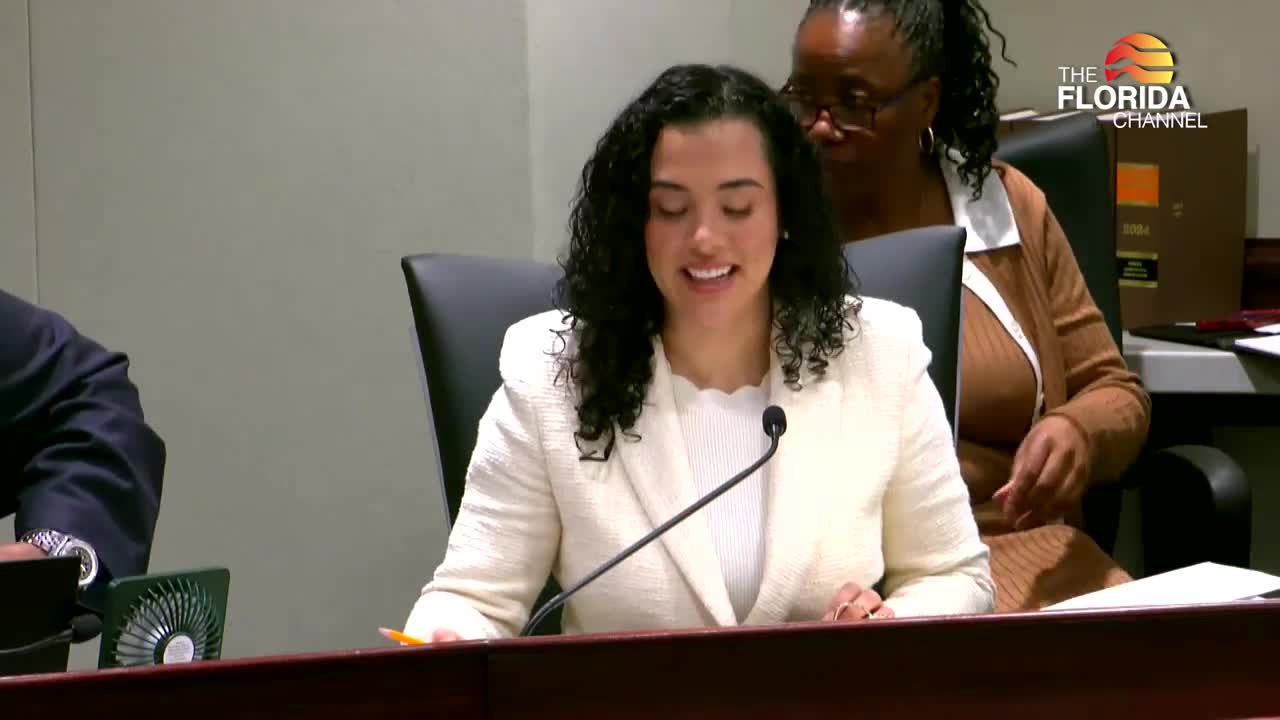
The PreK-12 Appropriations Subcommittee on Tuesday reported favorably on CS for SB 1708, a bill by Senator Collado that would expand eligibility for Schools of Hope and create a statutory framework allowing co-location — the operation of multiple schools within one public school facility — in certain underused buildings.
Senator Collado, the bill sponsor, said the bill revises the definition of persistently low-performing schools by changing the statutory test so that a school in the bottom 10 percent in either math OR reading (rather than both) could trigger eligibility for a School of Hope. “If a school is in the bottom 10% of student performance statewide in either math or reading, we should be acknowledging that,” Collado said.
Collado described co-location as a tool to increase options for students where facilities are underused. She told the committee the bill would create a “statewide structural framework” for co-location agreements and listed elements statutorily required in the agreements, including grade-level delineation, student and school safety requirements, supervision authority, applicable school board rules and emergency shelter protocols.
Senators pressed Collado on operational questions. President Gates asked whether a “school within a school” would require dedicated space and Collado said eligible facilities would be those that are at least half-vacant or have at least 500 student stations available, citing the Department of Education FISH report as a demonstration tool.
Vice Chair Pizzo and others raised concerns about whether co-location and expanded eligibility could create two-tier systems inside one building and how students would be selected. Collado clarified during her closing remarks that the Schools of Hope performance plan required in statute "must have recruitment of students from low performing schools or opportunity zones and are exempt from lottery." She also told members the bill requires a facility payment of $600 per student to the host district to cover facility utilization, and that the district would still receive the applicable FTE funding associated with students enrolled in the co-located charter.
More than two dozen members of the public — parents, students and school employees largely from Sarasota and other districts — testified in opposition during a lengthy public comment period. Speakers argued the bill would divert space and limited operational resources from public schools, exacerbate inequities, and allow charter operators to occupy public facilities without adequate accountability. Representative public comments included:
- Allen Romero (Sarasota), who said public schools are “barely staying afloat,” and urged a no vote because the bill “tips” the playing field rather than leveling it. - Anya Dennison (college student, Sarasota), who said the bill would force public schools to “give away their space and services for free to outside charters.” - Multiple high school students and parents expressed concern that co-location would increase class sizes and reduce support for public-school students.
Senator Collado said Miami‑Dade County Public Schools has worked with her on contract elements and she emphasized the bill would initially apply to Miami‑Dade and to facilities meeting the vacancy thresholds; she also said only high-performing charter operators designated as Schools of Hope would be eligible for the co-location path.
The committee recorded one recorded no vote by Senator Osgood during the roll call on the committee substitute; the bill was reported favorably. Committee members who voiced support said the bill is intended to create more options for low-performing students and to make use of underutilized public facilities; opponents and public commenters said it risks weakening already strained public schools.
The committee did not adopt any amendments to SB 1708 during the hearing. The sponsor asked colleagues to continue working on language to ensure low-income and low-performing students are prioritized for seats in co-located Schools of Hope.