Get Full Government Meeting Transcripts, Videos, & Alerts Forever!
Get email alerts on the Abortion Fetal Remains topic
No spam. Unsubscribe anytime.
Nebraska senators reject motion to indefinitely postpone measure requiring cremation or burial of fetal remains after elective abortions
Summary
The Nebraska Legislature debated LB 632, a bill that would require health care facilities performing elective abortions to provide for cremation or burial of fetal remains. A motion to indefinitely postpone the bill failed 12–31 after several hours of floor debate on public-health, legal and access concerns.
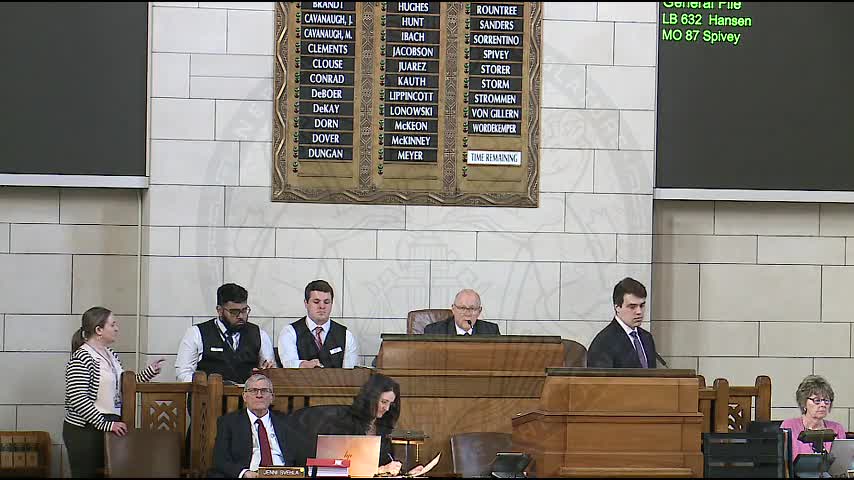
Senators debated LB 632 on the floor of the Nebraska Legislature, a bill that would require health care facilities performing elective abortions to provide for “the dignified and safe disposition of the remains of aborted unborn children” by burial or cremation.
Senator Hansen, the bill’s introducer, opened by saying, “LB 632 is a bill that requires health care facilities to perform elective abortions to provide for the dignified and safe disposition of human remains after an abortion procedure.” He argued the measure was intended to protect public and environmental health and to ensure respectful treatment of fetal remains.
The measure drew prolonged opposition from a large group of senators who said the bill was vague, could impose substantial new costs on providers, and risked reducing access to abortion services. Senator Spivey, who filed the motion to indefinitely postpone the bill, said the proposal was “another backdoor attempt to ban abortion in Nebraska” and warned it would impose burdens that could make procedural abortion impossible for the state’s remaining provider(s).
Opponents cited three central concerns: legal vagueness and potential for constitutional challenge; risk that civil or criminal enforcement provisions or private suits would chill providers’ willingness to offer care; and practical or financial burdens on clinics and patients. Senator Hunt said the bill’s text was unclear about key terms and enforcement and warned that “Section 4 of the bill allows any person to bring a civil action for failure to comply with the disposal requirements,” a change she said would open providers to politically motivated lawsuits. Senator John Kavanaugh and others argued the bill’s wording could create criminal exposure for providers because it says “it shall be unlawful” without specifying penalties or where the new prohibition would fit in existing statutes.
Proponents, including Senator Linowski and others, said the bill mirrors measures in other states and is about treating fetal remains with dignity and preventing improper disposal. Senator Linowski cited reports of remains discarded in landfills and said some states already require disposition by burial or cremation.
Floor debate included personal testimony and hypothetical examples. Several senators described contacts from constituents and people with histories of miscarriage or pregnancy complications to underscore the emotional weight of the topic. Opponents also said existing Nebraska rules and Department of Environment and Energy procedures already govern disposal of medical and pregnancy tissue and that the bill singles out abortion providers without addressing other medical contexts that handle similar tissue.
Votes at a glance
- Motion to indefinitely postpone (moved by Senator Spivey): failed, 12 yes, 31 no. The motion’s failure kept LB 632 pending on general file.
- Motion to cease debate and proceed (cloture): passed earlier on a separate voice/record vote, 28 yes, 3 no.
What it would do
As drafted on the floor, LB 632 directs that a health care facility at which an elective abortion has been performed must provide for individual disposition of the remains by cremation or internment by burial, or as directed by the Board of Health if cremation or burial is not feasible. The bill says no notice of the method of disposition is required to the woman on whom the abortion was performed.
Key details, unanswered questions
Opponents repeatedly asked how the bill defines “elective abortion,” how it applies to medication abortions that occur at home, whether the Board of Health would be given open-ended rulemaking authority, and what documentation would be required for disposition. Senator Hunt and others questioned whether the bill creates a private right of action and warned of potential “bounty-style” lawsuits. Supporters said the bill does not require counseling of patients about disposition and does not impose duties on parents.
Costs and access
Senators debating fiscal impact cited estimates for a single cremation in the range described on the floor as roughly $895 to $1,300 and argued that mandating individual cremations or burials for every procedural case could add substantial operational costs for clinics. Opponents said those added costs would be effectively an unfunded mandate that could force clinics to stop offering procedural abortions; proponents disputed that characterization and said hospital and funeral-contractor arrangements exist now for other human remains.
Legal context
Multiple senators raised questions about whether LB 632 is consistent with the state constitution and recent litigation in other states that challenged similar measures. Senator Raybould noted provisions of the recently adopted Article I, Section 31 of the Nebraska Constitution (as added by initiative) when discussing carve-outs and exceptions in state law. Senator Dungan and others argued the bill’s vagueness could invite a court challenge on due-process grounds.
What’s next
Because the motion to indefinitely postpone failed on a roll call, LB 632 remains on general file for further action. Lawmakers and staff on both sides signaled a range of possible next steps, including amendments to narrow the bill’s scope or additional committee work. No final disposition of the underlying bill occurred during the session excerpted in this transcript.
Ending
Floor debate showed sharp disagreement about whether LB 632 fills an unaddressed public-health gap or whether it is a targeted restriction that would raise costs, legal risk and stigma for providers and patients. The bill’s future depends on whether the sponsor and proponents can address the legal, technical and implementation questions raised repeatedly on the floor.