Get Full Government Meeting Transcripts, Videos, & Alerts Forever!
Get email alerts on the Wildlife Disease Cwd topic
No spam. Unsubscribe anytime.
Wildlife officials announce emergency action after chronic wasting disease found in Catahoula Parish deer
Summary
Department of Wildlife and Fisheries officials said the state will seek emergency authority and expand an existing chronic wasting disease (CWD) control zone after a wild deer in Catahoula Parish tested positive for the fatal prion disease.
Department of Wildlife and Fisheries officials said the state will seek emergency authority and expand an existing chronic wasting disease (CWD) control zone after a wild deer in Catahoula Parish tested positive for the fatal prion disease.
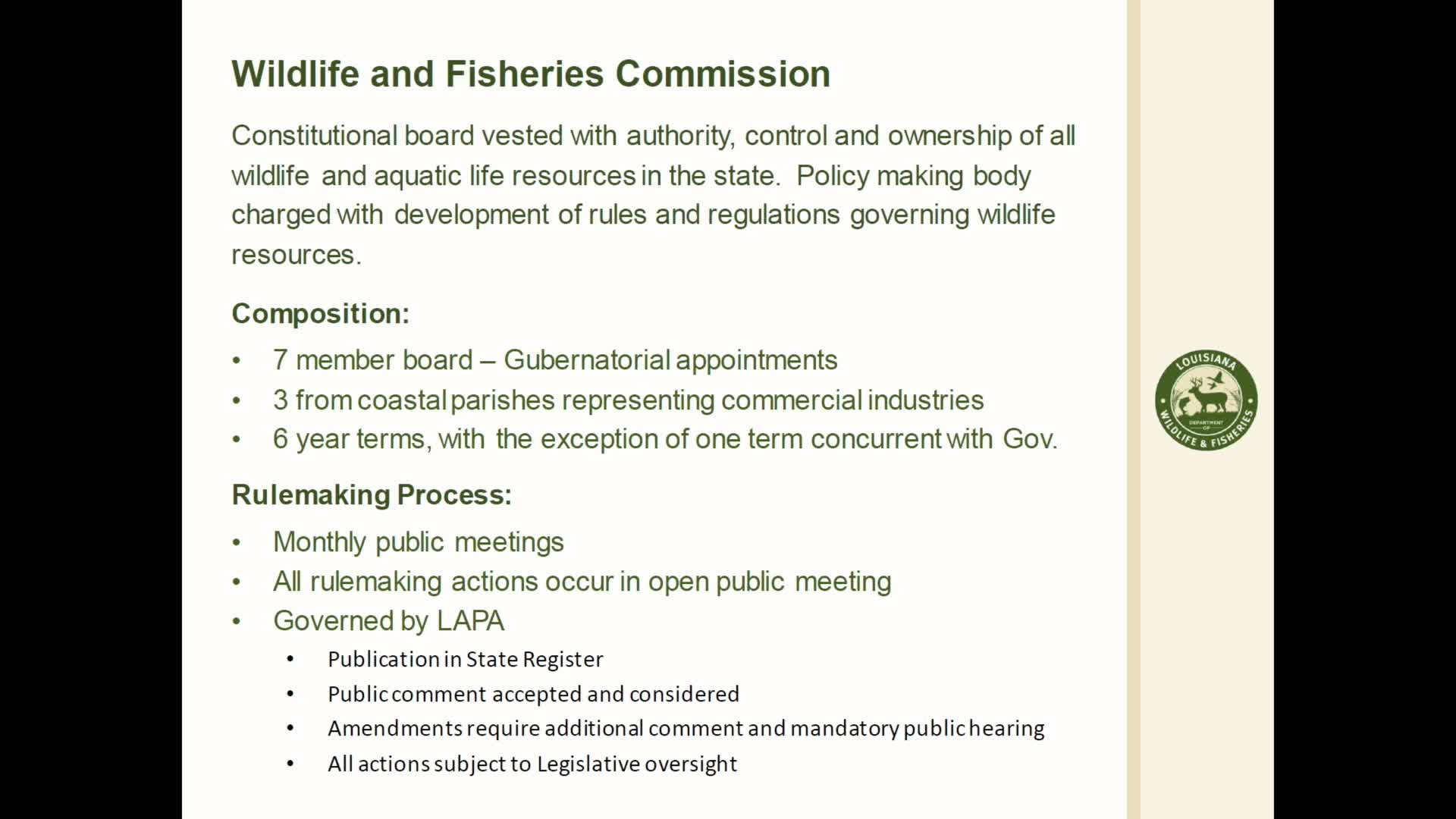
Cole Garrett, general counsel for the Department of Wildlife and Fisheries, told the joint Natural Resources Committee that the department will ask the Wildlife and Fisheries Commission at its Thursday meeting to adopt a declaration of emergency and a notice of intent to expand a 25-mile radius CWD control zone around the new positive test.
“That mutated prion is going to survive in the environment,” Garrett said. “It is always fatal.” He described CWD transmission as occurring through saliva, urine and feces and said the disease can persist in soil and on surfaces.
The department said its current CWD protocol inside a control zone has two principal elements: a ban on baiting or supplemental feeding that artificially congregates deer, and restrictions on exporting carcasses—particularly brain and spinal tissues—because those tissues concentrate the prion. Garrett said the goal is to reduce transmission within the zone and prevent spread outside it.
Under the department’s approach, the control zone is a 25-mile radius from a confirmed positive. Garrett noted the state’s first confirmed wild CWD case occurred in Tensas Parish in 2022 and that the program had largely kept subsequent positives contained within that original zone until the Catahoula detection.
Brian McClendon, undersecretary, thanked hunters who have voluntarily submitted samples at no cost and urged more participation in surveillance, saying increased harvest and sampling help officials estimate local prevalence. He also reiterated federal guidance: the Centers for Disease Control and Prevention recommends not eating animals that test positive for CWD.
Legislators asked operational questions. Senator Klumpeter asked when CWD first appeared in the U.S. and in Louisiana; Garrett said the disease has been documented in multiple states for decades and that Louisiana’s first wild positive was 2022. Senator Klumpeter also asked whether hunters who harvest an animal that tests positive could be penalized against tag limits; Garrett said the commission would consider that concern.
Discussion: officials described expanded surveillance, free head-drop freezer locations for testing and continued public outreach. Garrett said the commission’s Thursday agenda will include a notice of intent tied to the expanded control zone. No new statutory changes or emergency regulations were finalized during the committee meeting.
Officials encouraged hunters in or near the control zone to submit heads for testing so the department can monitor prevalence and adjust management. The department also said it is coordinating with the Department of Agriculture and Forestry about CWD on pen-raised deer, because those facilities are regulated by that agency and movement of pen-raised animals can present a risk.
The commission’s formal action on the emergency declaration and zone expansion is expected at its scheduled public meeting; the committee was informed but took no formal vote.
Notes: CWD is always fatal in affected cervids and is highly contagious; the department’s control-zone radius is 25 miles around confirmed positives and the department offers free testing to hunters who submit samples. The new detection in Catahoula prompted the scheduled commission action.